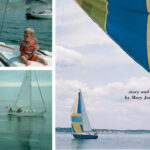
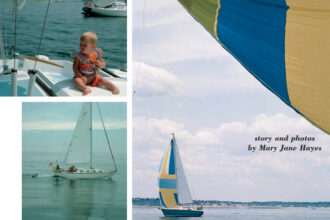
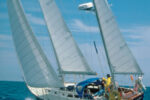
What Dan really wanted was an Alberg. With his Ericson 35, he believes he got one
Issue 2 : Sept/Oct 1998
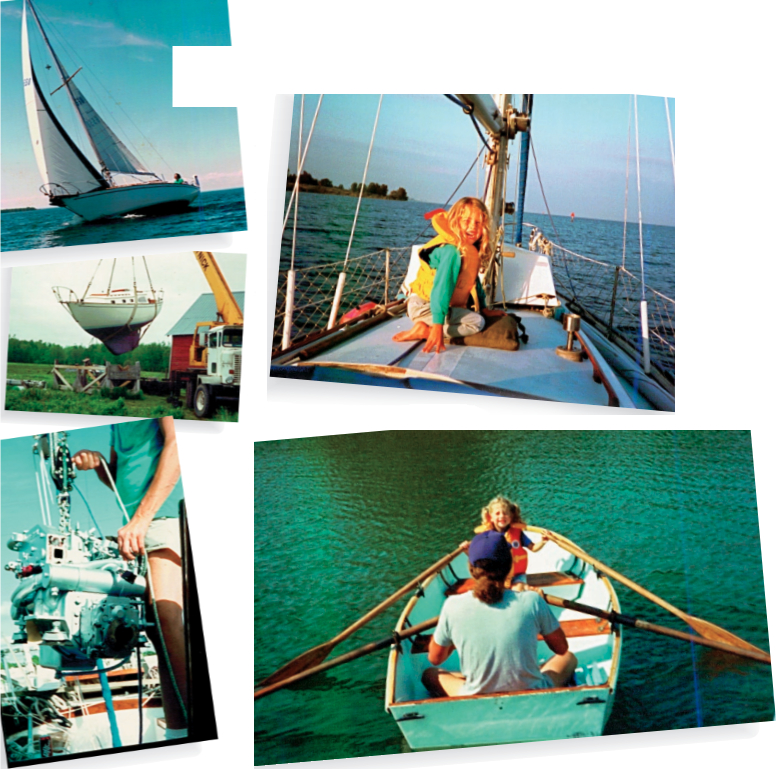
When he saw the Ericson 35 that would later be christened the Catherine L, Dan Haupert believed he’d found the Alberg of his dreams. “I always loved the Albergs,” he says. “They’re the most sensible boats.”
Although we haven’t found substantiation for this story, Dan believes Pearson sold the 35-foot mold to Ericson which then had Bruce King design a new deckhouse and develop a different rudder. To him, his Ericson hull #19 is an Alberg 35, Dan says, but with a different deckhouse, rudder, and a three-inch bulwark.
“It’s a beautiful boat,” he continues, “and aesthetics are a good part of sailing, but it’s not good for punching into seas. It was a CCA racing rule-beater design at the time, and it’s very pretty.” One limitation, he says, is that “she’s got a 24-foot waterline on a 35-foot boat.
While she’s narrow and small inside for a family of three, Dan says they can load the Catherine L up for cruising, and she retains her sailing characteristics while “many fin-keelers get dangerous as you load them up,” he notes. And people will load them up when cruising as the Hauperts do. “It’s unbelievable the stuff you need to be safe when you’re living aboard,” he says.
The boat’s long overhang at the stern gives her reserve buoyancy, Dan says. “You see a wave coming and think you’re going to get clobbered. Then she rises up, and the wave goes under and past.” In the Caribbean, the Hauperts have been in enough heavy seas to test and swear by sterns with a long overhang.
Tiller steering a plus
Unlike modern boats in the 35-foot range, the Catherine L is equipped with a tiller. Dan says he wouldn’t trade that feature. For one thing, it works well with the Aries windvane. “It’s awe-inspiring to watch a windvane sail when it’s working well,” Dan says. “But it does require a perfect balance of sails and a lot of sea room.” Unfortunately the Hauperts haven’t been able to use the windvane a great deal in their travels, because they haven’t had enough sea room when making island hops.
An autopilot steers a closer course, Dan notes, saying the windvane steers within plus or minus 10 degrees and requires at least 15 knots of wind to make it work well. When it’s too rough for the boat’s Navico Tiller Pilot, the Aries begins to come into its own, he says.
The Hauperts believe the Catherine L was sponsored by CBS in a Chicago-Mackinac race. She still owns a spinnaker which sports an enormous CBS eye logo. The spinnaker hasn’t been very handy in the Hauperts’ Caribbean cruises. Light air is a rare occurrence, and downwind sailing is a novelty.
Because the Catherine L was raced, the previous owners had installed an 18-inch bowsprit to lengthen the foretriange. Dan converted it for cruising by adding anchor rollers and a windlass. The larger foretriangle may also have solved a weather helm problem caused by the way she was originally rigged. “She handles very well now,” Dan says, “She loses some light-air performance, but there isn’t much light air in the Caribbean in the winter when we’re there. We always have too much.”
Equipment that counts
The Catherine L is sloop-rigged. She normally carries a 100-percent genoa on the Harken roller furler and has a 150-percent jib reserved for light air and downwind sailing. Dan installed a removable inner forestay and running backstays for use in heavy weather. The staysail is balanced by the third reef in the main, which he says brings the main to the size of a storm trysail.
Dan and Cathy bought the Catherine L a head sail and the main through sail brokers Atlantic Sail Traders. (For more on sail brokers see article on Page 44.) They had to recut the jib to make it fit, but the main was a perfect match. Dan is very appreciative of the services offered by sail brokers, saying, “You get good sails for not a whole lot of money.”
Other heavy weather equipment on the Catherine L includes a storm jib, a sea anchor, and a Jordan series drogue — none of which have been used. He describes this gear as “downwind and catastrophic” and adds that they simply haven’t sailed downwind much.
Auxiliary power is important on the “thorny path” (cruising primarily against the wind between Florida and the Virgin Islands), Dan notes. “People spend much of their time in anchorages waiting for a norther to dampen the trades,” he says. In many cases they simply motor upwind.
“Even when you’re in a sailboat, make no mistake about it,” he says, “you’re motoring a lot of the time to get to the ocean.” Unfortunately, the Ericson 35 is “not a good motorboat,” he says. “Sometimes, when beating on the thorny path, it would be good to turn on an engine and bash your way upwind.” (The Hauperts note that if you’re planning to make this trip, Bruce Van Sant’s Gentleman’s Guide to Passages South is required reading.)
The Catherine L started life as a racing boat with a direct-drive Atomic 4 and an 11-inch 2-bladed propeller. Dan and Cathy used the Atomic 4 for several seasons on Lake Superior and in her river and lock travels south. Dan says of the Atomic 4, “It was a wonderful engine when it ran well, but it had a way of going out on you in very inopportune moments.” He adds that it could have gone easily for 100 years, if they had continued to stay in a marina, motor out, set sails, and not turn it on again until it was time to return to the slip. But that’s not the kind of sailing they’re doing these days.
Engine conversion
The Atomic 4 was using a gallon of gas an hour in a flat calm, Dan notes, and the boat has an 18-gallon fuel tank to which Dan added four 5-gallon jerry jugs. Once they arrived in the Florida panhandle and were facing a 150-mile passage to Tarpon Springs, Dan knew that if the wind died, they’d reach the outer limits of fuel capacity for the Atomic 4. They didn’t like the idea of jerry cans full of gasoline sitting around on deck, and enough things had gone wrong with the engine to cause them to lose faith in it. Before setting out on their second season, they put in a diesel engine.
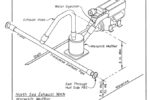
Dan researched the engine choices and settled on a Universal M25XP, which he says is a marinized Kubota. He selected it because theoretically it fit in the existing mounts, he says, but the engine in fact took up more space on the flywheel end than the Atomic 4, necessitating modifications — particularly to the companionway ladder.
Dan estimates that the conversion cost $5,000 including the new prop and shaft. He adds, however, that he did all the work himself. And he guesses that he may have spent 150 hours on the project. It took the better part of a month in the yard, he says, adding succinctly, “It’s a project.” He notes that the Universal Mini 3 or Mini 4 might have taken fewer hours of his time and cost about the same amount.
The new diesel engine had a reduction gear, so the Catherine L now has a 13×15 three-bladed prop. The prop shaft was too long and worn at the cutlass bearing, so Dan replaced it.
Cruising gear
In addition to the engine-driven alternator, the Catherine L has one 20-watt solar panel. They can anchor for a month at a time, he says, and never turn the engine on. They don’t rely on refrigeration, so their electrical energy needs are minimal. “It’s incredible what people will do to have ice in their drinks.” Dan says, “One boat we know runs the engine three hours each morning and three hours each afternoon.” Then he points out that others with refrigerators still go to town to buy ice, which they use to assist the refrigerator. “It’s absurd,” he concludes.
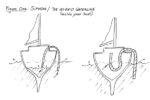
The Hauperts also have elected to live without a desalinator. The Catherine L was built with 35 gallons of water storage capacity, and Dan added two 15-gallon tanks in the bilge. They also carry four five-gallon jerry jugs and gather rainwater. The Catherine L’s three-inch bulwarks make a natural rainwater trap. Dan installed a thru-hull with a two-way valve where the starboard bulwark drains.
They let the decks rinse clean; then they capture the rainwater by turning a valve which is conveniently located inside the cabin near the quarterberth. The family uses three gallons of water a day. He adds that water is generally available in the Caribbean, but they’ve heard that it gets harder to find as cruisers move father south. They did go six weeks without rain one time in the Bahamas, but those stretches are rare.
Advice
Since Dan was once our personal dockmate and sailing guru, we asked him to offer advice for other sailors with similar dreams. He said the smartest thing in buying boats is to get one with everything on it … in other words a fully loaded good old used boat. He also advises people to do the work themselves so they know what’s on there and how to fix it. “I’ve seen people out there with more money than brains,” he says. “When something goes wrong, they don’t have a clue.”
And he advises other sailors not to be intimidated. Have safety gear aboard, and be aware of what your boat can handle. “It’s a mental thing,” he says, “Get a basis of experience behind you so when things intensify, they’re not shocking, and you can deal with them. Read and learn vicariously from other sailors. He adds as an afterthought, “Wait for bad weather to improve,” he adds.
Thank you to Sailrite Enterprises, Inc., for providing free access to back issues of Good Old Boat through intellectual property rights. Sailrite.com