As the forerunners of the fiberglass revolution reach their 50th birthdays, more and more questions are arising about the ultimate longevity of GRP boats. As is so often the case, there are few easy answers …
Issue 3 : Nov/Dec 1998
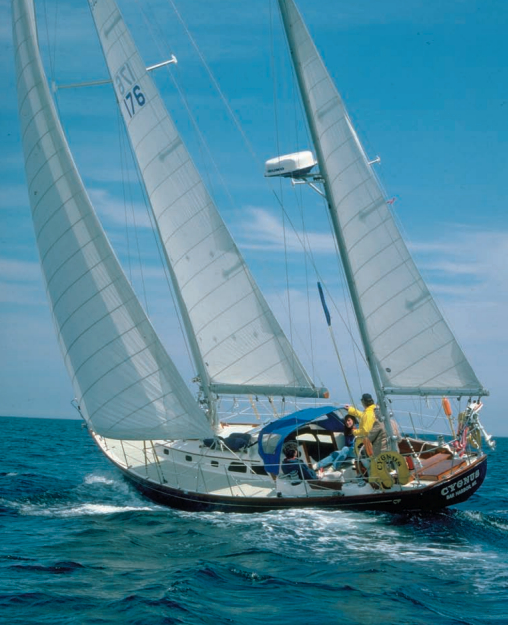
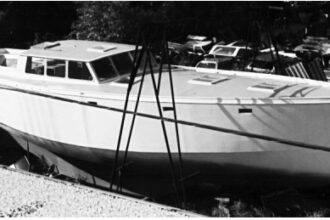
Like all of us, boats age; but unlike humans, old boats don’t necessarily die. Given enough tender loving care, there’s no reason why a venerable boat — whether fiberglass, wood, metal, or even concrete — can’t be kept in service indefinitely. Similarly, antique car buffs maintain vehicles that are 50-100 years old — often in better-than-new condition. However, the vast majority of autos are scrapped within 20 years of manufacture, at the point their current owners decide they’re no longer worth fixing. The average fiberglass boat is basically like a run-of-the-mill car, although its service life will probably be longer. In either case, the trick is determining when it’s no longer worthwhile to keep the aging trooper going.
Even more so with boats than cars, it’s not the chronological age of the boat which really matters. Much more important are the quality of original construction, service history, and maintenance. A well-constructed boat that was lightly used and properly maintained can be a better bet after 20 years, than a shoddily-built three-year-old vessel.
Of course, certain boats (like certain people) can be awfully good at hiding a shady past, so it’s vital when contemplating a used boat to investigate very carefully and, in most cases, to engage the services of a skilled professional surveyor. It is equally important to make realistic estimates of the costs involved in restoring or upgrading, not forgetting the value of your own time for do-it-yourself projects. Nautical dreamers have too often become the custodians of never-ending boat restoration projects.
All cautions aside, there are a lot of sound and serviceable older boats out there. But to identify a good candidate (or for that matter, to keep one you’ve already got in good health), it pays to know something about fiberglass and boat construction in general.
Early days of fiberglass
Experiments in fiberglass boat building began in the ’40s, but it was not until the late ’50s that the boom began. The ball got rolling with smaller boats. Boston Whaler, for example, got its start in 1954. Hatteras and Bertram were pioneers in using fiberglass construction for larger power boats, while Pearson and O’Day led the charge in the sailboat field.
By and large, the early fiberglass boats were built very conservatively, with massively thick hull lay-ups and quite often all-wood decks, cabins, and interiors. Working with an unfamiliar material, shipwrights tended to hedge their bets by overbuilding and, as a result, a goodly proportion of the earliest fiberglass hulls are still plenty strong enough to take to sea.
The ’60s brought explosive growth to the fiberglass boat building field and real competition within the industry. “Making it a little worse and selling it a little cheaper” could easily have been the unwritten credo of certain unscrupulous operators. Some others probably had the best intentions, but lacked the skill and knowledge to put out a good product. On the other hand, there were many excellent fiberglass boats from the late ’60s and ’70s — honest boats that decent maintenance and occasional refits should keep going almost indefinitely. By now, most of the real dogs from this era will have fallen by the wayside (or at any rate, be easily recognizable).
By the ’80s, fiberglassing supplies were a lot more expensive than they’d been in the “old days,” and most surviving boatbuilders had become considerably more sophisticated about using them. Cored construction was becoming commonplace and uni-directional reinforcements began to find a place alongside traditional mat and roving. Engineering advances such as bonded hull liners incorporating “force grids” also helped to produce some genuinely superior boats — lighter and faster, yet as robust as ever. On the other hand, greater sophistication also introduced new opportunities for things to go wrong … as always, it’s buyer beware.
Causes of deterioration
Some of the oldest fiberglass vessels have had excellent service records — a fact that has contributed to the myth that fiberglass is largely immune to degradation. In one study, Owens-Corning reported no detectable loss of physical properties in the hulls of 1952-vintage patrol boats when test samples were assessed in 1962 and again in 1971 (the year the boats were retired from active service). In another detailed evaluation, the U.S. Navy found that samples taken from fiberglass fairings on a submarine built in 1954 had suffered virtually no deterioration after 11 years in service. But lest we read too much into these results, it should be noted that these vessels were built to rigorous military specs generally using nothing but well-consolidated, woven reinforcements (no chopped strand mat containing soluble binders). In fact, the submarine laminate, made back in 1953, was vacuum bagged! It was common practice also, to paint the finished structure (rather than to lay up over opaque gelcoat) so the translucent laminate could be visually inspected to detect internal voids or other imperfections.
But once fiberglass pleasure boats started rolling off the assembly lines and popping out of backyard boat sheds, quality control seldom, if ever, measured up to military specifications. The following is a list of the most common deficiencies found in fiberglass pleasure boats. Of course, very few boats exhibit all of them, and some have few or none; but it’s important to know what to look for:
Weathering — Sun and atmospheric contaminants will gradually attack gelcoat, causing it to dull and eventually chalk. A sacrificial layer of wax, renewed periodically, offers some protection. Weathering is usually more a cosmetic problem than a structural threat. The rare exception is a dark-colored boat in tropical sunshine which may get so hot that the resin in the underlying laminate loses a portion of its strength.
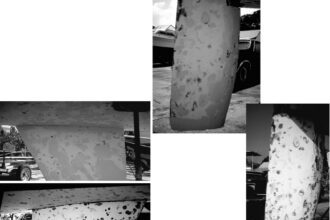
Hydration and osmosis — Polyester gelcoats and laminates will gradually take up small quantities of water if immersed for extended periods. Whether this hydration causes only insignificant softening of the superficial laminate or more serious damage depends upon a wide variety of factors relating to the materials used and construction quality. In rare cases, osmosis and/or water invasion are grave problems. However, more often it’s no more serious than rust spots on the fender. Most older boats are over-built enough to tolerate a fair bit of superficial osmosis (particularly if it’s confined to the outer skin of mat that normally overlies the roving layers) without becoming dangerously weak.
Under-cure — Molding that cures too slowly at overly low temperatures will lose too much styrene through evaporation. The result is a soft, weak boat because styrene monomer is not just a solvent, but an integral component in the polymerization of polyester resin. Builders who worked out of small, chilly shops were (and occasionally still are) the principal culprits.
“Dry” laminates — Inadequate wet-out of the glass fiber reinforcements will result in a weak, flexible laminate that’s likely to soak up water. Resin-starved areas in a hull or deck are much more likely than an entire “dry” part. However, when the latter does occur, it becomes very difficult to either upgrade, or to repair localized, accidental damage.
Micro-cracking — The Achilles heel of ordinary polyester resins is their brittleness and low “elongation to break.” Glass fibers will typically stretch about 5 percent before they fail, but the average laminating resin gives way at only 1- to 2-percent strain. In a fiberglass laminate, the resin will typically break away from some of the fibers on a microscopic scale, leaving the laminate permanently weakened and more flexible than before. This typically happens when portions of a hull or deck deflect too much due to insufficient laminate thickness or inadequate internal supports. It may also happen in portions of the laminate that are excessively resin-rich. Furthermore, high local loads such as having the topsides impact hard against the fenders can cause “bruising” of the underlying laminate (tough to detect if the boat has been subsequently re-faired and painted).
Stress concentrations — Sharp corners, cut-outs such as hatchways, and the abrupt termination of internal members such as engine beds can create situations in which internal forces are focused within a comparatively small part of the laminate. This may lead to micro-cracking or, occasionally, a catastrophic failure unless the stress concentration zone is appropriately reinforced. Fortunately, gelcoat cracking or crazing is often a good indicator of an incipient problem. The gelcoat is more brittle than the laminate beneath, so surface cracks don’t necessarily mean structural damage. All the same, an area of cracked gelcoat is a potential danger signal that warrants investigation and repair. (See sidebar.)
Repairing gelcoat cracking
Even small, localized areas of gelcoat cracking should not be neglected. Although they don’t always indicate stress damage to the underlying laminate, they represent pathways for water intrusion that may ultimately cause structural deterioration. The minimum satisfactory repair entails opening up each crack so it becomes a V-shaped groove (a hand-held power tool works well); then filling with new gelcoat. Accurate color matching is always a challenge. If cracking recurs, the underlying laminate probably needs beefing up.
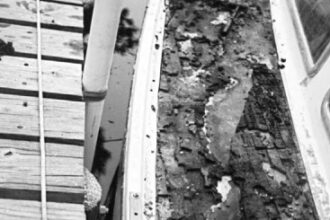
Core problems — If your boat is old enough, it will likely have “solidlaminates” in both hull and deck. However, many boats dating back even to the late ’60s feature “sandwich construction,” with plywood or end-grain balsa, particularly in transoms and decks. Encapsulated plywood is especially problematical, because if water gets at it, the rot tends to spread laterally at a good clip. End-grain balsa is somewhat better, although the saw cuts in “contour-cut” balsa can easily become water channels if not properly filled with resin.
Another common core-related problem is “delamination” (See Bill Sandifer’s article on Page 38.): having one or both of the fiberglass skins part company with the core due to local impact or other excessive stress. This can usually be detected by tap testing the boat (delaminated areas make a dull sound instead of a sharp click when struck with a coin or other small metal object). If the delamination is extensive, a deck will crackle and feel spongy underfoot. Minor delamination can be repaired by injecting epoxy resin. More serious cases may require replacing the outer skin and core material — a costly proposition.
Worth restoring?
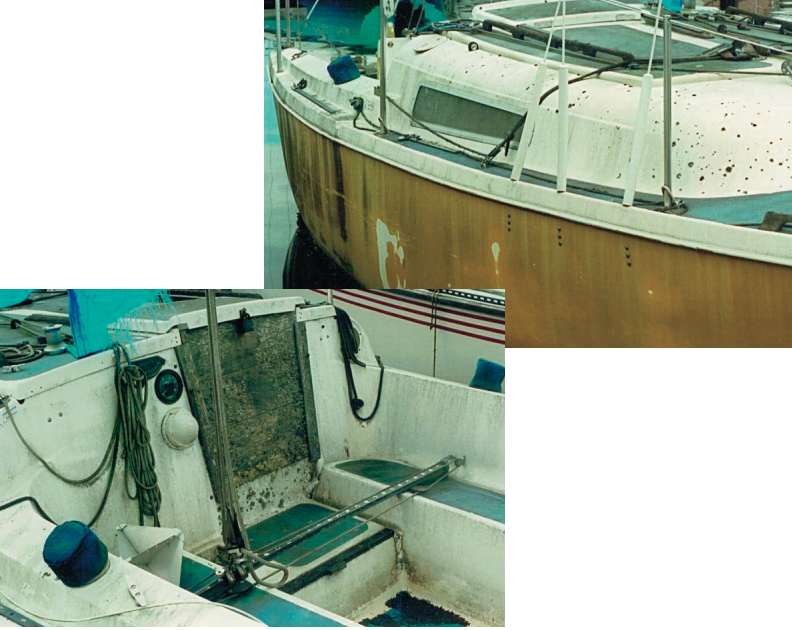
As often as not, it’s the condition of major equipment such as engines, rigging, hardware, furnishings, etc. that will determine whether an older fiberglass boat is worth saving or not. In practical terms, a boat “dies” when its owner (and everyone who considers buying it) decides that it’s too nasty and unsafe to use “as is,” and too expensive to restore to an acceptable condition. Although anything made of fiberglass can, in principle, be “made new” again, there comes a point when the exercise ceases to be worthwhile.
Some old fiberglass boats — Hinckleys, Swans, etc. — have become collectors’ items and are worth lavishing time and money upon because there’s a good chance that they’ll appreciate in years to come. However, many will never become classics and will therefore someday reach the point of no return. It’s wise to keep this basic principle firmly in mind when walking the docks in search of that ultimate “bargain.”
When the end finally comes the carcass itself becomes something of a problem, because fiberglass doesn’t decay like wood and can’t be readily recycled like steel or aluminum. Of course, some fiberglass boats catch fire and burn up (releasing clouds of poisonous smoke in the process), and a few are shipwrecked on exposed shores and pounded to shreds. However, the great majority of today’s fleet may still be around in a recognizably boatlike form 50 years from now. Interestingly, one of the most satisfactory methods of disposal is the construction of artificial reefs to serve as fish habitat. More frivolous-sounding suggestions such as swimming pools and low-cost housing may not, in fact, be entirely outlandish in all cases. Finally, there are pilot programs under way to recover and recycle the chemical constituents from old fiberglass — potentially the best solution of all when an elderly boat is plagued with overwhelming problems.
This is a revised version of an article which was published in Pacific Yachting, September 1995.
Thank you to Sailrite Enterprises, Inc., for providing free access to back issues of Good Old Boat through intellectual property rights. Sailrite.com