Issue 5 : Mar/Apr 1999
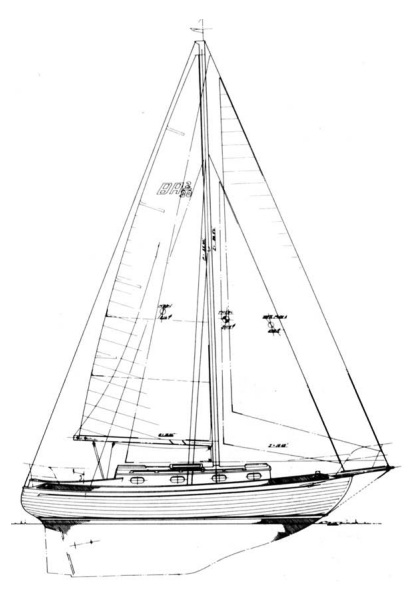
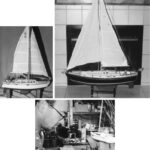
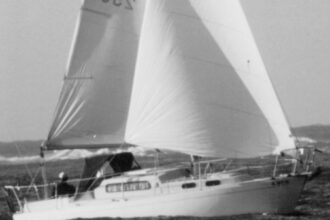
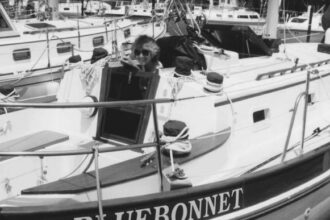
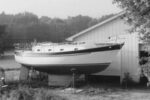
The Baba 30 is one in a series of husky, full-keel, double-ended, cruising yachts designed by my good friend Robert Perry and built in Taiwan. It always surprised me that Bob produced this line of popular full-keel designs after the spectacular success of his revolutionary Valiant 40. The fin-keel Valiant 40, as you may recall, is the boat that started cruising sailors thinking about “performance cruisers” after her successful single-handed transatlantic race back in the prehistoric ’70s. She proved that handsome double-enders with springy sheerlines don’t have to be slow boats to China, or from China for that matter.
In order to write these comments, I called Bob to ask why he had switched from the fin-keel lateral plane and moderate displacement/length ratio (256) of the 40 back to the Baba’s full keel and hefty D/L ratio of 364. Bob’s answer was, in effect, “Because that’s what the builder and the buyers wanted.” That answered my question because, as a designer, I know quite well that you can’t make a living unless you give the clients what they want. Bob said there was a strong market for bluewater cruisers at the time the 30 was conceived. Obviously, the idea of a seaworthy 30-foot double-ender grabbed a lot of imaginations, and that resulted in a lot of orders over the years.
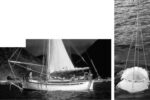
Some owners of Baba 30s and similar husky oceangoing craft may never get out of sight of land, but in the backs of their minds they know they can get up and go when the time comes and the wind beckons. At least one of the Baba 30s has circumnavigated the globe and many others have made long bluewater voyages. Given intelligent seamanship, the boat is quite capable of taking you anywhere you want to go on the world’s oceans and bringing you back.
So the full-keel Baba 30, with her very heavy displacement and modest sail area is not a “performance cruiser” by any stretch of the imagination, but she is a vessel capable of crossing oceans in safety and comfort. On the other hand, while many 30-foot “performance cruisers” are capable of crossing an ocean swiftly, and possibly safely, it’s unlikely that there will be much comfort aboard. It is the sudden scend (rise) of a light displacement boat in a seaway that upsets our human gyroscopes and leads to the sudden rise of one’s breakfast. With any given wave, the speed of motion depends on the weight of the boat and the amount of surface (the waterline area) that is acted upon.
Greater weight or lesser area means a slower motion and more comfort or at least less stomach upset. It also means a steadier working platform. In effect, to have ease of motion in a boat, you require heavy displacement and a moderate waterline area and, given these characteristics, the boat will scend more slowly as a sea passes beneath her. This becomes even more vital in a small boat, as you can imagine, so the 30’s husky D/L ratio of 364 is what puts her into the “sensible small bluewater cruiser” class.
Given her hefty displacement, the Baba 30 has the relatively modest sail area/displacement ratio of 15.4 or thereabouts. Here I will point out that the famous Sparkman & Stephens design Finisterre had a D/L ratio of 405 and a SA/D radio of only 14.5, and no one ever called her a slow boat. However, the SA/D ratio is misleading as far as light weather performance is concerned. In light air it is the sail area/wetted surface ratio that dictates performance, not the SA/D ratio. I do not have the wetted surface figures for the boats, but I expect the full-keel 30 will not show as well as the shoal-draft centerboard Finisterre in that regard.
Too, Finisterre was racing in an era of 150-percent genoa jibs and 180-percent spinnakers, and the Baba 30’s light-weather performance would be improved substantially if she were outfitted with larger headsails. However, I’m sure most cruisers will be happy with a smaller, handier jib and will gladly accept the slower speeds that result or turn on the iron breeze in light air. I, for one, would!
No boat is perfect, and the 30 has some faults. The berths are on the short side, and there is too much teak for me to maintain. Regardless, the Baba 30 does just what its designer and builder intended it to do. It provides the sailor on a modest budget with a true oceangoing cruiser, one that draws admiring glances wherever it pokes its perky bowsprit. What more can you ask?
Thank you to Sailrite Enterprises, Inc., for providing free access to back issues of Good Old Boat through intellectual property rights. Sailrite.com