An updated cruising classic has become a classic in her own right
Issue 11 : Mar/Apr 2000
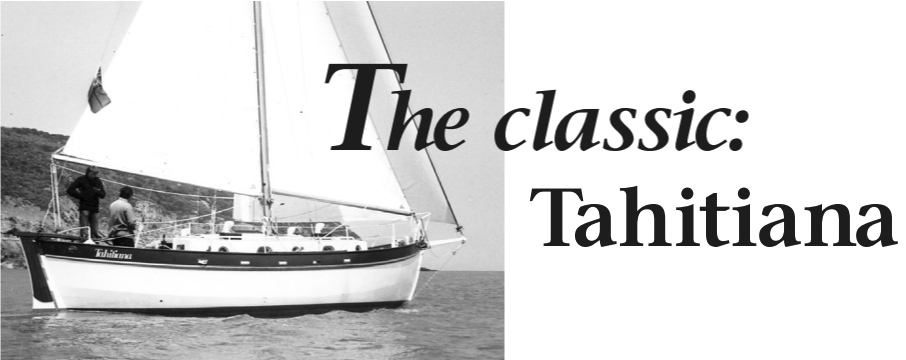
John G. (“Jack”) Hanna designed his famous Tahiti ketch during the Depression years of the 1930s. He created a great, sea-kindly craft an amateur builder could put together for a relatively modest amount of money. Since money was very hard to come by during those years, a boat you could afford to build while you were dreaming about sailing to the South Pacific and maybe taking life easier was attractive indeed. It has been estimated that during the ensuing years more than 3,000 boats have been built to this design, and at any given time there are perhaps dozens passagemaking somewhere in the world.
Early in his naval-architecture career, Jack became very interested in the sailing and sea-keeping qualities of the double-enders among the Mediterranean-type used in the sponge fisheries at Tarpon Springs, Florida, and made an extensive study of them. These craft were heavily influenced by the Colin Archer “redningskoite,” his double-ended rescue boat used extensively by the Norwegian lifesaving service, and Jack believed this design approach would lend itself well to a cruising sailboat for Everyman. As they say, the rest is history.
In the 1920s, Jack designed and built a double-ended sailboat he named Orca, and then another double-ender he named Carcasonne, both of which were influenced by his study of the Greek spongers. He was on his way to a career in naval architecture when the Great Depression hit, and it became extremely tough to make a living in this field. By the time the 1930s had rolled around, Jack — who, in later years of his life was known as “The Sage of Dunedin” (Florida) — had designed a third boat of this genre, unnamed, and was looking for a sale of his work in order to eat.
First publication
Enter my father, E. Weston Farmer, N.A., who at the time was editor of Fawcett’s Modern Mechanix and Inventions magazine (later re-named Mechanix Illustrated). “Westy,” as he was known, and Jack were friends. Dad became interested in being the first one to publish Jack’s design of his new, as-yet-unnamed cruising ketch. He was able to offer Jack the munificent sum of $150 for his design and article, over the violent objection of his boss and publisher, Roscoe Fawcett, who feared that paying this exorbitant amount would put him out of business.
Before publishing Jack’s design, Westy suggested the name Tahiti for a couple of reasons. First of all, he figured the name had just the magic to take the builder’s (and/or dreamer’s) mind off his Depression-caused woes and economic troubles — most people had them in those days. Secondly, someone in the office was going on a trip to Tahiti and agreed that was what he would name the boat if he were to sail her there. So the name stuck and has since come to mean a romantic attachment to the concept of sailing off into the sunset, heading for the balmy breezes of the South Pacific, where there is nary a care.
As more and more Tahiti sailboats were built and sailed around the seven seas by passagemakers, the craft gained a great reputation for sea-kindliness, comfort of motion, and safety. Many were the true tales of sailors riding out hurricanes and typhoons and returning to port safely. However, she also gained a reputation of being somewhat slow and not pointing especially well to weather.
Under-rigged
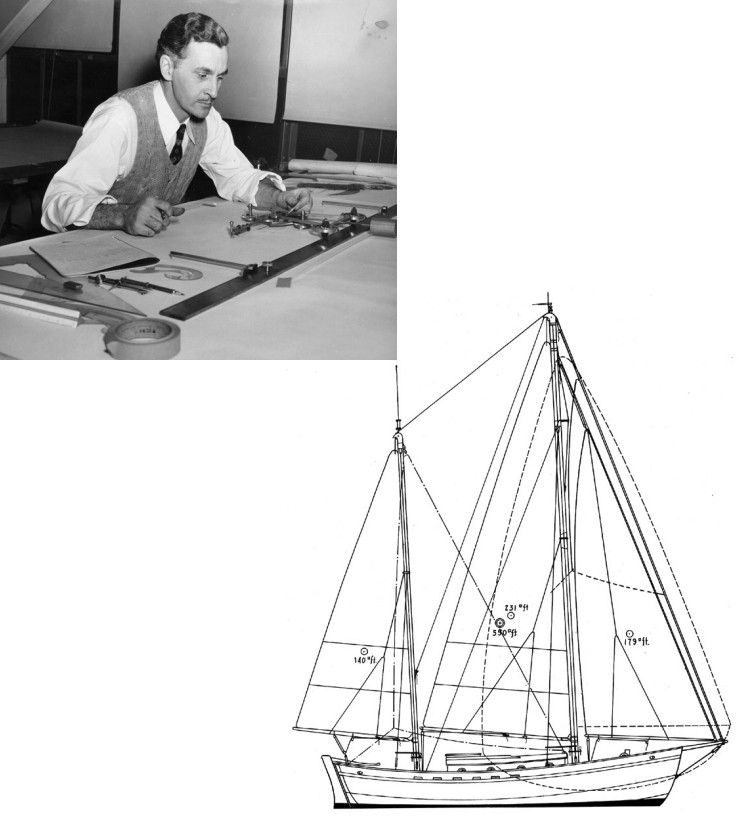
About 1975, quite some time after Jack’s death, Dad began to “noodle” about these concerns, as was his wont. He came to the conclusion that Tahiti was simply under-rigged, and her slowness was not in any way due to her hull shape. Of the known 3,000-plus Tahitis registered in the world’s nations, a small percentage had been provided with beefed-up rigs, measurably increasing her speed. Westy came to the conclusion that she was simply starved for sail area — Jack Hanna was not trying to design a racer, but rather a comfortable, conservative heavy-weather cruiser. Of her, Westy wrote, “Hanna’s original design carried but 420 square feet in her rig, and but 50 square feet extra (for a total of 470 square feet) after I had asked him for more. This works out to be about 44 pounds of boat lugged by each square foot of sail; whereas Svaap, almost the same boat technically, carries sail [which is] asked to lug but 29 pounds per square foot of sail. Sail is horsepower, and Tahiti just didn’t have enough.”
This “noodling” also encompassed the knowledge that by 1975, amateur boatbuilding of a craft the size of Tahiti was actually less expensive in steel and took less skill. More amateur builders out there had welding skills than had woodworking skills. A steel version of Tahiti, if properly designed, would be less expensive, go together in less time, be stronger than wood, and stand up under the rigors of sea water better over the long haul. For one thing, worms can’t eat steel, he reasoned.
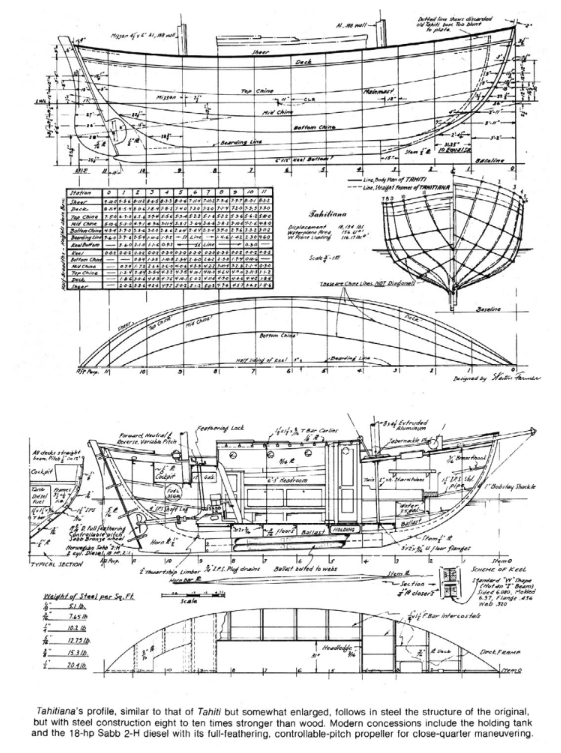
So Westy set about to design a steel version of the by-now-famous Hanna ketch. The lines for this new craft are shown superimposed on the lines of Tahiti in the top figure on the facing page. He achieved a very close approximation by the technique of giving her multiple chines; this type of construction is easier for the amateur builder to put together because the steel plates do not have to be preformed by large and expensive equipment. Rather, they can simply be clamped to the frames and welded in place. Westy added about a foot of length and gave her a more gentle entry at the stem in order to make it easier to bend the plates there properly. Note at the top right of the first illustration on Page 58 the notation, “dotted line shows discarded old Tahiti bow. Too blunt to plate.”
More headroom
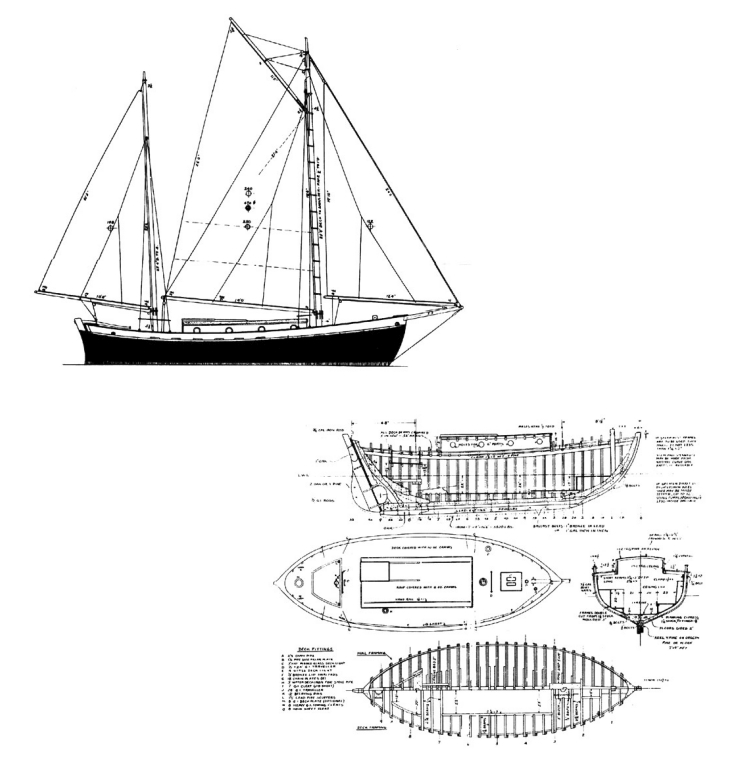
The profile and accommodations drawings at the bottom of the facing page demonstrate that the accommodations of Tahitiana are essentially the same as those of Hanna’s Tahiti. However, Tahiti had less than 6 feet of headroom in the main cabin, and Westy figured this was inadequate, especially for long passages, so he gave her headroom of 6 feet 3 inches and an enlarged forepeak for stowing sails and ground tackle.
He also reasoned that owners might prefer a cutter rig to the ketch rig, so he gave her two sailplans, both of which appear on his drawings and both of which carry significantly more sail area than the original. As a result, she is a faster craft, and points better to windward.
Like her predecessor, Tahitiana has proven to be seaworthy, comfortable, and safe for passagemaking. This is, in part, due to her lines, which were essentially true to the original. For years after Jack Hanna’s death, his widow, Dorothy, sold his Tahiti designs by mail order. Mechanix Illustrated also had a designer come up with a design for a Tahiti II, which was two feet longer. These plans were offered in the magazine for many years.
These days only Tahitiana seems to go on and on. I still get orders for the boat plans from builders all over the world. Since the first hull was built and floated, I have received many letters from owners who have safely sailed in at least most of the oceans. One letter described a rather harrowing journey that included riding out a hurricane bare-poled for three days off Cape Hatteras. The owner praised Tahitiana’s stability and seakindliness even under the most extreme conditions of wind and wave.
Wes Farmer is the son of the late E. Weston Farmer, N.A., the designer of Tahitiana. The latter passed away in 1981, but Wes still sells 23 of his father’s designs created specifically for the amateur builder.
Thank you to Sailrite Enterprises, Inc., for providing free access to back issues of Good Old Boat through intellectual property rights. Sailrite.com