Issue 14: Sept/Oct 2000
We christened our little sailboat Cecile (se-sl) after my wife’s grandmother, a kindergarten teacher from Williamsburg, Iowa. First sailboats and kindergarten teachers share a mutual goal of exposing people to new experiences. After a season of daysailing and several weekends on our 16-foot Newport, we ventured into chartering larger boats. Big boats and big water began to make Cecile appear inadequate. Her virtues were over-shadowed by her lack of size. The recumbent cabin seemed barely comfortable. You could sit upright while on the Porta Potti only with your head sticking out of the main hatch like some nautical jack-in-the-box. Everyone knew what you were doing; they just couldn’t see you doing it. We needed to change either our boat or our attitudes. Our decision came during a week of camping and sailing on Lake Michigan’s Green Bay.
The journey from western Illinois to Wisconsin’s Peninsula State Park was the biggest trip we’ve ever attempted with Cecile. Every nook and cranny of the hull was packed with camping equipment, food, clothes, and sailing gear. The added weight tamed the normally bouncy nature of the little boat and trailer on the road. When the wheels stopped turning, we had covered 416 miles in eight hours, making it the longest and fastest trip with our sailboat. Nothing makes a sailboat go faster than a trailer.
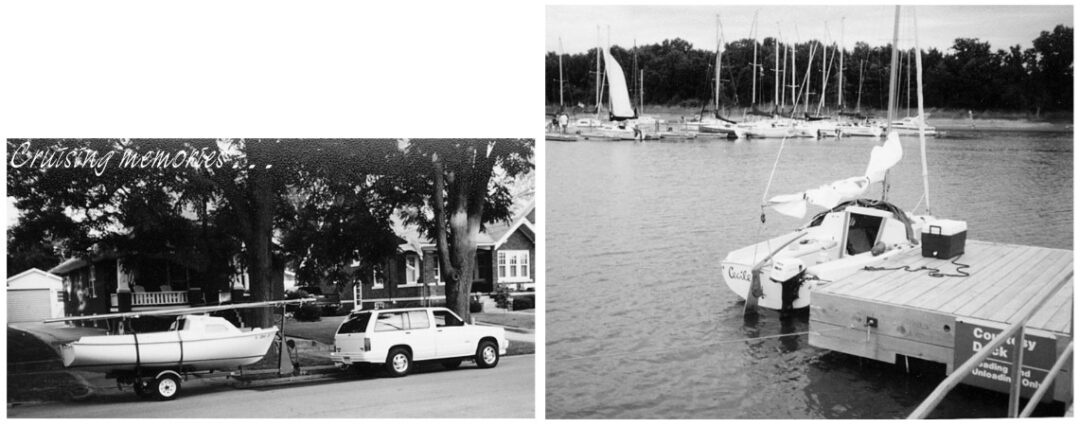
During our charters, we had always pushed the boat and ourselves to meet destination expectations. Sailing became a marathon, running within the time window of the charter. Cecile’s diminutive size forced us to let go of our self-imposed distance goals and enjoy moment-by-moment sailing. Weather, wind, and waves determined our daily agendas. Rough-weather days kept us in the shelter of the smaller bays. If the weather became severe, we knew we could load Cecile on the trailer in minutes. However, in typical late August style, tranquil weather prevailed, allowing us to leave Cecile at anchor each night in Peninsula State Park’s Nicolet Bay.
We could have spent one or two of those nights on the boat, but decided to enjoy the end of each day by the glow of a campfire. Camping gave us a new independence we had not achieved on any other sailing trip. More than once, I slipped away from camp with my morning coffee to watch the sunrise change the colors of Nicolet Bay. We also found that independence came with wheels. One day we explored the back roads of Door County. Our memories of Wisconsin’s thumb will always include a winding blacktop road leading through quaint hamlets and villages and ending at the water’s edge. Staying on land also allowed us daily showers (long ones with hot water). So every morning after breakfast, it was off to the showers before packing up a bag of essentials and strolling down to the boat.
Leaving Cecile at anchor was a major advantage on the trip. Within minutes she was ready for the next day’s sail. We don’t have a dinghy on a 16-foot sailboat, so getting to Cecile took some ingenuity. A long looped rope was threaded through a shackle at the end of the anchor line and led to a secure object on shore. We tied the boat onto this loop and drew it up tight against the shackle at night. This gave us two anchor points. Each morning we untied the line on shore and pulled Cecile to us. With the rudder and keel up, she beached so well we hardly got our feet wet.
This part of Door County seems ideally suited for the short-distance, small-boat cruiser. Bays and towns dot the shore with enough frequency to allow the sailor a safety net should the weather deteriorate or equipment failures occur. Stable late-August weather gave us some safety from violent storms. Warm water also meant embarrassment, rather than disaster, should one or both of us go in the drink. Each day we cautiously ventured farther out until our keel finally split the waters of Eagle Harbor, Fish Creek, and Sister Bay. In the evenings we returned to Nicolet Bay.
The Fish Creek fuel dock was our first landing after leaving the Nicolet Bay area. Light early morning winds made the six-mile trip seem a lot farther. After entering the harbor, we followed the marker buoys around the field of moored boats and ended up pointing directly at the dock. My wife, Ruth, passed our lines to the attendant as I reached back and popped the Johnson into neutral. The thrill of arriving at a new harbor is always the same, whatever the distance or the size of boat. As we started up the sidewalk into town, I looked back at the little boat that brought us safely to this new destination. She seemed a little bigger.
The next morning we flew twin headsails for a quiet glide downwind to Sister Bay, five miles to the northeast. This time Ruth brought us into the harbor while I handled the dock lines. We alternate boat-handling roles while sailing to learn from each other. Cecile has been an excellent boat for this, due to her size and simplicity. While we were closing up the boat, an elderly gentleman stopped and visited. He had admired our little sloop as we entered the marina and wanted a closer look. As he walked away, he complimented us on our perfect little boat. I smiled in agreement, sliding the padlock into the hasp of the main hatch.
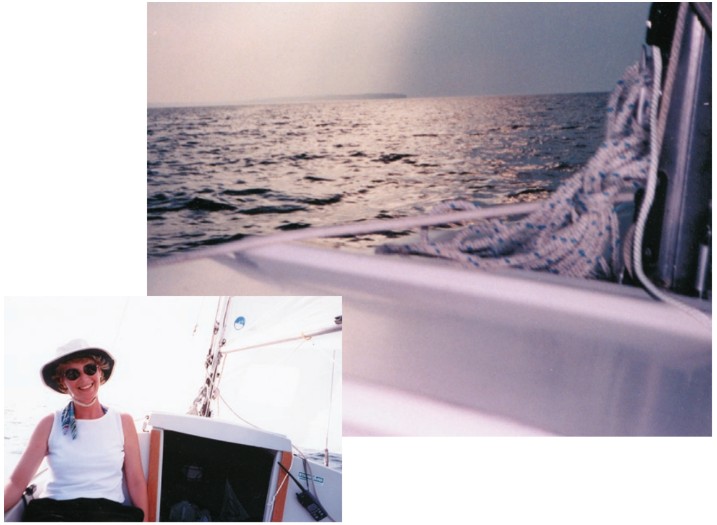
Horseshoe Island is located just a mile outside of Nicolet Bay and became a nautical milestone for us. It was our first circumnavigation and took a little over an hour with numerous tacks and sail changes. You can imagine the island’s shape from its name. On its lee side, Horseshoe Bay was perfectly still as we motored in. Several larger boats dotted the bay, so we tried to make our arrival as unobtrusive as possible. In an out-of-the-way spot, we quietly lowered the anchor through the clear water and watched it settle into the sand below. The wind that had powered us now wasted its energy on the hardwoods and pines of the island. Ruth and I stretched out in the afternoon sun on the cockpit cushions. We had come full circle around this piece of land and in our attitudes toward the little Newport 16 that brought us there.
Although our Newport will never sail great distances, and although I will never sit upright inside the cabin, I have come to respect the little sailboat for the things she does so well. Her shallow draft allows us to slip into any place a herring can walk. She can handle more weather than either Ruth or I want to. With her versatility and mobility, daysailing and longer vacations are equally achievable. Trailering the half-ton boat down the road is undemanding on the equipment and the driver. If some day we find another boat that fits our sailing needs better, it will be because our needs have changed. For now, the combination of camping and short cruises makes the adventures that lie ahead seem vast and endless.
Craig learned to sail in 1997 with the purchase of Cecile. He and Ruth obtained their ASA certificates a year later and have chartered on the East Coast and in the Midwest. Craig believes trailer sailing is their best option for unlimited destinations. A new dog (known as their Chief Petting Officer) expanded the family, so this year they gave in to three-footitis and sold Cecile for a West Wight Potter 19.
Thank you to Sailrite Enterprises, Inc., for providing free access to back issues of Good Old Boat through intellectual property rights. Sailrite.com