A little money, a lot of elbow grease, restore a 22-year-old Alberg classic
Issue 15 : Nov/Dec 2000

We pulled around to the field in the back of the old farmhouse, and there she sat, her fenders, mottled with mildew stains, still hanging over the sides. My nephew, John Phillip, and I jotted down all the reasons we shouldn’t buy the 22-year-old Cape Dory Typhoon. “Teak in very poor shape — two pieces need replacement, indent on starboard side of the hull, all running rigging stiff and eaten by years of sunlight, ports cracked, sails — original, tired, and stained.”
“Holy @$*&#!” I shouted, diving off the boat into the grass. “Put down ‘Hornet’s nest in cabin.’ ” The list went on. Funny thing about idiots and do-it-yourselfers: for every negative, one of us had something positive to say, “Well, a little bleach will help.” Or, “Your face isn’t really swelled-up that much.”
You shouldn’t buy a boat this way, but after four months of looking at a picture of the darned thing on the fridge, we did. The owner tried all summer but had not found a buyer. She finally called up and said, “You need to buy this boat.” How could we say no?
By now, winter was on the way. During a lovely spell of fall weather, I spent an afternoon scrubbing the inside of the 19-foot hull. When the bleach fumes got to me, I emerged to questioning looks of neighbors and drive-by gawkers who, I am sure, only dream about saving a boat like this. Well, maybe not, but I liked to think so each time I drew blood or smacked my head. By the end of that day, I reasoned the little boat could sail as is, even with the broken taffrail and old lines. Maybe nothing more was needed, and we could just sail next spring and call it even. We patched up the hand-me-down boat cover from my brother, John, who also owns a Typhoon, and we laid her up for the winter.
Growing list
The keep-it-simple plan was not to be. As winter progressed, my wife, brother, nephew, buddies, and boss added to the list of renovations. We all were sure it would be more than an old sailboat; it would be a fine little old sailboat. I also had the specter of my brother’s Typhoon to deal with. His 1975 Moana is one of the finest Typhoons anywhere. She has custom woodwork, systems, and accessories that speak to a very talented, and quite possibly insane, owner.
Work began in the spring. John loaned us his shop, a working man’s dream: high ceilings, heat, electricity, and more power tools than a trade show. As a valuable plus, John Phillip and I could usually mooch a well-prepared meal or two: heaven indeed.
We pulled everything off: all the teak (except the toerails), deck hardware, cockpit coamings, hatch rails, blocks, maststep fitting. She looked naked and cold.
We discovered wet deck core at the foredeck hatch. Decision time. Do we leave it and keep sailing or fix it? Before we had thought this through, I had dug it out with a coat hanger and drilled 22 holes in the top of the deck to dry it out. Thank God Cape Dory used end-grain balsa core instead of plywood, or the entire deck would have been rotten.
The teak grain was raised, so we sanded with John’s incredible team of sanders, one sander for each grit. We oiled the teak, as ours was to be more a working man’s boat than a varnished princess. John Phillip took on the task. The ravenous wood sucked in four or five coats. It glowed.
New taffrail
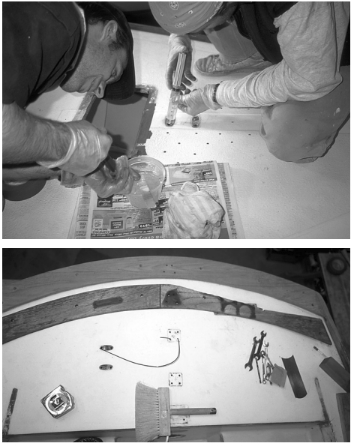
I busied myself with the taffrail. Poised to cut into a $20 piece of half-inch teak, I prayed my plan for it would work. After biscuit-joining two halves of the plank together to get the full curve, I cut and shaped using for a pattern what was left of the old piece. With John’s help, and all the tools of the shop, now christened “The Typhoonery,” I got a lovely new taffrail bedded, screwed, and bunged. We moved John’s boat in beside ours, and they became our “television,” as we sat pondering their lines and discussing centers of effort.
The seacocks for the cockpit drains were next. This job went well, thanks to one Typhoon owner’s response to my request on the California Cape Dory Owners’ Association Web page. The hero even had part numbers for each part needed. For one of the few times in my life, I did not reinvent the wheel. With the new ball valves, bronze elbows, adapters and hoses, and the through-hulls bedded, the cockpit drains like a flush toilet in high gear.
After the bottom was patched, sanded, and painted, we painstakingly marked and painted the bootstripe (there was none before), and we patched and buffed the topsides and painted the non-skid deck areas. We rebedded the hardware and teak in silicone. We filled the delaminated deck area with epoxy, left over from a cedar strip canoe project a few years before. Now there were two beautiful Typhoons in the Typhoonery. John replaced Moana’s seacocks after helping with ours. With warmer weather, the opened garage doors showed the distinctive bows of both boats and the antlike behavior around them.
Right wire
Work turned to the rig. I had built a new mainsail from a Sailrite kit over the winter and wanted the boat to sail as well as possible, so we cleaned all the mast fittings of rust and replaced the forestay and a few other fittings. The owner of a local marine store let me wander around his shop attic for just the right wire. We found it on an old broken C-scow mast. The wire was in perfect shape, but I really would like to have seen how that mast broke in two! John Phillip and I wet-sanded and waxed the mast, added new running rigging, and spliced in the shackles. We painted the name on the transom.
On the way back to our place, several people called out. “Hey, what a beautiful boat!” The new bronze portlights gleamed, the bootstripe was fair, the wood grain looked alive. All the pieces fit together to draw your eye to her. She was indeed a fine little sailboat, and a worthwhile refit.
Paul Danicic is a USCG captain who has taught sailing on Lake Superior and worked in a marina. He is now director of a YMCA camp, a wilderness tripping camp in Grand Marais, Minn.
Thank you to Sailrite Enterprises, Inc., for providing free access to back issues of Good Old Boat through intellectual property rights. Sailrite.com