The oldest skipjack rejoins the Chesapeake Bay fleet
Issue 16 : Jan/Feb 2001
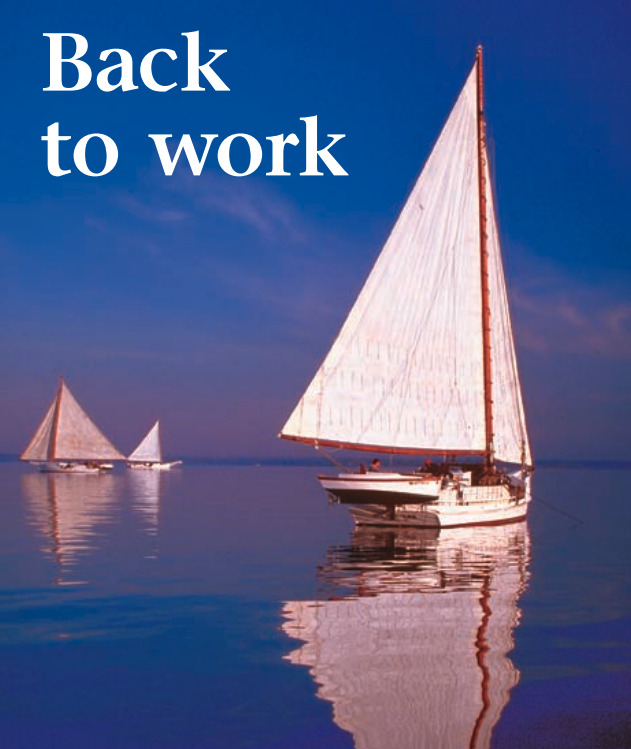
When the warm, hazy days OF summer give way to cold, crisp autumn mornings, the Chesapeake Bay undergoes a quiet transition. Hordes of pleasure cruisers disappear, replaced by a fleet of long, lean workboats on which solitary watermen can be seen dipping into the creeks and coves with hand tongs in a ritual as old as the nation itself. And out on the rivers and bay the last remains of the Chesapeake’s once mighty sailing fleet heads to the oyster bars as November 1 marks the start of another dredging season. Against great odds, the oldest boat in the fleet will join the handful of skipjacks that make up the last remaining working sail in the United States.
This season, the 114-year-old Rebecca T. Ruark should have been another dead hull littering the murky waters of the Choptank River, creating a haven for fish, a bonanza for fishermen, and a navigational nightmare for pleasure cruisers. Instead, she’s sailing again, stronger than ever. Unlike the ghosts of thousands of dredgeboats that have rotted away in watery graves all around the Chesapeake Bay, she had what they didn’t: a captain who cared.
But on November 2, 1999, it looked like the end of the graceful Rebecca T. Ruark and her crew of five. The day started as a typical cool, breezy autumn day, perfect for sailing. There was nothing in the forecast that hinted at what was to come. Captain Wade Murphy, Jr., whose love of telling a good story had gained him a certain notoriety among watermen and tourists, stood at the helm, gripping a spoke of the huge wood and metal wheel. He gave it a swing. Then he spun it again. For several seconds the wooden dredge boat did not respond. Then slowly, Rebecca T. Ruark started to come about.
Power days
Had this been a sail day, her broad Dacron sails would have fluttered in the stiff breeze as she made the graceful turn over the oyster bar. But it was Tuesday, one of only two days a week when skipjacks are allowed to dredge oysters under power on the Chesapeake Bay. So Murphy had his pushboat in the water — an 8-foot skiff that held an automobile engine, the only source of power for the skipjack. The little boat was snug in its chock against the stern of Rebecca doing its job: pushing the 52-foot skipjack.
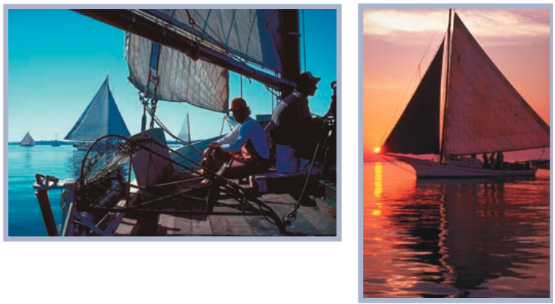
It could have been a scene right out of the 1930s, which is what has drawn so many tourists to Dogwood Harbor on Tilghman Island, where Rebecca ties up. In recent years, Capt. Murphy had taken advantage of the growing public fascination with the Chesapeake’s lively past. All summer long, Rebecca carried tourists out on the bay so men and women could roll back the clocks of time to an earlier era, hauling up the hefty sails by hand, throwing out the dredges, and culling through the harvest that clattered back on board. Rebecca’s picturesque, nostalgic lines, and Wade Murphy’s gift for storytelling made them a hit among tourists. Even when dredging season began, the captain often opted to take out tourists, who yearned to set aside their desk jobs for a day and play the role of rugged watermen.
History buffs and tourists can thank an antiquated law on Maryland’s books for the continued existence of working sailboats on the Chesapeake Bay. Before 1865, dredging in Maryland was outlawed because state legislators knew that everywhere the dredge had gone, from the English Channel to Narragansett Bay in New England, oyster bars had been depleted to exhaustion. The dredge, a scooping device that is dragged along the bottom until it fills with oysters, was just too efficient.
Fearing for the future of its oysters, Maryland outlawed the dredge for 30 years. But after several decades of fighting illegal dredging, state law-makers finally buckled under pressure from watermen and businessmen looking to make a fast buck and passed a law in 1865 permitting dredging, but only under sail. Whether they foresaw the day when power would dominate the seas or not, that extra little clause saved the dredge-boat and the Maryland oyster from extinction.
Oyster navy
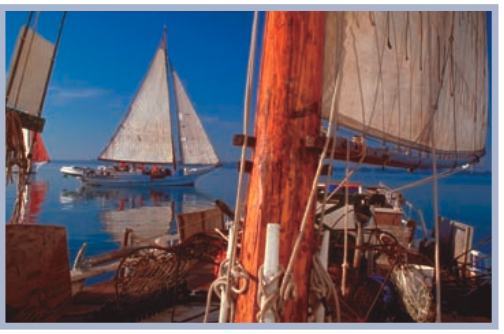
Rebecca was built in 1886 when the oyster industry was still in its heyday, and it took an oyster navy to maintain law and order among unruly watermen who often turned to shotguns to end feuds over harvest grounds. Having survived the worst of the 19th century bay oyster wars, and over a century’s worth of unpredictable Chesapeake winters, she now enjoyed a relatively leisurely pace.
But on this day in November there were no tourists on board. In the 1960s, the state had agreed to give dredgers two days to power dredge, guaranteeing them an income despite what Mother Nature chose to do. Dredgers, whose numbers had dwindled from several thousand skipjacks, bugeyes, schooners, and sloops in 1900 to about 40 vessels in the 1960s, hoped the law would curb their extinction. But while it did slow the loss of skipjacks on the Chesapeake Bay, the fleet continued to dwindle, down to 32 by the 1980s (despite the construction of two new vessels), further down to 22 in 1990, until finally, in recent years, the fleet fluctuates between six and 12 vessels, depending on the availability of oysters and men to work the boats.
Power days were too lucrative to chance dealing with amateurs, even paying amateurs, so Wade Murphy employed real watermen to haul in the catch on Mondays and Tuesdays. Now, just two days into the dredging season, he felt more optimistic about the oyster season than he had for almost a decade. On deck were about 90 bushels of the succulent bivalves, which he and his crew had dredged from their home waters in the Choptank River.
With two diseases devastating the oyster population of the Chesapeake in the 1990s, it was a rare season when he enjoyed dredging upriver from his home on Tilghman Island. Usually he and the other skipjack captains, most of whom lived and worked out of Tilghman or Deal islands on the Eastern Shore of Maryland, were forced to move their wooden vessels north to Tolchester, across from Baltimore, where fresher waters stymied the parasites that caused massive oyster die-offs farther south.
Perfect turn
Having made a perfect U-turn over the oyster bar, Rebecca leapt ahead, gaining momentum as the pushboat did its job until suddenly Wade yelled, “Hey.” Four crewmen threw out the two dredges on either side of the boat. As the iron teeth dug into the river bottom, Rebecca’s speed slowed and she bore down into the water, feeling the strain. Then she pulled ahead, powered by the little yawl.
The pushboat was a throwback to the early days of engine power when Model T Ford engines were fitted into the yawl boats that were towed behind big vessels and used to carry crew back and forth from their anchorage in a harbor. Despite the presence of Loran and radar on board, the antiquated pushboat remains the only source of power on a skipjack because, as even the captains acknowledged, they would forever be power dredging if the engine were hidden down in the hold, away from the ever-watchful eyes of the law. With the engine in a pushboat, marine police hardly had to raise their binoculars to spot a skipjack captain illegally power dredging on sail days.
Weathermen had forecast a beautiful day, but like all watermen, Wade was wary of the unexpected squalls that periodically lashed out at the Chesapeake and its tributaries, and threatened the lives of the men who worked the wintertime bay. Now as the sky darkened and the wind picked up, Capt. Murphy gave his crew the signal to haul in the dredges for the last time. Then he headed his boat west toward Tilghman Island, which was several hours away by boat, even with the yawl pushing.
Worsening conditions
As they headed home, the heavy winds quickly picked up and conditions deteriorated rapidly. Momentarily, Wade considered turning east and running to Cambridge, which was much closer, but that would have meant problems for him and his crew since they had no transportation home. Had he had his old Sigsbee underfoot, he probably would have turned, but Rebecca’s age gave her a unique advantage over other skipjacks.
Rebecca, as Wade affectionately called her, was not your average skipjack. In fact, she was built in the pre-skipjack era when boatbuilders didn’t cut corners, and vessels were constructed to the highest standards. Originally a sloop, she was planked fore-and-aft, typical of the sailing vessels of the 1800s. Her construction gave her a strong, rounded hull that could take more pounding than a hard-chined skipjack. Consequently, her age, rather than hurting her, made her more seaworthy than other skipjacks.
Skipjacks arrived on the Chesapeake scene in the late 1890s as the Chesapeake oyster industry suffered through an economic slump, brought on by overharvesting and a scarcity of oysters. The big boats were too expensive to maintain and crew. The skipjack emerged as a cheap, oversized skiff with a hard chine, a nearly flat V-bottom, a long bowsprit, and a short, raked mast with an over-sized boom.
The construction plan was so simple, it was passed around by word of mouth: the beam or greatest width equaled one-third the length of the boat on deck; the mast was the length of the boat on deck plus the boat’s beam; the boom was the length of the boat on deck; the bowsprit equaled the beam; and the width of the transom equaled three-fourths the beam. The length of the centerboard equaled one-third the length on deck, and the mast was raked about 75 degrees to the load waterline so that the top of the mast was directly over the point of the boat with the greatest beam. That’s where the hatch was generally located, which allowed watermen to use a halyard attached to the mast to lift oysters and other cargo out of the hold.
Shallow draft
The skipjack was a no-frills, practical boat that also had such shallow draft — usually as little as 3 to 3 1⁄2 feet — that dredgers could now work waters that had been inaccessible to the deep-draft dredge boats of the past era. Two types of skipjacks were made: a 20-foot, open boat that carried a tiny hand-drawn dredge called a “scrape.” This boat was probably built by the thousands, but today is found only at a few museums. However, it was the larger vessel, usually 38 to 45 feet on deck, with a cabin that accommodated crew for weeks or months at a time, that is known as a skipjack. Only about 600 large skipjacks were built, most of them between 1896 and 1915.
The construction plan for a skipjack was so simple that watermen handy with tools could, and often did, build them in their backyards at the turn of the century. Even when they hired a boatbuilder, the skipjack cost only $600, half the price of a sloop the same size.
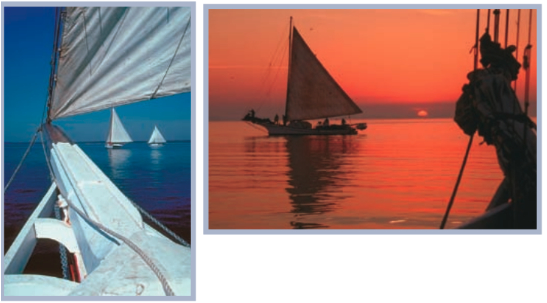
The sail plan also was simple. The skipjack carried a self-tending jib on a short spar. The jib sheet tied off in front of the mast, which allowed the sail to shift back and forth on its own as the boat tacked, freeing the crew to tend to the dredges. Likewise, the mainsail was designed for economy of effort. The sheet hooked to a simple bar behind the helm, which served as a traveler. Since dredge boats always work on a broad reach, which allows the crew a steady, flat platform from which to work the dredges and cull oysters, the captain never had to tend the mainsheet.
The sail rode up and down the raked mast on hoops so it could be dropped quickly in an approaching squall. And when the mainsail was dropped, it folded neatly into lazyjacks, so there was little chance of its getting caught up in the equipment on board. Some time after she was built, Rebecca shed the multiple sailplan of the working sloop, which included a topsail over a gaff-rigged mainsail, in favor of the simple skipjack sailplan.
Pure drudgery
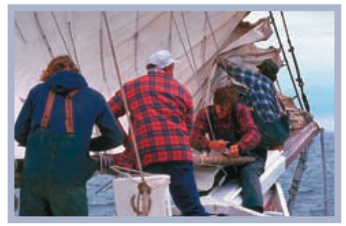
Watermen called the job “drudgin’ ” because it could be pure drudgery down on your knees on deck, separating small oysters from legal three-inch oysters that could be sold, and sending them back overboard. Also, oysters were harvested in the worst weather: from November through March.
On this day, there had been no hint of a squall on the marine radio, but now the wind had picked up so quickly that Wade feared the choppy seas would swamp his pushboat. That was the biggest fear of dredgers, that a swamped pushboat would drag down the bigger skipjack. When seas threatened to break over the pushboat, it was far less dangerous to haul the little boat out of the water onto its davits and go with sail power alone. As the weather developed into a full-blown squall, Capt. Murphy gave the order to haul up the main and winch in the yawl boat. Now he was under sail power alone.
Usually a river affords some protection from bad weather, but the Choptank is so wide that big seas develop quickly. In fact, the Choptank had a reputation as the scene of the worst catastrophe in dredging history. Back in the 1930s, a dry squall, which may well have been a twister, came out of the fog and capsized three vessels, drowning nine dredgers.
Seas began breaking over Rebecca’s bow, and so much seawater ran through the hatches into the hold that it appeared she had sprung a leak. Wade yelled for his crew to keep the bilge pumps free of debris as loose items and equipment sloshed around in the deepening cold water inside the boat. Meanwhile, hurricane-force winds were shredding the sails.
Rescue boats
Having run out of options to limp the boat home, Wade got on the marine radio to his wife, Jackie, at home. She quickly called her neighbor, Robbie Wilson, a former skipjack captain who had given up dredging when the oysters died off in the early 1990s. Robbie called his son, and the two of them took their workboats out in the squall to rescue Wade and his crew. At one point, the seas were so big that they rolled over the bow of one of the workboats and smashed the cabin window. By the time the two men reached Rebecca, she was half full of sea water. They managed to secure a line to the vessel and began a slow, treacherous tow back to shore.
Wade could see his life-long home, Tilghman Island, a swampy watermen’s enclave barely above sea level, stretched out before them. Another mile or two, and they would be in the calm waters of Knapp’s Narrows. Then a wave hit them broadside, and suddenly the men were in the water as Rebecca literally sunk out from under their feet.
The history of skipjacks and dredging is riddled with drownings. Sometimes entire crews were lost when a boat went down in a storm. The last time that happened was in the mid-1970s when the crew of the Claud W. Somers was caught in a squall off Deal Island. The crew members were all family and relatives of Captain Thompson Wallace.
While modern communications have reduced deaths on the Chesapeake, drowning was still a much more serious threat for watermen than for pleasure cruisers. Even if a man could swim, he had to first get out of his heavy boots and work clothes, which had carried many a dredger right to the bottom and a watery grave. Then he had to deal with the chilly water temperature, which could bring about hypothermia within minutes. Rebecca had lost at least two of her crew before Wade purchased her in the 1980s. Wade, who had come to the rescue of his nephew who fell off another nearby skipjack in 1990, had been in the water a few times himself, but never had he had a skipjack capsize or sink beneath him.
Men saved
Fortunately, Robbie Wilson and his son were able to release the tow line, or they might have been swimming, too. The crew of the Rebecca T. Ruark had shed their heavy boots and were bobbing in the water. One of the men clutched Rebecca’s mast, the only part of the boat still visible. For a few moments, Robbie feared he’d have to knock the man out to get him to release his death grip on the wooden spar. Finally, they dragged him aboard, too.
Capt. Murphy and his crew had narrowly escaped becoming another statistic in a history littered with tragedy. He was lucky that no one had been killed, or even seriously injured. But even as they plowed home through the swollen river, Wade wanted one more thing: he wanted to save Rebecca.
Wade came from a long line of dredgers, and he knew what it was like to struggle to own a decent boat. Unlike some captains, who got into dredging when the money was good and got out when it was tough, Wade’s life was dredging; he had started on the middle deck of his father’s boat, culling oysters, when he was 16.
“It blowed a gale, nor’west and rain, solid rain, for three days. I thought, ‘God almighty, I’ll go back to school and to hell with this,’ ” he remembers. Then, the skies finally cleared, the weather moderated, and Wade decided to stay aboard after all. That was in 1957.
It was no surprise to anyone that, despite the high price tag, $50,000 just for repairs, Wade was determined to raise Rebecca. As one dredger observed, “Wadie, he loves that boat.”
Ballast shifted
It seemed like an impossible task. She was lying on her side with just the mast sticking out of the water. Inside, a layer of loose bricks placed in her hold as ballast had shifted sideways when she capsized, helping to pin the boat to the bottom.
A few days later, as soon as weather permitted, a crew was at work, trying to lift the boat with a crane. The first efforts failed, but Wade persevered. Finally she was pulled out of the water before a crowd of friends and press and towed the last mile to Tilghman Island.
For the first time in 43 years, Capt. Murphy spent the dredging season on land, looking after repairs to his beloved boat. While he wanted to have her dredging again in the fall, he was trying to meet an even tighter deadline: the summer tourist season. With the decline in the seafood market, the tourist trade was now his biggest moneymaker. The tragedy finally had a silver lining when, in May, 2000, Rebecca was launched again and certified by the Coast Guard to be a stronger vessel, able to carry more tourists than before.
The skipjacks that have survived 40, 50, or 100 years aren’t always the best or the biggest, noted Captain Russell Dize, who captains the Kathryn, one of only four skipjacks that still work out of Tilghman Island. But they do have one common thread, he said: “They happened to get a captain who cared for them.”
Pat Vojtech spent one winter dredging with several captains to gather information and photographs for her book, Chesapeake Bay Skipjacks, a complete history, in the words of the captains who lived it, of the colorful world of dredging on the Chesapeake. This book is available from the Good Old Bookshelf, Page 65. Pat is an avid sailor who spends many summer weekends with her husband and son on their 1984 34-foot Hunter, Athena.
Thank you to Sailrite Enterprises, Inc., for providing free access to back issues of Good Old Boat through intellectual property rights. Sailrite.com