Memories of a very special old boat
Second of a two-part series
Issue 16 : Jan/Feb 2001
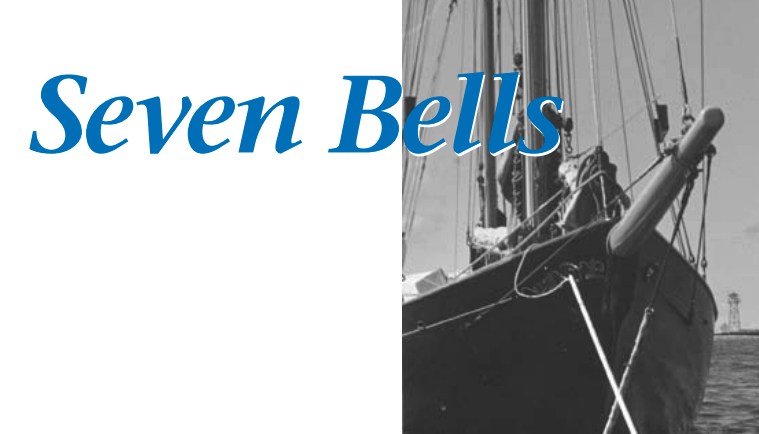
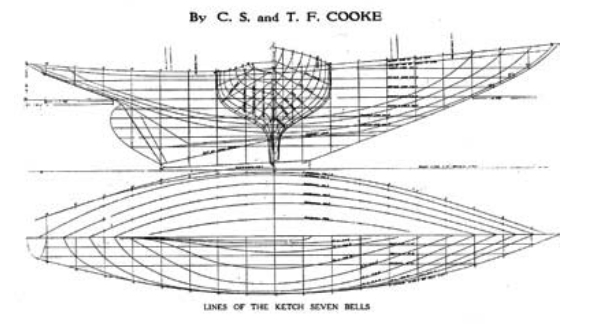
In our November 2000 issue, Ike Harter described his family’s long association with Seven Bells, a ketch 57 feet long on deck. She was the “kid sister” of the famous Nova Scotia racing/fishing schooner, Bluenose. Seven Bells was launched in 1926, and her story resumes in 1954, when the Harter family, headed by Ike’s father, was using her for a vacation charter.
Hurricane Carol began as a very slow-moving storm in the Caribbean Sea and would become a Category 3 hurricane that would do significant damage to the East Coast and New England.
At noon, Wednesday, August 25, 1954, the storm was 200 miles east of Nassau, the Bahamas.
It had been a delightful two weeks cruising the Maine coast. Once again, my father had chartered Seven Bells from the owner, Mrs. Cooke, and my girlfriend had joined us for the last week. The charter would expire Sept.-1 at Stratford, Connecticut.
Thursday, August 26, noon. The storm was located 300 miles east of Ft. Lauderdale, Fla.
We first heard of the storm while buying dinner from a lobsterman at sea. He only could say that a hurricane was brewing “somewhere down south.” Seven Bells was equipped with an old Bendix ship-to-shore radio that had marginal ability to contact the Boston or the New York marine operator. There were no crystals or coils for ship-to-ship channels or to receive notices to mariners. The other radio was a small RCA, a battery-operated AM personal radio about the size of a carton of cigarettes, belonging to my mother. There was no radar.
A Raytheon depthfinder had been fitted the previous winter and was one of those devices with a whirling indicator that produced two orange neon blips over two ranges from 0 to 60 feet and 0 to 240 feet. The first blip was calibrated at 7 feet 6 inches, and the second blip indicated the depth of water below the keel. Throughout the cruise, it had proven very reliable. The depthfinder was installed in the galley overhead where it would stay dry but easily visible from the cockpit through the large glass port in the galley trunk.
Friday, August 27, noon. The storm was located 260 miles east of Daytona Beach, Fla.
It was in York Harbor, Maine, that we first heard details of the storm. It was reported to have weakened and had slowed forward progress. Light winds
Saturday, August 28, noon. The storm was located 280 miles east of Jacksonville, Fla.
My father wanted to return to Stratford as soon as possible. We had a passenger to deliver to Newport, R.I., and the winds were light. Each day, we were obliged to motor most of the way in order to arrive in time for our passenger to make connections.
Sunday, August 29, noon. The storm was located 300 miles east of Brunswick, Ga.
It was necessary to refuel at Newport. Father was anxious to leave Newport as soon as possible, but there was little or no wind. We planned to be under way before dawn and try to make Stratford late Monday night.
The next morning was clear with a light southeast wind. We were able to sail without the engine, and by noon we were off New London. The wind had increased. My father pointed out the telltale clouds that he called “feeders” — the first signs of an approaching hurricane.
Monday, August 30, noon. The storm was located 100 miles east of Wilmington, N.C. It had suddenly covered 200 miles, instead of 75 to 80 miles as on the previous two days.
We arrived at New Haven, Conn., about 8 p.m. and anchored on the east side of the harbor just off the Coast Guard station at Morris Cove, inside the lighthouse point. Stratford was only another two hours’ cruise down Long Island Sound, but the skipper thought it was too much of a risk to attempt to enter and moor in the narrow Housatonic River if the storm should pass close by. The local radio had just given a hurricane “advisory” as we entered the harbor.
Monday, August 30, 8 p.m. The storm was located over Cape Hatteras, N.C.
I had completed a freshman year at Yale University earlier that spring and was somewhat familiar with the area around New Haven, including the harbor, which is divided into three parts. The shallow outer harbor is semi-circular and is guarded from Long Island Sound by two long stone breakwaters. There are navigable channels between the breakwaters and between the ends of the breakwaters and the beaches. The outer harbor is separated from the shallower inner harbor by two opposing sandy points.
A narrow, dredged, ship navigation channel through the outer harbor passes between the sandy points into the inner harbor. The inner harbor is surrounded by waterfront housing and marinas. The ship navigation channel leads through the inner harbor into the commercial harbor formed by the Quinnipiac River. The New Haven Railway and the Post Road, U.S. 1, cross the entrance to this small commercial harbor on two bascule bridges. The commercial harbor is heavily congested with piers for ocean-going ships and several marinas.
Light chop
Seven Bells was anchored in five fathoms with 150 feet of nylon cable attached to a 40-pound Danforth anchor. The wind raised a light chop on the harbor surface. Over at the Coast Guard station, an 83-foot cutter and a 42-foot utility launch were tied up at a long pier.
Beside the Coast Guard station was a lifesaving shed with two big motor surfboats on carriages, ready to launch down two sets of rails. Small homes and cottages dotted the beachfront.
Monday, August 30, 10 p.m. The storm was located 50 miles off Virginia Beach, Va.
The harbor chop had increased significantly since 8 p.m. and a steady swell was coming in through the breakwater. Seven Bells began to lurch back and forth on the elastic nylon cable.
My father and I put the 150-pound stock anchor over on 200 feet of chain and stowed the nylon cable and the Danforth. After checking all rigging and gear, father and mother turned in for the night in their fo’c’s’le cabin. My brother, sister, girlfriend, and I sat up late in the main cabin, playing cards and drinking more than a few in celebration of the end of the cruise.
Tuesday, August 31, midnight. The storm was located 50 miles off Ocean City, Md.
About midnight, we were alerted by the sound of vibrations from heavy diesel engines followed by an indecipherable squawk from a hailing speaker. I went on deck to find the 83-foot cutter alongside. The officer informed me that the hurricane was moving rapidly up the coast and was expected to pass close by in the morning. He suggested that we move Seven Bells up into the commercial harbor and tie up alongside a pier. I went to the fo’c’s’le, and woke up the skipper who gave me a message for the officer thanking him for his trouble, but if the hurricane was to arrive, he did not think he wanted to be in a small harbor with a lot of other boats. Furthermore, he did not think any drawbridge captain would open the bridge if anyone wanted to get out in the middle of a hurricane. We would go to sea if the storm approached. The Coast Guard officer said that we were “at our own risk” and departed into the night. The wind was still less than 15 mph. Our card game was over, the anchor was secure, and we four turned in for the night.
Carol arrives
The next thing I knew my father was shaking me. “Rise and shine, sleepy-head. We have company, and her name is Carol.” This was not going to be a good day. I might rise, but I did not feel like shining. I had more than just a slight hangover.
Tuesday, August 31, 8 a.m. The storm was located just off the New Jersey coast.
Mother had thrown a fast breakfast together, and I ate something with coffee as I got dressed and went on deck. There was nearly a full gale blowing. The skipper already had the engine running. He and my brother were busy with the mizzen, which was spilled all over the cockpit while they made up reefing points. We hoisted the mizzen with three reefs in it and stowed the mizzen boom down tight in the gallows frame. I took the stops from the mizzen and double-stopped the mainsail. The main boom was hauled down and stowed securely in its crutch and lashed port and starboard. The main preventers were set up snug. Later, as the manila tackles became wet, they would need to be slackened several times.
I went forward and put three reefs into the boom staysail, partially hoisted the staysail to the reefs and secured the sheet. My next task was to haul in the 200 feet of chain with the “horrible Hyde” windlass. Each stroke of the long iron handle hauled the chain only three inches. The job would take about 800 strokes. Father engaged the engine dead slow ahead and eased the task somewhat, but as the chain slacked, the ship began to pitch, and green water poured over me.
At one point, I stopped for a breather. The pawls on the windlass ratchet were not quite set and slipped a cog. The iron handle whipped back and clipped me on the side of the head. I saw stars. A few moments later, I was back in action, clickety-clank, until the chain was “straight up,” and I signaled aft to break the anchor out under power. It came free, and I ratcheted as fast as I could. My brother came forward and assisted in getting the monster on board and secured. We hoisted the boom staysail and close-hauled the sheet on the traveler.
We were still headed dead to windward and underway for the eastern channel between the breakwater and the beach. Over at the Coast Guard station, the hurricane warning flags and lights were set. The 83-footer and utility boat were bouncing alongside their pier. It had started to rain. Soon the whole scene faded from view.
Making secure
Father had the helm, and Mike and I went below to assist in securing everything that might come adrift from shelves and lockers. My mother, sister, and girlfriend sat down in the main cabin and attempted to get some hurricane news on the small portable radio. I turned on the depthfinder, and Mike put the harbor chart in a new transparent plastic waterproof folder, and grabbed a wax crayon slate and a hand bearing compass. We went back on deck.
Once clear of the breakwaters, father put me at the helm, sitting on the box behind the wheel. He tied two bowlines around me and lashed me down to deck eyes, port and starboard.
With tethers tied around each of them, father and Mike huddled down in the cockpit recess where they could use the chart and see the depthfinder.
Tuesday, August 31, 10 a.m. The storm center had made landfall over Long Island.
There was no doubt about it. We were in a big hurricane. Our plan was to cruise slowly back and forth outside the breakwaters. The wind was blowing south of east and nearly parallel to one of the breakwaters, and we stayed clear of this potential lee shore, but kept it in sight when we could.
Most of the time, the visibility was nearly zero, and I could not see the bow. Father and Mike navigated by compass and depth finder and took visual bearings when they had the opportunity. On the chart, the depth contours were very clear, and there was deep water right up to the breakwaters. They wrote the compass course on the slate where I could see it, and that is what I steered.
Outside the breakwaters, the broad entrance to New Haven is embraced by Morgan Point to the east and Oyster River Point, about four miles to the west. We sailed a course between these two points, back and forth in Long Island Sound, following the bottom contours and making occasional sightings of recognizable landmarks. We saw no other vessels.
Going to windward, the mizzen and staysail remained hauled tight, and the engine ran enough to maintain a slow headway relative to the ground. Running downwind or to leeward, we idled the engine and slacked the staysail sheet so we could sail the return course. The reefed sails provided more stability than motor propulsion under bare spars.
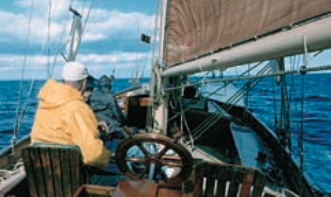
Flying objects
All that morning, the wind was blowing toward New Haven, but at one point, I saw several objects (including a door from a house) sailing high overhead, apparently against the wind. There must have been some tornado effect mixed in with the normal counter-clockwise hurricane-force winds, which were later said to have been Category 3, between 120 and 130 miles per hour.
The wave heights were 10 to 12 feet, and as waves approached, the wind tore the tops off and flung them at me — solid green water. Try as I might to keep my mouth weather-tight, the salt water was rammed in, and about every 15 or 20 minutes I turned to leeward and vomited clear seawater. Several attempts to drink a cup of hot tea failed as the wind siphoned the tea out of the mug before I could drink. Occasionally, a hand opened the window in the galley port and passed through a bottle of good Myers’ rum. The deck crew would each take a pull on the bottle and go back to work. The ordeal lasted more than three hours.
Tuesday, August 31, noon. The storm was located directly over New Haven, Conn.
It was amazing how quickly the rain and wind eased and then stopped. To the southwest, we saw light, then clearing, and then actual blue sky. We were in the eye of the storm. The breakwaters and shoreline appeared, and we were exactly where the navigators expected us to be.
The surface of the water was almost calm. All around us were the inner cloud formations of the immense storm, rising like canyon walls. Overhead was blue sky and sunshine. It was time for a break, it was time for a head call, it was time for lunch. I got out of my rope harness.
Mother opened the scuttle hatch and peered out, looking very pale. It had been very close down there, with engine fumes and the unpleasant effects of seasickness. She said there had been a problem. I went below and found six inches of water over the cabin deck with strange shapes rolling back and forth in the somewhat oily mess that had floated up from the bilge.
The “problem” was tied down in one of the berths, and she had just regained consciousness.
Right at the very beginning of the storm, as the ship came about at the end of a course, one of the trays full of tools stowed between the overhead deck beams had broken its lanyards and had slid out and struck my girlfriend in the back of the head. The poor lady went out like a light. My mother and sister were able to lift her into the berth where she had slept through it all. She had a headache and a small knot on her head but no sign of concussion, and she was hungry like the rest of us.
Leaky hawse pipes
The water had come in through the hawse pipes in the foredeck where the chain and nylon cable ran down to the chain locker. They had not been booted and gasketed during our hurried departure, and we had not been able to risk sending anyone forward during the storm. This was quickly attended to while we had a break. Everything else topside was in good order. The fuel tank was free of water and had plenty of fuel. The engine oil and temperature were normal.
The engine had been fitted with a small bilge pump that ran continuously, and the impeller was known to be badly worn. The suction strainer was clogged with a mysterious gurry. This problem was quickly remedied, and the water was soon pumped out with the portable pumps. The shapes rolling on the deck were food and paint cans that had lost their labels.
All hands came on deck for some fresh air, lunch, and a well-earned drink before the clouds began to gather overhead and the wind began again, this time from the northwest as the hurricane moved on past New Haven. I got back into my harness and resumed my station at the wheel. By 2 p.m. we were back in the storm, cruising back and forth outside the breakwaters. The visibility was better this time, since the wind was from the land, and there were many sightings of pieces and parts of things flying overhead. I do not recall having problems with swallowing and pumping seawater during the afternoon, and my lunch stayed down. I don’t think it did with the poor ladies confined below.
Tuesday, August 31, 4 p.m. The storm was moving rapidly east, off the coast of Maine.
The storm was over, and the sky was clearing quickly. We returned to New Haven through the eastern channel. Someone had apparently taken their big powerboat outside the harbor and run her on the sandy beach at full throttle. There she was, high, dry, and safe. I am sure the insurance company was more than happy to buy some new screws and shafting for the owner and to pay to have her refloated.
Inside the outer harbor, at our anchorage, it was another matter. The Coast Guard station and the pier were gone. The lifesaving station was gone. Most of the little houses around the shore were gone. The harbor was smooth and calm, filled with bits and pieces of floating debris. Only the bow of the 83-foot cutter poked above the surface about a half mile from shore, and the 42-footer was nowhere in sight. A search of the harbor with binoculars showed damage and wrecked boats everywhere. We anchored in about the same spot as the night before and checked out our own ship. We had lost a boathook and a mop that had not been secured on deck.
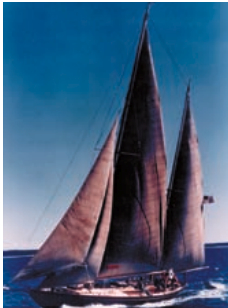
Radio call
Knowing how my grandmother would be worried, my mother called her on the radio via the New York marine operator and let her know everyone was safe and well and that Seven Bells and her captain had brought us through the storm. It took some while to make contact, but the radiotelephone network was functioning. From my grandmother and the reports on the portable radio, we understood that the damage was severe in New York and New England.
About 6 p.m., a small rowboat with three men appeared from shore where the Coast Guard station had been. They were the station commander, a petty officer, and the officer on the 83-footer to whom I had spoken the night before. They wanted to know if we had a radio transmitter and if they could use it to call their district command in New York, because their telephone service in New Haven was gone. We were told that in the inner harbor and up in the New Haven commercial harbor, there were hundreds of boats, yachts, fishermen, and ocean-going ships all crushed up together, sunk, or washed up on shore. We were the only ship in the harbor.
The three visitors were all very wet, cold, and hungry. We took them aboard, and they joined us for dinner. Once the commander had made his radio call, he determined that he and his friends were no longer on duty and were therefore eligible for several rounds of drinks. They had been certain that we had been lost in the storm and were amazed that Seven Bells had proven so seaworthy. They complimented my father on his seamanship and decision to put to sea.
Tuesday, August 31, 8 p.m. The storm was over the Atlantic, east of Canada. It had traveled 600 miles from New Haven since noon.
The next morning, the Coast Guard commander and his petty officer came aboard once more to use the radio and share some hot coffee. We got under way and arrived before noon at the boatyard in Stratford, Conn., before the charter expired. We were obliged to anchor in the stream, because the piers were gone, and the shore was littered with wrecked boats. We had to ferry our gear ashore in a launch. It was an inconvenient, but happy, ending to a memorable experience. From the shore, Seven Bells looked proud of herself out there amid the wreckage.
Bought her
“Seven Bells IS OURS – Pop.” That’s what the telegram said. I was in Arizona on active duty with the Army. The details were filled in later by several letters and phone calls.
My father had called Mrs. Cooke about chartering Seven Bells again in 1955 and was told that she no longer planned to offer the boat for charter. She had decided that she was no longer interested in maintaining the boat, and she had received an offer from the shipbreakers. My father had immediately made her a better offer and closed the deal by telephone. A month later, he took possession of the boat at the Long Island yard. After a brief refit, he and some friends set out for a two-week cruise in Maine. Seven Bells would be homeported at Southwest Harbor, on Mt. Desert Island, Maine. Seven Bells would need to help support herself, so she went out on charter several times that year and was soon booked up for the next year.
In 1956, three male charterers and their three female companions were returning to Southwest Harbor from Nova Scotia. They were crossing the Bay of Fundy at night, in the fog, under full working sail and the auxiliary engine. They had not streamed the log. They had only a vague idea of where they were and how far they had traveled by very rough dead reckoning. There was no GPS in those days. Still they pressed on.
Egg Rock lies about 30 miles east of Mt. Desert. It is a small reef about four feet below mean low water. Seven Bells drew seven-and-one-half feet. She was making seven, maybe eight, knots when they struck the reef. She climbed up on the rock a bit and stopped abruptly. Both masts went over the side and remained attached by the shrouds. The mizzenmast, awash in the waves, went to work beating a hole in the hull.
Only one man had been on deck. He was at the wheel and had been thrown into the cockpit. The other three were below and had all been thrown off their feet. The three ladies were not experienced in boats and certainly not in marine emergencies. They reacted with panic, as the cabin began to flood from severe hull damage. The water stopped rising in the cabin only because the ship was aground and could not sink further. The engine had quit, but the batteries were still able to support the radio and lighting. A mayday call was answered by the Coast Guard at Southwest Harbor, and help soon arrived.
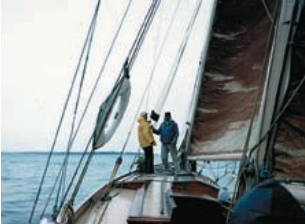
Kept afloat
The Coast Guard was able to pull Seven Bells off the reef. She was sinking, but they lashed her alongside the cutter and put big suction hoses aboard. The pumps managed to keep ahead of the flooding, and the wreck was taken into Southwest Harbor. The yard had a cradle waiting, and they hauled Seven Bells out on the marine railway.
Her back was broken. The keel was broken across in two places and split longitudinally the full 22-foot length along the row of keel bolts. Every hull and deck seam had been started, fittings ripped out, and there was massive damage to the hull planking and frames. Nearly every fastening had been started or broken. The engine was completely ruined. The insurance company was ready to declare her a total loss, pending a final assessment and bid by the Southwest Boat Corp. The shipwrights agreed that they would to try to save the old ship.
They blocked her up and cut off her lower hull above the keel with a two-man saw. The keel bolts were found to be perfectly sound after 30 years. The “Swedish iron” had not corroded, but had only a black oxide coating. It was almost like new. All the other hull fastenings were the same. A major problem was that the hull planks and frames had been fastened with cut boat nails, which had been clinched over after having been driven through the frames. There was no way to tighten them without removing all of the ceiling and cabin outfitting. It was decided to leave the boat nails in place and refasten with lag screws.
My father was a metallurgical engineer and had contacts through his company with access to many sources of material. Pure, ferritic (Swedish) iron was available only through the Krupp organization in Germany and Sweden. The fastenings were manufactured in Poland, shipped back out from behind the Iron Curtain to Sweden, then to Germany for finishing and galvanizing. It was a long way about, but still better than any local prices, including shipping and handling.
While the fastenings were on order, a large piece of white oak was found in a barn in Ohio. It was shipped to Maine, and Mr. Somes spent a large part of the winter fashioning it into a new keel. Exact measurements were taken off the hull and compared with the original drawings.
Builders ad-libbing
It was found that in spite of her injuries, the old lady had not developed the middle-age spread common to older wooden hulls. It was also discovered that in spite of the designer’s best intentions, the builders at Shelbourne had incorporated a few of their own touches. This sort of ad-libbing has been happening in shipyards since the Ark.
New frame extensions and “sister” frames had been fitted where the broken ends had been cut off, and in the spring the shipwrights carried the new keel out to the railway and lifted it up into place. It fit perfectly. Every mortise and rabbet precut in the shop lined up with its corresponding frame or floor. Most of the shipwrights had only minimal formal education, but they had years of experience.
My military service ended and, by the time I arrived at the boatyard in the spring of 1957, the hull repairs were complete. Seven Bells was afloat again at the pier. My assignment as “owner’s representative” did not conflict with my job as a worker on the payroll at Southwest Boat. I had already decided on a career in naval architecture and marine engineering and was scheduled to resume college at the University of Michigan in the fall. Work at the yard would be a good start in the business. I would also be fortunate to work part time for Henry Hinckley, across the harbor, in the evenings. Henry taught me the finer points of wooden hull design and how to fair lines drawings.
A new Daimler-Benz OM-636 diesel engine had been installed and the fuel system converted from the original gasoline. The engine room was equipped with a powerful, new exhaust blower. Twin alternators and a duplex battery complemented new rewiring. A new Raytheon multipurpose radiotelephone had replaced the old Bendix. A new engine-driven bilge pump was backed up by two automatic electric units. The galley was being refurbished and the propane equipment had been replaced by a Primus kerosene/alcohol stove.
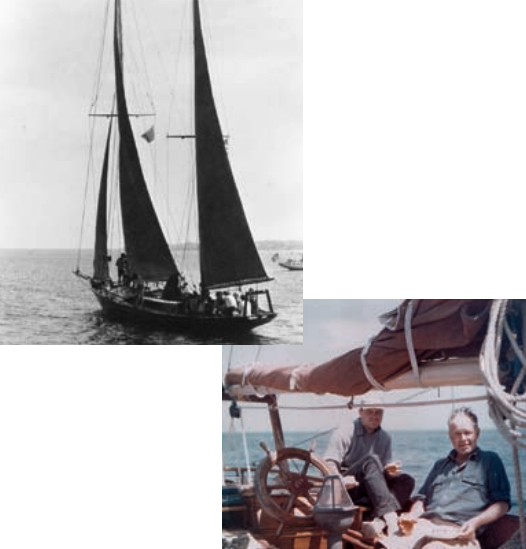
Brightwork renewed
All weather decks had been refastened and covered with a new Silastic fabric system. The brightwork was being reconditioned, and I took over this task. New lower ends had been scarfed to both masts, and I was on hand for the restepping and the setting up of the standing rigging. The ship had been built with the stainless-steel chainplates secured to the frames inboard of the hull planking. It was probably done for cosmetic reasons, but when the shrouds were under heavy loads, the chainplates tended to pull inboard, away from the toerails and open up leaks where they penetrated the deck. The hull had been rebuilt with the chainplates outside the hull in the manner of a fisherman. Not very yacht-like, but painted black with the rest of the hull, they were barely visible at close range.
I did most of the interior cleanup and painting, and by the end of July Seven Bells was ready for sea again in better shape than she had been in many years. Thirty years before, her designer and builders had put the craftsmanship into Seven Bells that would allow her to survive the wreck and leave enough ship still together so that the shipwrights of Southwest Boat could rebuild her, when most yards and underwriters would have given her up for lost.
My father arrived in August, and we enjoyed a week’s shakedown cruise, before we both returned to our jobs. I would become absorbed at college and with beginning a shipbuilding career at Newport News, Va., using much of what I had learned in Maine.
When my father retired, he and mother moved from western Pennsylvania to Nantucket. Seven Bells also moved her homeport to Nantucket, but my father still preferred to cruise in Maine. My brother and I joined him when we could, but by then we had wives and children and full-time jobs with little vacation time. I saw Seven Bells only during short visits to Nantucket or during an occasional Maine cruise.
Medicare Mariners
Over the next 15 years, old age and wear and tear slowly caught up with Seven Bells and her skipper. Her cruises were limited to daysails in and around Nantucket Sound with her crew of “Medicare Mariners,” as my father and his friends were known. In an age of fiberglass and plastic, it was becoming hard to find people in Nantucket with the skills or interest in maintaining a large wooden boat.
We considered moving Seven Bells to Virginia, where the winters were short, and I could be nearby to keep the boat up. I lived on Hampton Roads, off Chesapeake Bay, but most of the water there was too shallow for Seven Bells unless she stayed in the shipping channels. My father did not want her to “go south” to be eaten alive by the marine borers that she had eluded all of her life, and Virginia was too close to frequent hurricanes.
My father finally made the decision and found Seven Bells a new owner, not far from Nantucket. He thought the new owner would have the time, interest, and funds to take care of the 55-year-old lady. He was to be sadly disappointed.
On Dec. 13, 1984, at 11:30 p.m., Seven Bells exploded and sank while entering harbor at Scituate, Mass. According to witnesses, she was showing no lights. Members of the crew were rescued, but nothing was reported publicly as to the cause of the explosion and intense fire below. No explanation was ever reported as to why the ship was even at sea at a time of the year when most self-respecting yachts are laid up in yards for the season. My father purchased the mainmast and a quantity of fittings salvaged from the wreck. The mainmast was erected as a flagpole at his home on Nantucket. My father, Isaac Harter, Jr. passed away August 14, 1986.
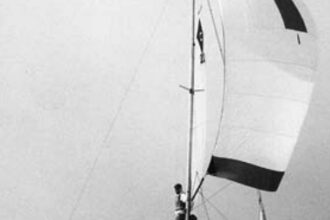
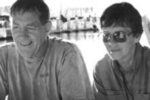
Issac Harter III (Ike) spent nearly 40 years in engineering at Newport News Shipbuilding in Virginia. He is pictured above in 1957 with his father on Seven Bells. Ike’s career involved the design, construction, and testing of naval and commercial ships, including nuclear submarines and aircraft carriers. He designed several small craft and marine machinery systems for friends and private customers. He also designed and built a 28-foot ocean-going steam yacht for himself and wrote numerous articles on small marine steam systems.
Thank you to Sailrite Enterprises, Inc., for providing free access to back issues of Good Old Boat through intellectual property rights. Sailrite.com