Issue 17 : Mar/Apr 2001
If you sail in Texas, or somewhere just as hot, you learn to live with the heat. But on those nights when the breeze dies, there’s only one thing to do: head for the marina and plug in the air conditioner! After a long hot sail, any way to get cool is welcomed, especially if the alternative is packing it up and driving home.
After getting an estimate of over $3,000 to install an air conditioning system in our boat, my wife/accountant convinced me to be creative once again and figure out an inexpensive solution.
First, I researched several portable air conditioners. My criteria were these: the unit must be light, give the highest output for the price, have a carrying handle, and not look like the ugly square ones that hang out of windows.
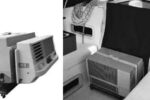
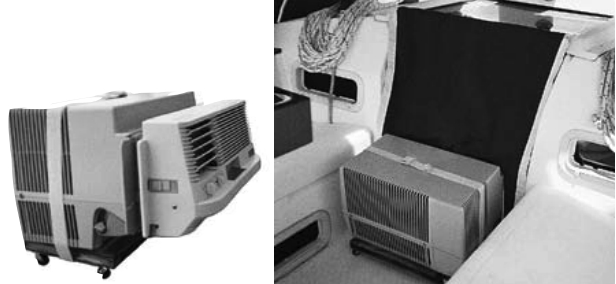
The winner was a unit made by White Westinghouse that weighs only 50 pounds, puts out 7,000 Btu per hour, has a handle and a white plastic exterior that even looks cool! The recommended cooling capacity for our boat was 12,000 Btu per hour, but just for nighttime use we found that 7,000 Btu per hour works really well.
You may choose another brand, but make sure the width will fit into your main cockpit hatch.
You may have seen some people make a new hatchboard and cut a hole in which to mount the air conditioner, but how practical is this? How do you get in and out of your boat?
Here’s my solution: I built a simple wooden platform to fit the bottom of the air conditioner and added four, 360-degree-rotating, small rubber wheels on the bottom. I paid special attention to the total height of the lower front edge of the air conditioner, so it would go over the bottom edge of the main hatch and protrude inside the hatch.
On the underside of the wooden platform I mounted two battery tie-down strap mounts on both sides and, with an extra long plastic webbing strap, I secured the air conditioner to the mobile platform.
Next, I measured and cut two pieces of Sunbrella to cover the open hatch with two small flaps to go on either side of the air conditioner, all about an inch larger when hemmed for overlap to keep out the rain. Then I placed a sheet of old pink fiberglass insulating material in between the two layers of canvas, like a blanket, and sewed it all together. Later, I added canvas button snaps along the top to attach it to the sliding hatch. (You could use a Velcro strip if you don’t like putting screws anywhere in your boat.) Also, I am planning a partial wooden hatch so I can lock the hatch. We routed a very-heavy-duty short extension cord to an aft locker for the power supply, and for about $400 we are cool, man!
The great part is that to enter the boat, all we do is slide the hatch back, flip up the canvas cover, roll the air conditioner back a bit (leave it running) and soon we’re inside relaxing in cool comfort.
Charles has been an artist and sailor in the Dallas, Texas, area for more than 20 years. He dreams of retiring to paint and sail. These days he and Lynn, his wife, sail a Hunter 34 named Artistry.
Thank you to Sailrite Enterprises, Inc., for providing free access to back issues of Good Old Boat through intellectual property rights. Sailrite.com