But of course, sailing. What better activity to begin or continue as you near and reach retirement years?
Issue 18: May/June 2001
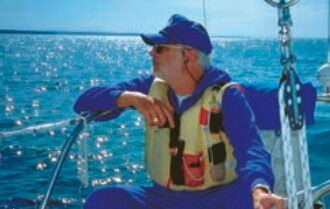
Reese Palley
“Putting around the golf course is my idea of death,” says Reese Palley. “Why die before your time?”
After 20 years as a successful art dealer, Reese reinvented himself as a sailor and writer. Reese, whose personal motto is “Always certain, often wrong,” bought a 32-foot sailboat and decided to cross an ocean.
“It was an enormous conceit, since I really knew nothing about sailing,” he recalls. “I think that I had a vague and formless expectation that, at sea, I would discover something of value in myself.”
Today, Reese is the author of three books about sailing: Unlikely Passages, There Be No Dragons, and Unlikely People. There was a time, however, when Reese did not know how to sail. In fact, he didn’t come to sailing until his early thirties, in the midst of his career as an art dealer.
“At the time I was up to my armpits in people,” says Reese. “Buyers, sellers, wives, lovers, kids, lawyers, and the whole panoply of other folk who need something from you. We lived by a quiet enclosed bay in New Jersey and, in a blind attempt to save something of me for me, I bought a little sailboat. I thought that I was seeking adventure, but I found something so much more valuable . . . solitude.
“My first summer on my boat was spent with my jib sheeted to windward,” he says. “I was too proud to ask. I was certain that I could figure it out for myself. Actually, you only really learn to sail by sailing.”
Reese insists there is no parallel between his life as an art dealer and his life as a sailor, except the conviction that he could succeed against “the two most dangerous competitors of all: the Art Mafia and the Sea.”
Reese spent one summer teaching sailing and restoring a 26-foot boat. When pressed to disclose his technique as a sailing instructor, Reese admits, “My system of teaching is to admonish my student to closely observe where the wind is coming from. After that, I usually doze off.”
In general, Reese has little interest in keeping a finger on the pulse of the sailing community. “The whole purpose of sailing to me is to create distance from people . . . even from other sailors,” says Reese.
When he first set off on Unlikely VII, Reese didn’t know he’d spend the next 15 years circumnavigating. At the beginning of his journey, he discovered that it was easier to look ahead than behind him.
“You kind of get into the habit of going on and a reluctance to face the land and its toxicity,” says Reese. “Later, I learned that Moitessier went around again (in a 1968 solo round-the-world-race) rather than deal with the prospect of fame and admiration.”
In the prologue to Unlikely Passages, Reese wrote “An Encouragement of Ancients,” in which he entices the newly retired to embrace life at sea: “Clear your body of land-based pollutants, lose weight, take off your clothes, and find a new faith in God.” Reese discusses all this and more.
“We are perforce slower and weaker than the young apes,” explains Reese. “Since sailing needs neither speed nor excessive muscle, we can sail forever. The real attraction of sailing for an old guy (or gal) is that there is essentially no end. Sir Francis Chichester sailed his last circumnavigation and achieved his first 200-mile day alone in a 55-footer while dying of cancer.
“I cannot conceive of ending my sailing life,” he continues. Although his boat, Unlikely, took a beating in Hurricane Georges in 1998, Reese took a year to re-fit the boat and prepare for his next adventure. He and his wife, Marilyn, hope to retrace the last passage of the Fantome, the 282-foot windjammer schooner that went down with its 32-year-old captain and 30 crewmembers during Hurricane Mitch in October 1998.
Reese sums up his current thoughts about life with a note of optimism.
“At 79,” says Reese, “I am somewhat interested in dying, but much more interested in what curious project will I be involved in next year.”

Daniel D’Urso
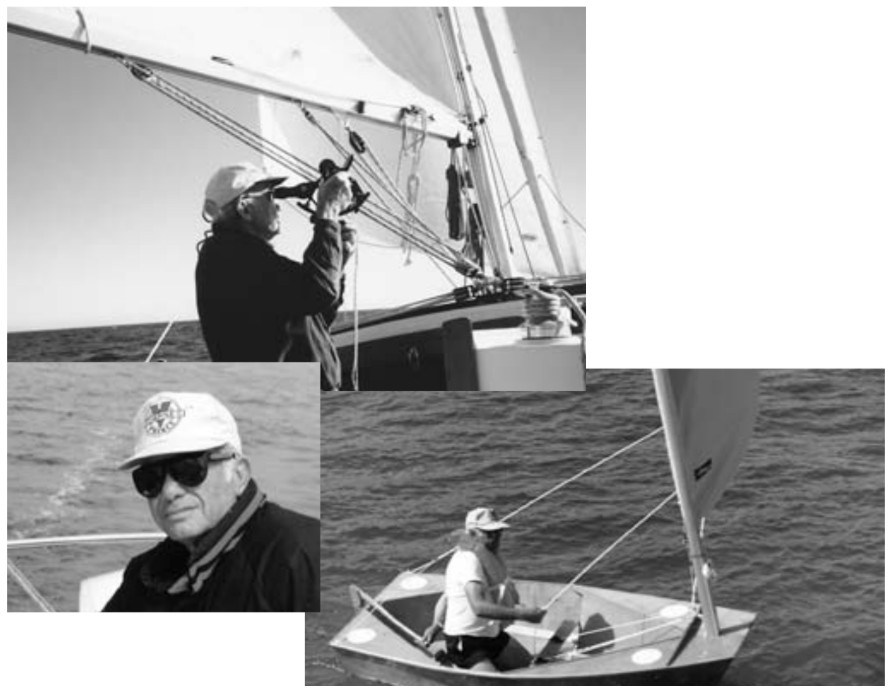
At the age of 81, Daniel D’Urso is still building and sailing boats. “I like being out on the water,” says Dan. “You’re getting away from everything when you cast off your lines and head out to sea. You leave all your problems behind.”
When he was 20, Dan volunteered for service in the U.S. Navy. By May, 1941, he had been commissioned as a Navy Ensign and designated a Naval Aviator.
During World War II, Dan flew seaplanes throughout the Pacific. Being a pilot helped Dan learn about sailing. “In a seaplane, you are very conscious of the wind, current, and sea conditions. You have to take off into the wind. You’re very conscious of the wind direction and velocity. It’s very easy to go from a seaplane to a boat,” says Dan.
“Knowing my exact position at all times was of more than casual interest,” he continues. “As a result, navigation is practically a habit. Navigation is still of major interest. As a member of the USCG Auxiliary, I teach navigation classes to the general public roughly six times a year.”
In 1946, Dan purchased his first boat, an El Toro dinghy, and sailed it in the Oakland estuary in California. He took the El Toro with him when he was transferred to Honolulu and sold it in Hawaii. While on duty in Honolulu, Dan sailed 110s furnished by the Navy as part of the recreation program.
In 1949, while stationed in Florida, Dan built his first boat, a 13-foot outboard, from a kit by Chris-Craft.
“Building a boat is a challenge I enjoy,” says Dan, “but sometimes there’s frustration. Not everything fits like it’s supposed to, and everything takes twice as long as it’s supposed to. However, when everything is done, and all the lines are ‘sweet and fair,’ it does give you a keen sense of accomplishment.”
In 1955, Dan was ordered to duty as an operations officer/navigator. During off-duty hours, he built a 12-foot J-class racing boat, which left his shipmates bewildered and amused.
“They insisted it would not go through the hatch,” recalls Dan. “It did. The trick was to not install the gunwale rubbing strakes until the boat was out of the compartment and on deck.”
Over the years, Dan continued to build boats. He built a 17-foot outboard with a cuddy cabin and used it to fish from Newport Harbor. With the scraps left over from this boat, he built a 12-foot kayak.
After a 12-year hiatus, Dan returned to sailing in 1987 with a 10-foot dinghy. He trailer-sailed a Compac 16 on Lake Perris, California, and then moved to sea with a Compac 23.
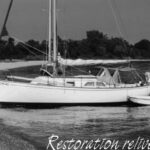
Dan’s most recent project is the restoration of a West Wight Potter 14, which came to him as a gift from an old friend. According to the previous owner, this was the third hull built by West Wight Potter in the United States.
“The boat had been terribly neglected and was in sad condition,” says Dan. “The biggest problem was dry rot in and around the mast step and supporting structure. Restoration has been a real challenge. The ports on the sides have been enlarged, and the port in the front is now longer and narrower. The side ports were no problem. I enlarged the opening in each side of the cabin to fit the factory-supplied ports and riveted them in place. The front one is being built from scratch.”
When he is not working on his West Wight Potter (which he will name Luna Rosa, Jr.), Dan sails his Island Packet 29, Brezzalino (“gentle breeze” in Italian) with his wife, Julie.
“The Potter is intended to be an afternoon daysailer,” says Dan. “It’s easy to launch and easy to handle . . . and it will be a great boat in which to teach my great-grandchildren to sail.”
Ted Adamopoulos
Ted Adamopoulos, 61, grew up in a small seaside town in Greece. As a child, he watched sailboats race in national competitions in the nearby harbor of Tourkolimano.
“Sailing is in my blood,” Ted declares. “Greece has beautiful, clear water. It’s a beautiful country.”
Ted’s father taught him to sail when he was eight years old. By the time he was 18, Ted was winning local competitions in Lightnings. He was made an honorary member of the Greek Royal Yachting Club. For the next four years, sponsored by the yacht club, Ted traveled to Italy, Finland, Yugoslavia, Germany, and Switzerland as he worked his way to the top of the racing circuit.
“I raced three regattas per week. I was in the Finn, the Olympic-class Star, the Lightning, 5.5-Meter boats, and the Olympic-class Dragons. I was the Greek national champion and European champion in the Flying Dutchman,” explains Ted.
Ted’s trophies, medallions, and photos do little to convey one of his favorite parts of racing — the people. “I’ve met some very nice people,” he says. “I’ve made a lot of friends.”
One of the relationships that Ted treasures is his 40-year friendship with King Constantine of Greece. In their younger days, the two men kept a watchful eye on each other as friendly competitors. Today, they correspond by mail. Ted lives in Florida; King Constantine lives in exile in London. Ted takes pride in telling that King Constantine and Odisseau Eskitzoglou were gold medallists in the Dragon class in the 1960 Olympics. But later that year Ted beat the two of them in a Flying Dutchman competition.
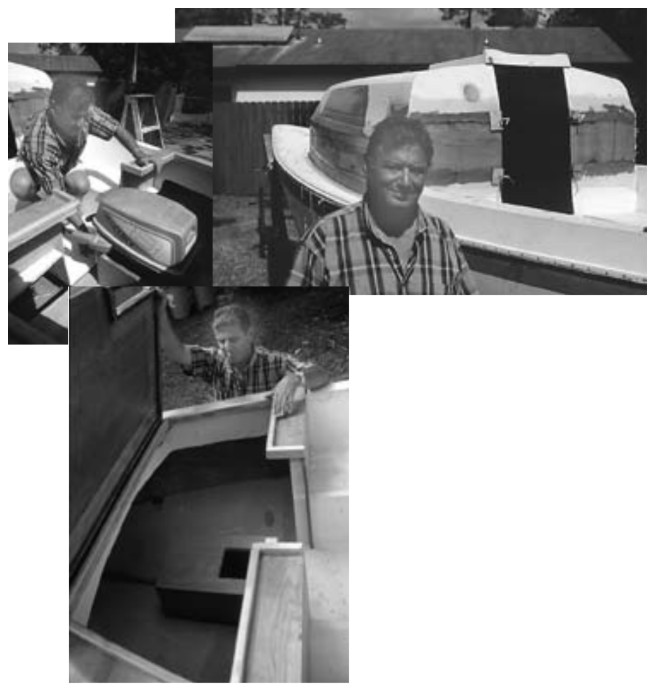
In 1962, Ted retired from racing and came to the United States. He and his wife, Lurene, spent summers cruising in Maine before a project at his home in Orlando, Florida caught his eye. In 1997, Ted bought a 30-year-old Cal 21 from the Salvation Army for $200. He has spent the last three years restoring it.
From the beginning, Ted knew that his project would be a labor of love. He stripped Seabreeze and kept only the fiberglass shell. The amount of time involved with the restoration has surprised him.
“It takes a lot of time to do this,” says Ted. “It’s not a five-minute job. It’s a lot more difficult to take an old boat and restore it rather than build a new boat from scratch. With an old boat, you have to take out all the material, the wood inside the boat that has rotted through the years. It’s been a much, much longer project than I anticipated.”
Ted took special care to customize Seabreeze during his restoration. He started by raising the cabin so he could have more headroom. Inside, Ted installed a V-berth at the bow, a single berth on one side, and a head with an electric flush system. In the cockpit, Ted went with a wheel steering system as opposed to the more typical tiller.
His most significant modification to Seabreeze concerns the engine. Instead of an outboard engine mounted on the transom, he decided to build a dry well to house the engine in the lazarette of the boat. By moving the engine toward the center of the boat, Ted hopes to prevent the outboard’s propeller from interfering with the keel-hung rudder.
When asked if racing ever crosses his mind, Ted smiles and shakes his head.
“This kind of modification isn’t for a racing boat, it’s for cruising. The reason I chose to get a smaller boat is because it’s easy to go different places and trailer the boat,” explains Ted. He plans to cruise down the Intracoastal with his wife, and then hopes to return to Maine.
“The scenery in Maine is much nicer than Florida,” says Ted. “You can go island-hopping. The view is beautiful any place you go. Maine is probably the prettiest state in the country.”
Michelle is a sailor, educator, and writer. She raced on the 4th-place team in the 1998 Women’s Worlds for J24s. Today, she writes for SailNet and cruises on Moondancer, a 34-foot wooden boat built by her husband, Whitney.
Thank you to Sailrite Enterprises, Inc., for providing free access to back issues of Good Old Boat through intellectual property rights. Sailrite.com