A neglected 1977 Cape Dory 27 is returned to the sea. Second of a two-part series
Issue 17 : Mar/Apr 2001
In the January issue of Good Old Boat, Peter wrote about the project he took on when he bought a 27-foot Cape Dory that had been neglected for 10 years. With this article, we bring you to launch day and the trials of the first season. Perhaps the events which follow demonstrate the true origin of the expression “sea trials.”
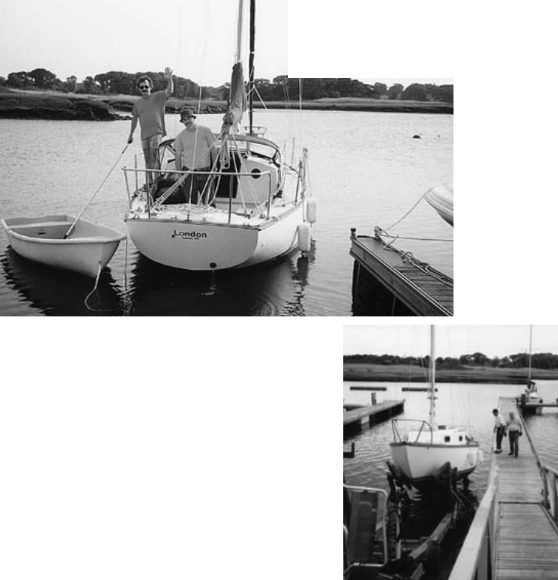
In a few days, we were at the water’s edge. Before she was launched I sprayed her bow with English Ale and then said a few words of blessing. The truck driver, crane operator, and crew were smiling. I passed around the some of the rest of the beer. It was May 19, 1999. I wanted to go through this simple launching ritual because I had renamed the boat from Loon to London when I had applied for the documentation change. Since this is reputed to be bad luck, I wanted to make amends. Bass Ale seemed appropriate. It seemed to work.
When the boat was launched, water ran in through the stern tube in a steady stream, but after perhaps an hour settled down to a steadier drip and one that I, the batteries, and the new automatic bilge pump could live with. Once she was afloat and tied to the dock, I began getting used to the sensation of her movement underfoot as I knocked around down below looking for leaks. Other than the stern tube, not a drop! And so it would stay through her first season.
That evening my friend Pete came by the dock. He helped me get the boom and the mainsail rigged. We ran the engine for a while but stayed tied to the dock, stowing supplies and getting things shipshape. It was a warm, still evening. The dock I had rented for two weeks of commissioning was way up a tidal river, almost at the limits of navigation, away from the open expanses of Boston Harbor. It was very sheltered, but this evening you could still smell the ocean a mile or so away. Our side of the river was densely developed. The narrow drive into the marina passed between a muffler shop and a body shop off a busy highway, past boats sitting among cars in various stages of rebuild. Four huge green oil tanks overshadowed the eastern end of the marina shoreline, but the view across the river was of a protected area, entirely green with open marsh and scrub trees.
Off cruising
The next day when Rich arrived, I started the engine, he untied the lines, and I backed her out. Quite suddenly, and as if we had been doing it forever, we were off, cruising down the Town River toward the open harbor. The much-anticipated instant of actually being underway in this sailboat I had worked on and obsessed over for so long was missed somehow in these first moments, but by the time we had traveled down this short stretch of river and made the turn out into the open water, I was feeling great. Better than great, I was soaring. The motor was on, and the mainsail was up, pulling just a bit. The bow splashed through the salt water, and I felt the first gentle breezes from the sea on my face. It all hit me: the pride in this accomplishment, the joy of being on the water, the sudden realization that I now had my own boat after all those years of standing on docks and looking and yearning. I became ecstatically happy.
It should have gone on like this for the rest of the day. Rich and I should have gone out through Hull Gut and on to at least Boston Light, but things don’t go as we might expect or even think we deserve. Before I had hanked on the jib, the engine quit. It refused to restart. We were adrift in the ferry channel to Boston. The afternoon began to take on a different aspect. A little chillier. I got the jib on and hoisted before we drifted into the shallow water, and we soon had her sailing and under control. As we turned and sailed back the way we had come, the breeze came up suddenly in our faces. We ended this first sail in my new boat with an awkward spread-eagle landing at the marina slip.
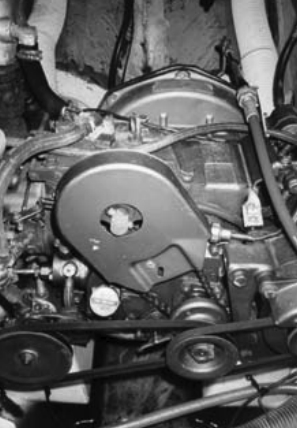
I spent the next three days on my knees in the cabin with my head in the engine compartment learning to bleed the engine. The consensus was that after all the work I had done on her fuel system, there was still air in there somewhere, or maybe I had a bad fuel pump. Don Casey says, in his book, something to the effect that the problem with gasoline engines is keeping the fuel in, and the problem with diesel engines is keeping the air out. One of my neighbors at the marina, who has a nicely rebuilt Ericson 28, and who had generously helped me with a few other problems, was now telling me about the virtues of gasoline power. As he spoke, a large pirate flag flapped behind him in the breeze from his mast. I heard that the Coast Guard had boarded him a few days before and stopped him from flying it while underway.
Pumping bilges
One slip further over, a recently launched wooden cabin cruiser had an emergency pump in her bilge and was now wired to the power mains. Every 30 minutes, she would shoot a stream of fresh water, enough to fill several bathtubs, out of her bilge with the force of a jet engine and lift again several inches on her lines. It was spring in the marina. We all had our problems.
After bleeding the system, I would let the engine run. It would run for 15 to maybe 30 minutes and then just quit. It would not restart until I bled it again. I would go through the process over and over, trying something a little different each time. Early on Saturday morning, on my way to the marina, I stopped at a marine store and read another book on the subject of bleeding.
I realized I had not been bleeding the complete system. I raced to the boat and tried a new method. By early afternoon, the engine had run for an hour before I shut her off. That was done. I felt another surge of pride at solving a difficult problem and fixing it myself. The rest of the weekend was spent happily tinkering, followed by a successful Sunday sail with my wife, friend Bruce, and his son.
I had her all nicely cleaned up and had rebuilt the manual bilge pump when it was time to move London to her summer mooring in Buzzard’s Bay. My friend Pete and I planned to sail out of Boston Harbor and turn south to cruise just off the coast past the old coastal towns of Cohasset, Scituate, and Plymouth to the entrance of the Cape Cod Canal. Once through the canal, we would go down Buzzard’s Bay, almost to New Bedford, where my summer mooring lay. It was a distance of about 80 nautical miles. We planned to take our time and enjoy the trip, spending two nights on the boat. Sailboats are required to motor through the canal. To make good time you want to hit the tide right, because the current averages 4 knots. We left early to catch that evening’s ebb tide at the canal entrance.
Changeable weather
We had a nice westerly breeze, maybe 20 knots, all day. It was a changeable day, with rainsqualls off Plymouth beach in the afternoon. London really showed her stuff. We seemed to be averaging better than six knots. This was the one thing that really surprised me about the boat: she could actually go faster than I had ever imagined. I had expected her stable, full-keeled shape to provide us with a comfortable, but somewhat stately, ride; instead we could often coax her into a brisk run.
The wind was with us until we rounded the Mary Ann Rocks off Manomet Point. We decided to power the last eight miles to the canal in order to make the tide and have daylight through its length. Not far from the canal entrance mark, the engine quit and would not restart. My heart sank. I had thought that was behind me. While we drifted, I bled it again. And again it ran. We went through the canal with Pete at the helm and me standing near the engine with my wrenches laid out on the bunk, ready to bleed her again at a moment’s notice. We were lucky; she ran fine right through the canal.
This is how it would go over the next few weeks. Most of the time the engine (now referred to as Old Reliable in the hope of flattering it into consistent performance) would rumble on, but at those moments when the most seemed to be at stake, it would cough, sputter, and stop with a rattle and a shake. I began to associate that last mechanical shudder with a sinking feeling in my stomach.
On my first solo sail in London, at the entrance to Wood’s Hole, just as I was standing at the mast lowering the mainsail for the passage through that ornery current, and just as I was thinking: “This would be a terrible place to lose power,” I noticed it had gotten very quiet. Looking at the rocks to my lee with resignation and a sigh, I quickly raised the main and tacked my way into a cove, dropped the anchor, and went down into the cabin to kneel before Old Reliable and bleed it again.
It quit again
With my friend Bruce, on a day when the small-craft warnings were up, and we were making that dogleg in the channel back to my mooring, right where it is the narrowest and shoal to either side, Old Reliable quit again. Bruce made the familiar rush to the bow to toss the anchor over, and I went below to relieve Old Reliable of that offensive air again. Bruce said, “You have got to get this fixed.”
So with new resolve, on a day Nancy and I spent on the boat at the mooring waiting for the wind to drop from gale force, as London tacked back and forth on her pendant, we tried something new with some tape and a bicycle pump. I disconnected the vent hose from the fuel tank and sealed the opening with duct tape. Then I attached a needle valve on the end of the pump hose and used it to pierce the duct tape covering the vent. While Nancy gently used the pump to pressurize the tank, I assumed my position in front of the engine. The air pressure forced the fuel into the system as I felt around the fuel lines and filter with clean paper towels looking for leaks. We figured if it leaks fuel when being pumped, it will leak air when the fuel pump is sucking under load. We found leaks around the fitting to the new fuel filter. The fittings and clamps were as tight as they could be, but the fuel was leaking out around the metal threads of the fittings. I removed all the threaded fittings from the filter, spread liquid rubber gasket on their threads, and screwed them back in nice and snug. I bled the engine again.
Old Reliable ran through the summer and fall without any further trouble, and as the summer progressed into fall, the mechanics of the boat finally settled into the background of my thinking. I was now focused on cruises along the southern New England coast, on what to eat, who to have aboard, and where to anchor during London’s first season afloat.
It is only now, as I write this with snow outside the window, and London again standing next to the garage, that I have begun to think about the next set of changes to the boat — but that’s another story.
Peter says he sails to avoid technology overload. A sailor most of his life, he was converted to cruising just 12 years ago. He sails London in the Buzzard’s Bay area.
Thank you to Sailrite Enterprises, Inc., for providing free access to back issues of Good Old Boat through intellectual property rights. Sailrite.com