Confused by jib nomenclature? A look at names past and present
Issue 17 : Mar/Apr 2001
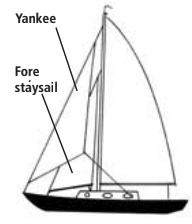
They come drifting out of the past like the ghosts of old friends: Yankee. Spitfire. Mule. Drifter. Like specters in a dream, they are frequently ill-defined and only vaguely recognizable. But we know them, or at least think we should know them.
If you’re in the market for a good old boat, you definitely should know the old-fashioned names of various headsails. Numbers too. As I found in my recent search for a keel/centerboard boat of 1960s vintage, modern boatbrokers, sailmakers, and even the sellers of the boats themselves often misuse the terms shown on listings of a boat’s sail inventory. I suspect the arrival of roller furlers is the chief reason for the old terms falling by the wayside.
In any case, with only a novice’s knowledge myself, I had to do some quick self-education in sail terminology. What I found were a lot of colorful terms and numbers for sails, the precise definitions of which are occasionally elusive even for sailmaking experts. Still, I was able to put together some useful rules of thumb and offer them here.
Jib names
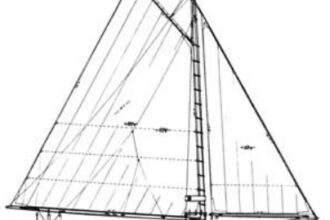
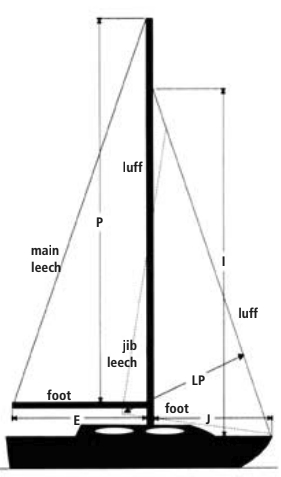
Originally, a jib was any triangular fore-and-aft sail set forward of a boat’s foremost mast. Jibs were usually hanked onto the forestay. Depending on their size and intended use, they developed various names as a quick means of identification. Sounds simple enough, doesn’t it? Well, as with many things nautical, the more terminology, the more chance for misunderstanding.
Over the last year, the two most misnamed jibs I’ve encountered were the Yankee and the spitfire. I saw them in listings all the time, but everyone seemed to have a different definition. After consulting such published sailmaking and terminology-defining legends as Lenfesty, Ross, Ulmer, and some others, I found a 19th-century Yankee was originally considered a small sail for racing in rough weather only. It was set high on the forestay and more properly called a Yankee jib topsail. But eventually, the term Yankee became a standard name for other heavy-weather headsails.
In the 20th century, a Yankee was sometimes numbered to help indicate its size and use. Or it was paired with another name, like Yankee staysail, again to indicate its size and use. Roughly speaking, then, a Yankee jib can occupy from 75 percent to 100 percent of the foretriangle formed by the forestay, mast, and deck.
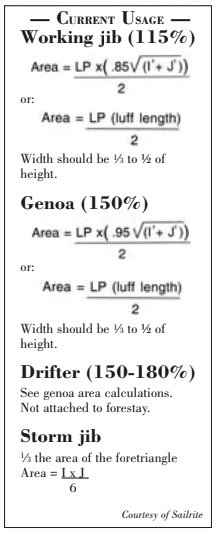
The spitfire, however, is better defined. It’s a storm headsail cut from very heavy material and limited to about 35 percent of the foretriangle. It is distinct from the more common terminology of a storm jib, which may be of slightly lighter material than a spitfire and cover up to 60 percent of the foretriangle. A mule is another term for a sail the approximate size and use of a storm jib.
Jibs greater than 100 percent of the foretriangle have acquired a broad range of names, some well-defined and others less so. The lapper has been a popular name for a lightweight jib which is approximately 120 percent the size of the foretriangle. As the name suggests, this sail overlaps the main mast.
But a lapper is often confused with a genoa, which was first developed in 1927 by a Swedish sailor for a race in Genoa, Italy. These days, a genoa (also known as a “genny”) is often used interchangeably with the word jib. The British are particularly fond of calling nearly any jib a genny. But as a rule of thumb, a genoa is most often a larger headsail of lightweight material covering 130 percent or more of the foretriangle. Sailmakers frequently discuss genoas in terms of the placement of the clew, whether it’s high or low. But in listings of older boats, genoas are most often just a larger headsail.
Drifters are similar to genoas except they are not hanked on the forestay and the material often is as light as a spinnaker’s. Technically, this removes it from the narrow definition of a true jib. Sometimes this sail is referred to as a gollywobbler, a ghoster, or a reacher. If the clew of these larger sails is cut low, the boat’s listing may call it a decksweeper. Other names include blooper, big boy, and wind-finder.
Jib numbers
When jib names began to go out of fashion in the mid-20th century, jibs were then (and often still are) referred to by numbers. In brokerage listings and among many older skippers, they are frequently called, simply, the Number 1, Number 2, Number 3, or Number 4 jib. The British will often use those numbers and substitute the word genny or genoa for jib. In any case, although many brokers and even some owners get it backward, the rule of thumb is: the smaller the jib number, the bigger the jib.
Like most of the jib names, the numbers are reasonably well defined but rarely absolute. For instance, a Number 1 jib (or a Number 1 genoa) is about 150 percent or more of the foretriangle. Alternately, its size may be a percentage worked out using outdated offshore racing rules. Since most older boats are no longer suitable for offshore racing, it’s best just to remember that a Number 1 is usually made of light material; it’s big and best for light-air situations.
The Number 2 and Number 3 jibs are smaller than Number 1 and usually fall somewhere between the size of the lapper jib and working jib, with progressively heavier cloth in each of them. Their size is either a percentage of the foretriangle or a percentage of the Number 1 genoa. Sailmakers often differ on the way these sails should overlap the mast, with some insisting on their being decksweepers and others opting for a high clew. In any case, no one definition fits all, so it’s best just to remember that low-numbered sails will vary in their cut and uses. You may be able to contact the sailmaker and discuss the exact reasoning and formulae behind the cut of a sail.
The Number 4 jib, however, is always a heavy-weather sail and rarely occupies much more than 75 percent of the foretriangle. The cloth is thick, heavily stitched and copiously reinforced. It’s rare to see a Number 5 jib listed in a sail inventory. But if one is, it’s likely to be of a size similar to the spitfire.
Jib miscellany
Of course, jibs are subject to myriad modifications. For instance, a Number 1 jib could be made of considerably heavier material and, with reef points sewn in it, can be used in a greater variety of conditions. There are also club-footed jibs on many older boats. This simply means the jib has a small boom attached to its clew and there is only one jib sheet to tend. This makes tacking a lot less work. Obviously, a club-footed jib must be smaller than the foretriangle, usually around 90 percent.
The cut of a jib’s components may vary. Panels for headsails have been sewn horizontally, vertically, diagonally, on the miter, and bi-radially. Sailmakers can discuss the pros and cons of these technicalities for hours. Still, when buying or sailing on an older boat, it’s always best to discuss first with the boat’s owner the exact nature and use of each jib included in the boat’s inventory. Then you can be assured you’ll get the most out of sailing with your jibs, either by their names or their numbers.
Ken has lived and worked aboard boats for 24 years. He is a contributor to many sailing magazines and recently bought an Allied Seabreeze which he is restoring.
Thank you to Sailrite Enterprises, Inc., for providing free access to back issues of Good Old Boat through intellectual property rights. Sailrite.com