Fixing his boat in exotic places and exploring distant locales appeals so much, he does it twice
Issue 18: May/June 2001
AS A CHILD WATCHING SAILBOATS glide across the flat waters of Michigan’s Lake St. Clair, I used to imagine they were all bound for distant adventures. Looking back, it seems I’d always dreamed of a sailing voyage that would take me beyond the confined waters of the Great Lakes to explore the open seas, particularly to the fabled islands of the South Pacific. These thoughts recurred as I spent my teenage years finishing school and then moving into my own apartment and earning a living. I nearly married and settled down at one point. Then, at the age of 21, an impulsive decision brought my dormant dream within reach when I spent my entire savings buying a used 28-foot Pearson Triton from a Detroit yacht broker.
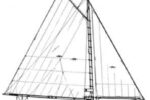
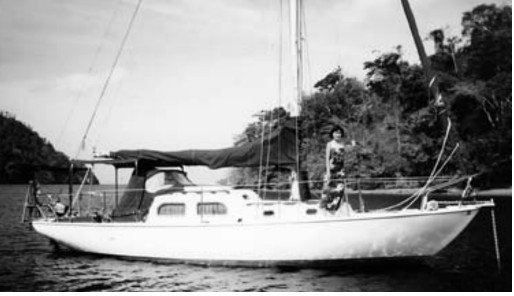
I knew little about boats when I bought this 13-year-old 1966 Triton. Fortunately, my broker gave me sound advice when he recommended this as the best boat available in my price range. Some 700 of these Carl Alberg- designed boats were built by the Pearson cousins in Rhode Island between 1959 and 1967, and many are still sailing. Although my broker rightfully viewed this minimally equipped boat as a coastal cruiser, I admired her long keel, low profile, and handsome lines. Instinctively, I knew she was the boat to take me across oceans. Obviously, she would need more equipment and a few structural modifications, but exactly what would be required to make her into my ideal boat would remain a mystery until I gained more sailing experience.
My sailor’s apprenticeship began two years later when I quit my factory job in Detroit and convinced two friends that the best way to avoid the coming Michigan winter was to join me on a voyage to the Caribbean. That September we set out for the Atlantic by sailing through lakes Erie and Ontario and motoring down the barge canal to the Hudson River and New York City. We reached Florida by a series of short offshore passages and longer detours inland through the Intracoastal Waterway. In the waterway we practiced running aground and (unknowingly) annoyed impatient bridge operators and road traffic by trying to pass through under sail. Offshore, I nervously plotted our course and speed each hour and made wildly inaccurate first attempts at celestial navigation. Despite some further misadventures, we enjoyed an idyllic winter cruising among the low sandy islands and shallow gin-clear waters of the Bahamas. After making a crew change, we sailed through the Caribbean as far as Trinidad before running low on funds and turning back to Florida.
Strengthened resolve
That first voyage introduced me to a cruising life that suited me perfectly and strengthened my resolve for the ultimate adventure — to sail alone around the world. I renamed my little big-hearted boat Atom, in honor of Jean Gau who, decades earlier, made two solo circumnavigations in his 29-foot Tahiti ketch named Atom. After working as yacht delivery crew and training as a marine service engineer for one year at a boatyard in Ft. Lauderdale, Fla., I prepared for my upcoming voyage by undertaking the first of several refits. To free me from the drudgery of the tiller, I installed a new Aries windvane self-steering gear. I beefed up the original 7/8ths mast rigging by adding a set of forward lower shrouds, upper shrouds, a masthead forestay, a second backstay, and a pair of running backstays. By leaving the original fractional rigging in place I gained the security of redundancy at the expense of some windward efficiency.
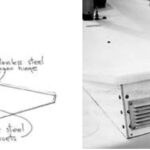
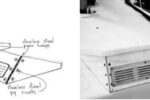
A weak point on the Triton is the light overhead beam supporting the deck-stepped mast. When I noticed a small crack in the beam and the cabintop beginning to deflect downward, I reinforced it from underneath by bolting a stainless steel U-channel frame around the original wooden beam and supporting bulkheads.
When the boat was as ready as my youthful impatience and limited funds allowed, I found I had only $500 left. Yet I refused to consider delaying the voyage for another year or two. There is a certain wisdom to reckless youth. After all, if lack of money stopped me this year, then other insecurities could just as easily keep stopping me until my exploring instinct faded into a life of vague regrets. With an undiscovered world before me, I set out alone from Miami in June of 1984 and threaded my way nonstop for 15 days through the islands of the Caribbean to Panama.
In all but the lightest of winds, the self-steering gear held Atom on her course, giving me the freedom to take short naps, prepare meals, and navigate by sextant. To find some kind of harmony with the creatures who would be my sole companions, I stopped fishing and became vegetarian. After locking through the Panama Canal, I entered the 10,000-mile-wide Pacific Ocean. For six months I explored among the stunningly beautiful islands of Polynesia, Tonga, and the Solomon Islands.
Anchor lines parted
During this two-year voyage, I visited 10 islands. At each I left Atom moored securely to two or three anchors while I went out with a backpack for days or weeks to walk across the island and climb its highest peaks. Always I returned to find her unmolested, though sometimes one of the anchor lines had parted from chafing on coral. At that time I used only a short length of chain next to the anchors because I lacked a windlass to handle an all-chain rode. On the little island of Tikopia I was delighted to find one of the last remaining outposts where native Pacific island culture was bravely resisting the onslaught of Western technology. Several times I was tempted to settle down among the welcoming people of these happy isles, but the dream of completing the voyage and the adventures just ahead over the western horizon always lured me on.
While awaiting the end of the Indian Ocean’s typhoon season in New Guinea, I spent three months walking alone through the island’s forbidding rain forest. Staying in thatched huts in remote mountain villages, I learned how to live as a primitive man — narrowly escaping death from recurring malaria, getting caught between warring tribes, and once falling 50 feet down a hidden shaft in an abandoned gold mine. A village chief who befriended me in the Highlands — an ex-cannibal who had four wives himself — tried to convince me to stay by offering me two of his daughters in marriage. This was a bargain, since daughters as fine as his were usually commanding a “bride price” of 100 pigs each. New Guinea was pure Adventure Country. I loved it, but knew I had to leave before it killed me.
Sailed nonstop
From the smothering rain forests of New Guinea, Atom and I sailed nonstop for 30 days through the wreck-littered Torres Strait and past the long, empty, northern coast of Australia to the open waters of the Indian Ocean. The trade winds blow at their strongest here, often at gale force for several days at a time. We made fast passages between the islands, running with deeply reefed sails at average speeds of 130 miles a day.
Although the islands of the South Indian Ocean are less numerous than those of the Pacific, they are no less exotic. I was again lured away from the sea to walk across Mauritius and the French territory of Reunion Island. With its active volcano, knife-edged mountains rising 10,000 feet above the sea, and uncountable waterfalls pouring into lush hidden valleys where small communities live in complete indifference to the mad goings-on of the outside world, Reunion Island qualifies as the nearest thing to paradise on this earth. Perhaps my view of the island is biased, as I remember the girl there who waved goodbye from the shore when Atom sailed reluctantly out of the bay.
The only illness I suffered at sea on this voyage occurred after I departed Reunion for Durban, South Africa. Somewhere south of Madagascar, in a region known for frequent gales and unsteady winds, I became incapacitated from a relapse of malaria. As I lay in my bunk for three days in a lonely, helpless fever, Atom dutifully looked after herself, and somehow covered 200 miles through disturbed seas in the general direction of Durban.
Increasing deck leaks forced me to take drastic action during my two-month layover in Durban. Many Tritons suffer from waterlogged balsa-cored decks. I removed every deck fitting and cut off the deck’s upper fiberglass layer. I removed bucketsful of stinking balsa mush, refilled and leveled the deck, and reinstalled the hardware. It was a miserable job I had been putting off for a long time. Having an absolutely dry boat inside made it worthwhile.
Off the aptly named Wild Coast of South Africa, I met the first serious storm of my sailing career. As the southwester blew up some impressive seas, I turned and ran directly downwind under a bar-tight storm jib sheeted amidships. While dropping headlong down one of these slab-sided waves, the strain from the windvane steering lines snapped the wooden tiller. Atom instantly broached, roughly plunging her lee spreader into the sea. I remember a loud snap signaling a broken intermediate shroud. But thankfully, due to the extra rigging I had installed, the mast stayed in place. As Atom rolled wildly while being hammered by the beam seas, I bolted on the emergency tiller. Ironically, days later we were carried gently past the rocky buttress of the Cape of Good Hope by a favorable current in a flat calm on a brilliant sunny day.
Only two stops
From Cape Town back to Florida, I enjoyed the life alone at sea so much I visited land only twice, stopping briefly at St. Helena Island and Martinique. For navigation, I usually fixed my position with three star sights during evening or morning twilight. The night sky of the Southern Hemisphere had become a familiar field of fiery beacons and signposts. At night in the South Atlantic, I could even maintain my course from my bunk by keeping the frosty streak of Halley’s Comet lined up in view through the open hatch.
As exhausting and frightening as it was at times, I now remember the easy days far outnumbering the bad. The personal rewards of the voyage were incalculable, and I never for a moment regretted my decision to go. Those two years as a vagabond sailor created an unbreakable bond between Atom and me and ended any chance that I could remain satisfied with the normal life of a land dweller. Within a year I would set out again, this time on a voyage alone to China and what would become a 12-year-long second circumnavigation.
Second time around
Back in Ft. Lauderdale in 1987, I began my second major overhaul of Atom’s vital components. To reduce the risk of collision with floating objects, I installed a watertight collision bulkhead in the bow section under the V-berth. Atom’s original worm-eaten mahogany rudder was replaced with a piece of 1 1⁄2-inch tapered plywood sheathed in fiberglass. Then, after several months drying out on her trailer in a Ft. Lauderdale boatyard, I sealed the hull below the waterline with two coats of epoxy barrier coat.
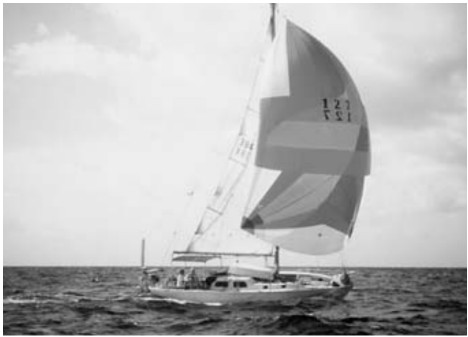
For years I had been continuously repairing my Atomic 4 gasoline inboard motor. It had been such a beast to maintain that I decided to remove it entirely and sail engineless. I also felt that I was ready to tackle this sport on a higher level. Sailing alone and engineless seemed the best way to discover my limits. By crossing the Pacific and cruising extensively for five years in southeast Asia without an engine, I proved to myself that it was entirely practical. All that’s required are a boat like the Triton that sails well in light air, a sculling oar, and an uncommon degree of forethought and patience.
Borrowed motor
To transit the Panama Canal I borrowed an outboard motor, but barely used it as we took advantage of a brisk following wind to complete the majority of the passage at 6 knots under spinnaker. When I arrived in Hong Kong I found I was unable to get a permit to make a river journey into mainland China as I had originally planned. I did manage to navigate the shoals of Chinese bureaucracy and cruise the mainland coast, however, by leaving Atom on a mooring in Hong Kong and signing on as first mate on a three-masted Chinese junk for the British-sponsored Marco Polo Expedition. Between delivery jobs and cruises around Asia on Atom, I stopped to work for two years as production manager for Hans Christian Yachts in Taiwan and Thailand.
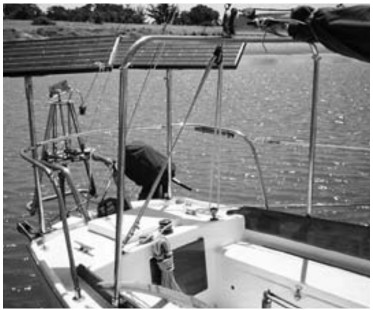
Supervising the construction of these well-designed cruisers gave me new insight into boatbuilding techniques as well as the funds necessary to continue making improvements to my own boat. When I made my final departure from Hong Kong, Atom was fitted out with all-new teak exterior trim, an improved Chinese sculling oar, three stainless steel anchors, a new dodger and Bimini, and a hefty bronze anchor windlass, among other things.
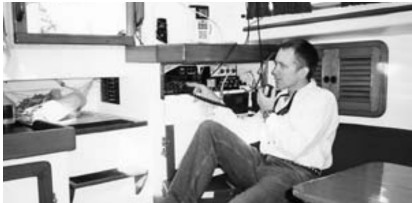
I upgraded my self-steering with a new Monitor windvane. The Monitor’s size may be overkill for a 28-foot boat, but its performance has been exceptionally good, even in light air where the Aries vane had struggled to find its way. I also opted to rejoin the modern world by adding GPS, an HF-SSB transceiver, and a 3-hp outboard motor that hung on an adjustable stern bracket.
For another two years I traveled through the best cruising grounds imaginable among the hundreds of islands in the central Philippines. My days of singlehanding came to an end on Leyte Island when I met an island princess. Marjorie Lacaba was a fisher- man’s daughter with the innocence and courage to join this mad foreigner on a small boat headed for Africa. We sailed together for the next three years through the Philippines, Indonesia, and across the Indian Ocean to Madagascar and South Africa.
Another refit
In South Africa it was time to give Atom another thorough refit. I discarded her mast, due to excessive corrosion between the aluminum and the bolted-on bronze sail track, and replaced it with a new anodized aluminum mast with a molded slot for sail slugs. My new masthead rig was two feet shorter than the original fractional rig. I now added a Harken jib furling system but kept two of my working jibs and a storm jib to use on an inner forestay if the furling ever became inoperable. To give extra support to the mast, the inner forestay normally attaches to a heavily reinforced pad eye halfway between the mast and the stem, where it does not interfere with tacking the jib. If I ever need to hang a sail on it, there is a wire eye strap near the bow that it can connect to.
To support the inner forestay, I installed intermediate aft lower shrouds that can be set up like running back- stays but which I usually keep attached to chainplates just aft of the lower shrouds. These sort of semi-permanent running backstays have a plastic sleeve on them to prevent chafe on the mainsail. They not only act as support for the inner forestay but also will provide a degree of redundancy if my backstay or a shroud should ever break.
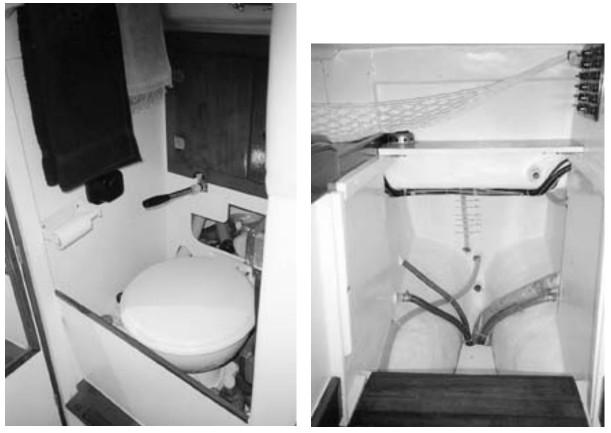
Down below, I modified most of the lower storage lockers into watertight compartments by adding sealed partitions and gasketed access hatches. I’ve added enough of these sealed compartments that I’m confident you could knock a hole in Atom anywhere below the waterline, and she would remain afloat. Even the Lavac toilet was placed behind a watertight bulkhead to prevent any of its plumbing fittings from flooding the boat.
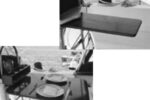
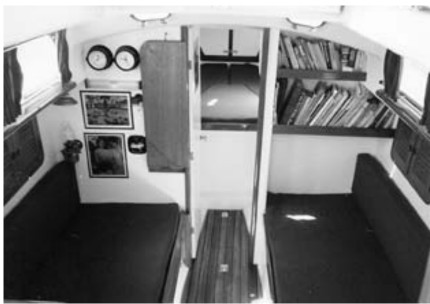
My Triton came with a plywood cabin sole covered by a thin veneer of teak. Over the years the teak had become worn and chipped until it looked so hideous I covered it with a piece of outdoor carpeting. While rebuilding the interior, I resurfaced the plywood sole with 2-inch-wide strips of African iroko separated by lines of black Sikaflex. I converted the area below the V-berth, where the original 23-gallon fiberglass water tank was located, into a 43- gallon integral water tank whose bottom was the hull of the boat itself. Another 30-gallon integral tank was installed in the otherwise useless space between the cockpit floor, the cockpit side lockers and the hull.
I fit the two deck scuppers with valves that allow me to divert rainwater collected on deck to a hose below deck that I insert into the water tank or use to fill jerry jugs.
In South Africa I replaced my single 12-volt battery with four 6-volt golf cart batteries wired into a single 12-volt bank of over 400 amp-hours capacity. To recharge them I use two solar panels, each rated at 43-watts output. With a good charging system and massive battery storage capacity, I chucked my portable gasoline generator and replaced it with an 800-watt inverter. Even with all this electrical capacity, I replaced all my power-hungry incandescent lights with fluorescent or halogen.
Atom was now in better shape than she had ever been since her birth 33 years ago. This was fortunate because she would soon be tested to the limits in her second passage around South Africa. After our first year in South Africa, my companion of three years decided she would not spend one more cold, dreary winter living in a boat that was being rapidly torn to pieces and slowly rebuilt. It was sad, but understandable, when she boarded the plane with a one-way ticket to her home island in the Pacific.
As replacement crew I took on Alex, a young French traveler who admitted to having no sailing experience. This I considered an advantage, as the coming discomforts of sailing a small boat around the Cape of Good Hope are best left to an innocent’s imagination. His only other qualification was that he’d been in the elite French commando marines, so I guessed he could handle whatever hardships might come his way.
Port to port
On my first rounding of the Cape 12 years earlier, I sailed nonstop from Durban to Cape Town in 10 days. To make it more interesting and (I thought) easier, this time around I took the standard strategy of running from port to port between favorable weather forecasts. Unfortunately, due to either El Niño, or just God’s will, that year the South African coast was plagued by an unending succession of westerly gales. With the rest of the international cruising fleet, we crawled and beat our way from port to port through one cold front after another.
Upon rounding Cape Agulhas, the southernmost tip of Africa, Alex and I were congratulating ourselves on our clever timing when out of nowhere came a southeasterly storm, locally called a Black Southeaster. In Cape Town, the wind-weary locals hardly notice the average 40-knot gale, which they refer to affectionately as the Cape Doctor. But even the rugged Cape Towners furl their umbrellas and curse the dreaded Black Southeaster. For two days we ran off, hove to, and even tried to run for shelter at one of the fishing harbors in False Bay.
By deciding to go into False Bay I had weighed up the sailor’s classic dilemma of choosing between seeking safe harbor in a storm or staying offshore with plenty of sea room. My decision to attempt making port was partly influenced by my crew. Alex may have been the only marine commando never to find his sea legs. During the height of the storm, he retreated to his bunk, drenched from the icy waters that had gone right through his faulty foul-weather gear, teeth chattering like Spanish castanets, and heaving his guts out into a bucket.
First encounter
Because katabatic winds coming off the mountains increased the closer we worked our way in toward port, I decided to exit False Bay and take our chances offshore. This was also my first encounter with hurricane-force winds, and I was surprised to find most of my well-planned storm tactics were totally unworkable once the wind had laid us over flat and breaking seas were sweeping the decks. Going forward to hoist the storm jib on the mostly submerged foredeck was impossible and, besides, I realized my storm jib was ridiculously large for winds gusting more than 80 knots. Because of a lack of sea room, I couldn’t deploy the sea anchor. My parachute-type sea anchor needs a minimum scope of 600 feet of line to be effective, and once clear of the coast there was too much shipping in the area to sit there as an unmaneuverable 600-foot-long target. I was thankful that at least my cockpit lockers were now individual watertight compartments because the lee side of the cockpit was constantly awash.
We eventually managed to hoist the tiny 12-square-foot storm trysail which, along with a tiny corner of unfurled jib, allowed us to claw our way offshore, saving us from being dashed to pieces against the cliffs of Cape Point. Early the next morning we weathered the surf- beaten cliffs of the Cape Peninsula by a narrow mile and turned downwind to round the bony finger of the Cape of Good Hope under bare poles. Atom stood up remarkably well to this storm, the only damage being some chafed lines and repairable cracks in the deck-stowed kayak. Even Alex’s wounded pride recovered when I congratulated him on surviving the worst storm he was ever likely to see. Surprisingly, he agreed to continue on with me to Brazil.
Dream crossing
As if compensating for the severe beating, we crossed the South Atlantic with hardly any effort. Day after pleasant day, Atom rode the waves with sails spread like giant butterfly wings before the gentle southeast trade winds. In Brazil I made use of dry-out legs fabricated out of stainless steel pipes to dry the boat standing upright between tides. I left Alex in the care of four lovely barmaids at a riverside disco on Brazil’s northeast coast and continued on to the Caribbean. I not only lost my crew in Brazil, but I also lost my outboard motor to an envious fisherman who figured he needed it more than I did — which may have been true, after all.
After 20 years of cruising the world’s oceans, my 35-year-old Triton is in every way a better boat than new. I’ve never thought of replacing her with another boat. And why would I, now that she is everything I need in a boat? Over the years, Atom has evolved into a self- sufficient and capable cruising boat that has brought me through numerous adventures — with more to come.
James has been published in many popular sailing magazines. Some of his other articles can be down-loaded at www.mightywords.com. Contact him at: yachtatom@hotmail.com.
Thank you to Sailrite Enterprises, Inc., for providing free access to back issues of Good Old Boat through intellectual property rights. Sailrite.com