Did Norse seafarers build a pleasure yacht 1,200 years ago?
Issue 20 : Sept/Oct 2001
Many double-ended boats are descended directly from the Viking longship. The best preserved of these ships are not the warships or the ocean-crossing freighters celebrated in movies and historical novels, but sheltered-water boats used for the same pleasant, but pedestrian, purposes as our own boats.
It’s often said that western sailing vessels evolved from the dugout canoe. Others argue convincingly that the clinker-built (lapstrake) double-ended Norse longboat evolved from vessels made of skin stretched over a framework of wooden ribs and stringers. Whatever the origin, boats made with wooden strakes made their appearance in Northern Europe well before the Bronze Age. As the boats grew in size, paddles were replaced by oars, and steering oars at bow and stern were replaced by a single rudder controlled by a tiller.
Starting with a broad plank on the bottom of the boat, the development of the keel was the most troublesome aspect of the evolution, and the keel did not gain its modern form until just before the beginning of the Viking Age, usually dated from AD 793. The last stage in the evolution of the longship was the adoption of sails. Even as the Viking longship grew larger and was used to sail across the oceans, in design it remained basically a rowing vessel.
Ship burials
Seafaring Germanic people sometimes interred their kings and great men in ships. Many of these burials are known, and some have been excavated. The earliest significant burial of this type was excavated at Sutton Hoo, in East Anglia, England. The excavation revealed a clinker-planked open ship constructed well before AD 650. Although its hull is very similar to the two longships discussed in this article, it was unlike them in that it had no provision for sails, all of its fastenings were of metal, and its keel had not yet reached the final form found in ships built two centuries later.
Near the turn of the 20th century, two longships in a remarkable state of preservation were discovered in burial mounds on the western shore of Oslo Fjord, in Norway. One, excavated at Oseberg farm, was constructed about AD 800. The other, excavated at Gokstad farm a few miles away, was constructed about the year 900. The honored dead in the Oseberg vessel was a woman of high rank, accompanied by her sacrificed maid. Both vessels were in active service for some 50 years before being converted into sepulchers. They were built exclusively of oak, except for fastenings.
Construction details
The keel has a cross section like a parenthesis mark, extending 10 to 12 inches below the garboards. In the Gokstad boat, the keel is a single piece of straight-grained oak 67 feet 7-inches long; in the Oseberg boat, the keel is 64 feet 4 inches long, formed of two pieces of oak scarfed and riveted 13 feet from the after end. The sharply recurved stem and stern posts are strongly riveted and nailed to the keel. A decorative figure fashioned in wood is lightly fastened atop each post. Post heads have no technical function, but some are most elaborately carved and must have cost the owner dearly. The Oseberg figures are quite detailed and represent the head and tail of a serpent; the Gokstad post heads are plain.
Each keel is almost imperceptibly rockered, with the mid-point about one foot lower than the ends. The garboard on each side is strongly riveted to the underside of the keel’s arms. The strakes are laid on clinker fashion, with the upper strake overlapping the lower strake and fastened rigidly to it with iron rivets placed every few inches. The top of each strake is grooved for caulking yarn made of tarred animal fibers, usually wool. None of the strakes stretch in one piece from stem to stern, but instead are extended by scarfed, riveted, and caulked joints. No backing plates are used at these joints. The ends of the garboards and other strakes are fastened by rivets and nails into rabbets in the stem and stern posts.
The bottom consists of nine strakes, including the garboard. The 10th strake, at the waterline, is much heavier than both bottom and top strakes and does double duty as a stringer. Holes for oars are pierced in the 12th strake in both boats. The Oseberg boat has no more strakes, resulting in a freeboard of about two feet amidships. The Gokstad boat has two more strakes above the waterline, yielding a freeboard of 3 feet 7 inches at the mid-line.
Except at the very ends, where they sweep up steeply into rabbets in the stem and stern posts, the strakes lie parallel to the waterline. This is because Viking longboats of all types, even the latest, largest, and most developed are, first and foremost, rowing boats. The strakes are as thin as possible consistent with the necessary strength. The point cannot be overemphasized, since the seaworthiness of the open Norse longboat is due in large part to lightness.
Although for other parts the Scandinavian shipwrights used both ordinary and rabbet planes, the strakes were shaped with a broad ax. A tree of suitable size and grain was felled and split, and one plank hewn from each half. A projecting pad or cleat had to be left every 39 inches on the inside of each plank. The workmanship is beyond admiration.
Although the Viking longship is an open vessel, it was decked at the waterline by planks laid fore-and-aft over the entire vessel, resting upon shelves cut in the beams. In the Oseberg vessel these deck planks were permanently nailed to the beams, except for two or three left unfastened so that bailers could be inserted into the bilges. In the Gokstad boat all the deck planks were unfastened, so cargo could be stored below.
As in all earlier and smaller vessels, there are no provisions for the seating of the oarsmen, yet the placement of the oar holes is such as to force them to be seated. Although it is possible they were seated directly on the floorboards, a more reasonable suggestion is that the oarsmen seated themselves upon their own sea chests.

Ribs
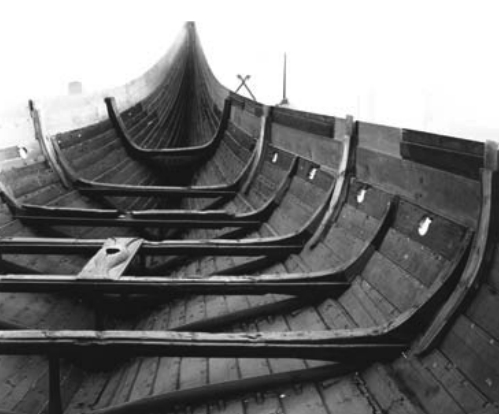
The most unusual construction feature is that of the ribs. In the Oseberg boat, there are 15 ribs placed at 39-inch intervals, with rib number 8 at the mid-point and widest part of the hull. The interval between ribs is the same in all Norse longboats of whatever size, type, or age and represents the minimum distance needed to give the oarsmen sufficient working room. In the Gokstad vessel there is a 16th rib.
Each rib is a single natural-grown piece of oak of modest width and thickness extending thwartship from one waterline strake (the gunnel) to the other. It is firmly fastened to both by iron rivets and nails. An unarched beam stretching from rail to rail lies on the top of each rib, to which it is nailed and riveted. An elbow riveted to both rib and beam extends the line of each rib end vertically, and the top strakes (10 to 14) are fastened to it with iron rivets. The ribs were placed in the hull after it was completely planked up to the gunnel. The ribs did not give form to the hull but rather followed and reinforced a form already perfect. The planking was almost certainly laid around temporary molds just as is the modern practice.
Viking ships were built of oak framing strongly fastened by iron rivets and nails at all points — except only the fastening of the ribs below the waterline. Remarkably, the ribs were not fastened in any way at the keel, but merely laid over it. The ribs were riveted to garboard and gunnel, but to all other bottom strakes (numbers 2 to 9) the ribs were fastened only by ties of whalebone, spruce rootlets, or bast, a flexible fibrous bark.
One theory about this peculiar fastening practice is that Norse shipwrights were conservative and were just building the hulls in the same way their remote ancestors fastened hides to ribs in the primitive coracles from which the longboat evolved. In view of the plenitude of the iron found all over the boat at every other point, including many at which the ribs are fastened to other parts of the structure, I don’t think this theory stands up, and it deserves to be buried along with the boats. A more popular theory is that these fiber ties were used to permit the hull to flex in a seaway and thus preserve it. A rigid hull of such light construction would be broken by the stresses.
In 1893, an exact replica of the Gokstad ship was sailed from Norway to New York, under Captain Magnus Andersen. The entire trip was under sail, the oars not being used even when entering the North River in New York City. At times the ship attained speeds in excess of 10 knots. Captain Andersen reported that in heavy seas the ship twisted and wracked continuously with parts of the bottom distorting as much as 12 inches out of the normal line. This seems to support one of the traditional arguments for the rib tying, but in my view this flexing is the consequence of the very light construction of the hull, with its complete absence of strong fore and aft members other than the keel and the gunnel. If the ribs had been grappled to the strakes with iron bands, I believe the hull would have flexed just as much.
Had these very thin strakes been fastened to ribs by rivets, I think an inevitable consequence of constant flexing would have been an enlargement of the rivet holes, and the strakes would have been weakened more and more by this erosion and eventually would fail. But softer fibers holding hard oak strakes would themselves bear the burden of the constant friction and the strakes would be preserved — for 50 years in our examples. The strakes proper never actually touched the ribs at the points of fastening, as the ribs bore on the raised cleats or pads left on the strakes when they were cut. Each tie was made through a hole bored in this cleat and two holes bored in the rib. This made it feasible for the fiber ties to be renewed easily at sea, one at a time, as they wore out. My guess is that fiber ties were used because the ship was flexible, not to create the flexibility.
The Oseberg find
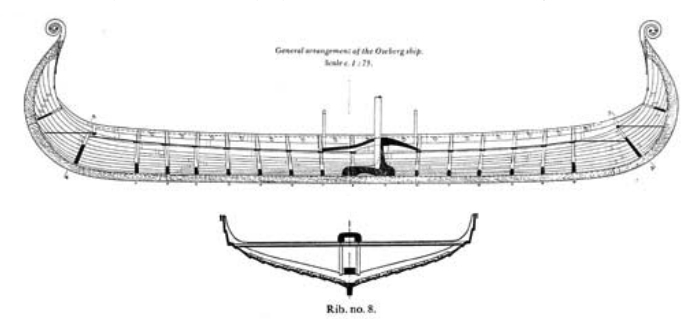
The illustration below shows the profile and mid-section of the Oseberg boat. Each rail describes a perfect circular arc. The radius of the circle is equal to the extreme distance from the inside of the stem post to the inside of the stern post. The identical feature is found in the Gokstad boat and in the drawings of other longships. Although this circularity is not mentioned in references, surely it must have some intended and important functional purpose.
The rudder
Before the opening of the Viking Age, the steering sweep or oar had been replaced by a rudder hung on the starboard rail as far aft as possible while still leaving footroom for the helmsman. The tiller extended into the boat at right angles to the rudder. The rudder was very narrow, with an aspect ratio as high as in any modern racing sailboat. It extended deep into the sea, several feet below the keel.
By means of a small block of wood and what can only be described as a ball joint ingeniously fashioned of rope, the rudder was held firmly in a vertical position, yet could be retracted for repair, swiveled up when the boat was beached, and easily turned by the small transverse tiller. On his transatlantic voyage in the Gokstad replica, Captain Andersen found the rudder to be easily controlled and as effective and efficient as any of modern design.
“Rooms”
Just as battleships in the days of cannon and sail were rated by the number of guns each carried, so the Viking vessels were rated by the number of “rooms” enclosed by the rib-and-beam structure. Thus the Oseberg ship is a 15-roomer and the Gokstad ship is a 16-roomer. For short excursions there were probably only two oarsmen in each room (one man for each oar) plus a small afterguard. A full crew for warships and overseas freighters included two to three oarsmen in each half-room (thus providing frequent relief at the oars), the commander, one or two steersmen, and specialists such as a cook, bosun, smith, or shipwright. Warships added as many additional warriors as could be crammed in. One of the 35-room monsters built during the dynastic wars that closed the Viking Era might have had a full combat complement of more than 300 men.
Uses and types
During the almost constant internecine warfare and in the rebellions against the Viking kings, longships were used to fight for control of coastal waters in Scandinavia. But these battles were fought exclusively in the sheltered waters of fjords and in the lee of the many islands along the coast. The romantic “Dragonships” specifically designed for these battles proved entirely useless for service in open water. For the galleys of the Mediterranean Sea, ramming was an important tactic in sea battles. In the lightly built ships of the northern seas, ramming was not a choice; it might have been as destructive to the attacker as to the attacked. Instead, the battles were preceded by maneuvering under oars to bring two cooperating warships alongside a single enemy so it could be overwhelmed by boarding. To provide the greatest number of warriors for these hand-to-hand fights, the warships were crammed with six or more crew per half-room.
The invasions of Britain by the Saxons, Angles, Frisians, and other North Germans in the 6th and 7th centuries, of Britain and Western Europe by Danes and Norwegians in the 9th, 10th, and 11th centuries, and the overseas voyages to the Orkneys, the Faroes, Iceland, Greenland, and Vinland, were not conducted by warships festooned with shields hung overboard to impress and cow the enemy. Sea battles preliminary to landing were neither anticipated nor fought.
The invasions and transatlantic voyages were conducted by freighters lacking such romantic aspects but having the capacity and seakeeping qualities that the stereotyped Viking ship lacked. They gained these qualities from heavier scantlings, greater depth, higher freeboard, a little more beam, and a commitment in design and gear to use as sailing vessels. Internal ballast was apparently never used, but it must be remembered that a freighter of 15 rooms would have more than two tons of human ballast to shift from rail to rail when the ship needed stiffening.
The Oseberg and Gokstad ships were neither fighters nor freighters. One authority writes that “The Oseberg ship also has the characteristics of a pleasure vessel for use in good weather on closed waters.” It is the Viking equivalent of a modern daysailer. The same writer notes that the Gokstad ship, of heavier build and a little larger than the other boat and far better adapted to sailing, “bears the characteristics of a practical utility vessel” for coastal waters but not for the open ocean.
The Oseberg vessel is a millpond rowboat with sailing gear added as an afterthought. The mast was thin and unstayed, held in place by inadequate mast partners which had cracked in use and been repaired by iron bands. The Gokstad vessel is a working boat intended to sail, with a much heftier mast supported by massive partners. It was not stayed forward or thwartship, but the halyard was cleated at the stern and served as a backstay. There is almost no reliable information about mast heights or sail areas for Viking ships. In combat, warships maneuvered only by oars; and sailing gear and qualities were accordingly neglected. Freighters, with small crews and compromised in favor of carrying capacity, were sailed whenever possible and probably had more elaborate gear than the surviving artifacts demonstrate.
Robert (Will) Brigham first sailed on the Ohio River in a Comet at age 12. He’s been nuts about sailing ever since. He has sailed his O’Day Day Sailer on lakes from New York to Ohio and Kentucky and crewed on other boats whenever he got the chance. He lives in the “Great Hoosier Desert” and dreams of circumnavigating the eastern half of North America.
An unrelated Gokstad replica (half-size) is being built and launched in British Columbia.
Thank you to Sailrite Enterprises, Inc., for providing free access to back issues of Good Old Boat through intellectual property rights. Sailrite.com