A cruising chef shares sound advice and delicious recipes for sailors
Issue 21 : Nov/Dec 2001
Sailor Michael Greenwald has created a marvelous cookbook featuring the sea’s rich and varied bounty and offering menus using ingredients that will remain fresh on long passages. Over the next year we’ll share bits and pieces from his Cruising Chef Cookbook (Paradise Cay Publications, 1996). Our focus will be on recognizing, obtaining, cleaning, and cooking these treasures.
Michael’s book is spiced with delightful illustrations by Rebecca Thomson and Michael’s own poetic prose about the sailing lifestyle. We don’t have room to share all the recipes, let alone his marvelous musings. Pick up a copy for yourself and see what we mean. These excerpts are offered as a how-to for those who would enjoy the gifts of the oceans they sail.
The first thing to note is that recipes for mussels, oysters, and clams are somewhat interchangeable, as are recipes for scallops, surf clams, and pen shell mussels. In addition, excellent variety can be achieved by mixing one or more different species together. Almost invariably, each complements the other, and everyone compliments the cook.
Clams
Steamers, longneck, or soft-shelled clams
Longneck clams are found in Atlantic waters as far south as Cape Hatteras. The leathery “neck” contains both of the clam’s siphons. Longnecks live just below the sand surface in the intertidal zone. They are gathered commercially by the millions, while many more are collected by amateurs for home consumption. The demand is greater than the natural supply; for this reason commercial farms raise them by the ton.
Longnecks are hunted at low tide by watching for the telltale squirt as the clam, detecting your advance, hastily withdraws his siphon. When a relatively larger number of squirts indicate a concentration of clams, turn the sand back and collect the mollusks. When plentiful, they may be collected by the quart or the bushel basket. The largest, four to five inches long, is just as sweet and delicious as the smallest.
Longnecks are sandy clams and should be washed several times in a bucket. Change the water a few times and agitate the clams to loosen clinging sand. Then soak them for a day in a mixture of sea water and corn meal. Finally, serve a small cup of clam juice with each portion of long necks. The diner may then swirl each clam in the juice to free it of the last bits of sand.
Longnecks may be eaten raw by slitting the rubbery “skin” along the edge of the shell, shucking off the tough neck, and dipping it in cocktail sauce. We have always preferred them steamed, allowing about one quart or more of clams per person. Serve them with a cup of clam nectar, some melted butter, a few seafood fritters on the side, and cold beer or a big jug of lemonade. After longnecks have been degritted, they may be used in all of the recipes calling for sweet, tender clams. Longnecks are great for clambakes.
Little clams
Little clams are tender and just need a little steaming. Big clams may need to be ground or eviscerated and pounded. Use the little clams, or tenderized big ones, in soups and chowders; tougher ones in Mrs. Kelly’s Clam Pancakes, or grind, add hot peppers and onion, batter, and fry. You can also just cut them into thin strips, dip in egg and milk, double bread, and fry.
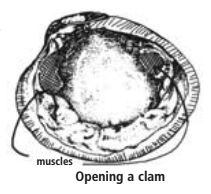
Opening clams: To open fresh clams, use a clam or butter knife, place it on the shell lips and tap with a hammer until the knife blade forces a slight opening. Slip in with a thin, sharp knife and cut the incredibly tough abductor muscles. Clam abductor muscles are located on either side of the shell toward the rear, so don’t go hewing around inside the shell with your knife. Never try to break away the lips of a clam or cockle as the shell usually fractures, leaving shell fragments in the meat. Open over a bowl to catch the juice. Chill before opening.
Steamed clams
Any clam can be served steamed, but the guide to good eating is to use only the smallest ones, such as cherrystones, or the most tender species, such as razor clams, and grind the rest. If your steamed clams do turn out to be made of old golf balls, don’t throw them out. Grind and use them for fritters.
Place 1⁄2 inch of water or wine in the bottom of the pot and dump in the clams. Close the lid and steam for about 15 minutes, or until all of the clams are open. Do not overcook; this toughens the meat. Serve with hot melted butter.
Mrs. Kelly’s Clam Pancakes
Mrs. Kelly called these clam fritters, but they resemble potato pancakes.
Combine:
3 medium potatoes, grated and squeezed
2 eggs, lightly beaten
1 large onion, grated and squeezed
1 cup breading mix or cracker meal
1 teaspoon salt and pepper
2 tablespoons baking powder
2 cups clams, ground or well chopped
To prepare: Make into patties about two inches in diameter and no more than 1⁄2 inch thick. Fry in vegetable oil until potatoes are quite brown. Drain or blot excess oil and serve immediately.
Clambake
Some of the best seafood we have eaten was cooked at a clambake. All you really need for a clambake are lots of clams and potatoes, but all sorts of delicious things can be added. Traditionally, a pit about 18 inches deep is dug in the sand and lined with flat rocks or bricks. The pit requires 8 to 10 pounds of rocks per square foot. A big fire is built and allowed to burn for at least an hour, adding fuel steadily to make a good bed of coals. When the coals are ready, sweep them toward the edges of the pit to expose the hot rocks. Add a 6-inch layer of seaweed or chopped lettuce.
Add food to the pit in a single layer. Brush small or medium potatoes with oil or butter, wrap in foil, pierce many times with a fork and place on the stones, close to the coals. Corn on the husk also goes here. Fish is usually cut into individual portions and wrapped in foil. Chopped vegetables, such as summer squash and tomatoes, are often enclosed with the fish. If live crabs are on the menu, they should be contained in a mesh sack. Place whole fish that have been gutted and scaled directly on the clams or crabs. Traditionally, the fish are wrapped in banana leaves to make handling easier. You can use foil, but leaves are much better.
After you have added the food, cover it with a 4-inch layer of seaweed. The briny steam from seaweed enhances the flavor of the food. Clean, wet burlap sacks are placed on top of the seaweed to close the pit and contain the steam and heat. Allow at least three hours for steaming. Resist the temptation to peek. As soon as the pit is opened and the food removed, turn the seaweed back, sweep the coals over all and throw on more wood. You will need heat to toast those marshmallows and to burn the used plates. Be sure to have a big pot of melted butter, coleslaw, and lots of cold drinks on hand.
Oysters
Grill oysters, open, and squirt in chili sauce, salsa, or a few drops of lemon, butter, and hot sauce. Use grilled oysters in other recipes such as Oysters Rockefeller.
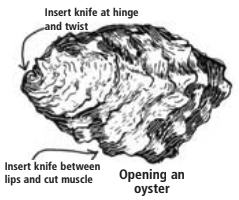
Opening oysters: Scrub the shell briskly with a brush. Position the oyster with the rounded side down on a chopping block so as much juice (called liquor) as possible will be retained. Use a cloth or oven mitt to protect your hand. Use an oyster knife that has a little diamond-shaped blade. The point does the initial opening job. You can also use a small, good-quality screwdriver. Insert the point into the hinge of the shell and twist until the hinge separates. Slip a thin knife into the shell, and cut the single abductor muscle, toward the front of the shell.
If it’s not possible to open the oyster in this fashion, break off a piece of the oyster’s shell at the lips big enough for the entry of a thin knife. Wash away the broken shell fragments. Slip in the knife, pressing toward the top of the flat shell and cut the single muscle that holds the oyster together. Remove the flat shell and cut the muscle where it is attached to the lower shell. Be careful not to lose too much of the liquor. Examine the meat for debris caused by your forced entry.
Fried Oysters
Pat oysters dry, double dip them in egg and bread crumbs, and fry a minute or two in hot oil. Pat dry.
Oysters Rockefeller
Oysters Rockefeller are traditionally made by first grilling (or steaming) the oysters open. The meat is then lifted, and a bed of hot spinach is slipped beneath. The oyster is then breaded and grilled. You can also make this dish by using jarred fresh oysters and making the dish in an oven casserole.
12 oysters
1 package frozen spinach or 2 pounds
fresh spinach, thoroughly washed
1⁄4 cup butter
1⁄2 cup bread crumbs
1⁄2 cup slivered almonds
1⁄2 lemon juice
1 cup sour cream
3 tablespoons
horseradish
salt and pepper
To prepare: Steam oysters open and reserve. Boil a large pot of water and parboil fresh spinach for one minute. Drain, chop, squeeze, and reserve. If using frozen spinach, defrost, drain, and warm. Sauté almonds in butter until golden, add almonds to spinach; add a sprinkle of lemon, salt, and pepper. Make a bed of spinach and slip on oysters.
Brush oysters with butter. Grill until oysters are just sizzling, but do not let edges curl. Sprinkle on bread crumbs and brown. The object is to slightly dry and toughen the oyster, but not much.
The sauce: Mix horseradish, lemon juice, sour cream, salt, pepper, and warm. Just warm. Pour sauce over all and serve.
Mussels
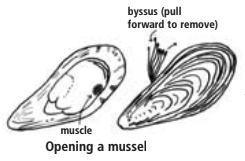
Some mussel bodies are white, some are orange. Both are perfectly edible. Mussels are very tender and full of flavor. They are excellent just steamed open and dipped in butter or sauce. Mussel soup and stews are also a delight, and the fine meat is a good addition to seafood Newburg. Mussels can be eaten on the half shell with a little lemon juice. A knife is easily slipped between the lips and drawn toward the muscle, which is approximately opposite the beard.
Cleaning mussels
Mussels should be bearded by pulling the beard toward the front of the shell. The beard is a web of fine golden-brown threads called byssus, which they secrete to anchor themselves to the surrounding rocks and other mussels. This golden thread is remarkably tough. The shell should be scrubbed with a brush.
Sea snails
Conch
There are a number of different varieties of conch (pronounced “konk”). This is a huge, snail-like mollusk, most of which are found in the warm Atlantic and Pacific waters and in the Indian Ocean. All are edible except the huge horse conch, really a giant whelk, which may exceed 18 inches in length (refer to illustration on Page 54). Conch are slow-moving bottom feeders that live in shallow water on sand or grass. Their huge shells are easily spotted when snorkeling, and there is no trick to finding them. Where there is one, there are a million. Where there are none, you may not see them for days.
Most conch are timid and retreat into their shells when handled. But there are several small (three- to four-inch) varieties called fighting conch that don’t know this and will attack you aggressively when you pick them up. You may well wonder how an overgrown snail can move to the attack. It’s best we tell you before you find out the hard way.
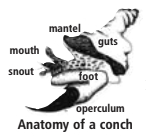
All conch have a horny covering on their foot, called an operculum. It is pointed at one end, rather sharp, and covered with mucus. The conch will take one look at your hand and spear you with its operculum so severely (though fortunately not with lightning speed) that you will immediately forget all about conch fritters and begin thinking about first aid. The best defense is to hold the creature in its shell by placing your thumb over the flat part of the operculum.
Your next problem is getting the darned thing out of its shell — no easy task for the uninitiated. There is no way to pull the conch from its shell. It is a far better puller than you are and always wins this game. Breaking the shell with a rock is also a loser’s game unless you don’t mind dropping a boulder on your dinner and picking the pieces of shell from the mess.
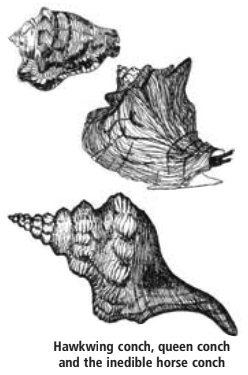
There is, in fact, only one reasonable way to separate the conch from his home: grab the operculum and attach a pair of Vise-Grips to it. This will prevent the conch from pulling far back into its shell and make removal from the shell much easier. Hold the shell in the left hand, with the opening downward and the spiral toward you. It is better to work somewhere other than on the boat, as the shell and slime tends to fly everywhere. Using the claw of a hammer, make a slit in the shell between the third and fourth spiral. Rinse the slit. Using a small knife with a narrow blade, cut the tendon which holds the conch in its shell. The tendon is beneath the meat. It is a broad flat sheet that lies against the pink center column, extending several inches into the shell. Slip a knife into the slit beneath the meat and cut the tendon completely. The conch can be removed from the shell with a slight pull. If it will not come out, the tendon is not completely cut. Resist the temptation to force the conch free by pulling with the Vise-Grips. The operculum is brittle and easily broken.
Kill the conch with a scooping cut which removes the eye stalks and snout. Do not delay as the conch is now thoroughly irritated and can secrete an amazing amount of slime. Cut away the guts and the colorful orange-yellow mantle. Feel the mantle for conch pearls before discarding it. Some people save the mantle for fritters but eating it raw is an acquired taste. The clear rubbery “style,” of unknown function, looking like a piece of spaghetti, may be eaten raw but doesn’t have much flavor. A short digestive tract runs from the snout to the center of the body. Cut it open and wash the meat.
The dark, tough skin must now be removed, a slimy and difficult job. Absorb the slime with corn meal. Make a series of slits through the skin radiating away from the operculum. Pull the skin off with a butter knife or pliers. Conch meat is extremely tough, but tasty. You will have to either beat it with a tenderizing hammer or grind it. Put the meat into a plastic bag so it won’t spatter, and pound it with a meat hammer until it begs for mercy. Wash the meat and your tools in vinegar. The conch is now ready for use.
Storing live conch: Live conch will last a day out of water if kept cool and wet. Islanders collect bunches of conch, tapping a hole in the lip of each shell, tying them together, and throwing them over the side at night. The conch all try to go in different directions (like some sailors we know) and, therefore, go nowhere.
Cracked Conch
This popular Bahamian recipe is the West Indies’ answer to the hamburger. When one fried conch is served on a hamburger bun, it’s called a conchburger. When two fried conchs are served on a plate they are called “cracked conch.” Call it what you like, the taste is great.
To prepare: Thoroughly pound a cleaned conch until tender. Rinse in salt water and sprinkle all over with lemon juice. Dust thoroughly with flour. Pan fry in a half-inch of vegetable oil until golden. Serve as hamburger with some garnishes or on a plate with a side dish of potato salad.
Periwinkles and turban shells
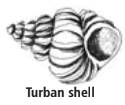
Periwinkles are not popular in the U.S., but are eagerly consumed elsewhere (see illustration on Page 56). There are about a dozen varieties of winkles, the largest two inches long, about twice the bulk of a land snail. These are very tasty but tough little devils and need some cooking to arrive at the chewy but pleasant consistency needed for eating. Since they are usually free for the taking along any rocky shore, the price is certainly right.
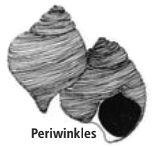
To prepare: Rinse and simmer winkles in their shells for 20 minutes in salted water (about two tablespoons per quart with a generous pinch of bouquet garni). The salt helps shrivel the meat to improve texture and facilitate its removal from the shell. Remove and trim away the gut end.
Pressure-cook the winks in a little (2⁄3-cup) simmering broth for 20 minutes. Sprinkle in a little finely chopped green onion, carrot shavings, and a shot of sherry. Strain the solids and reserve. Thicken the broth. Serve over rice with the winks.
Land snails
French vineyard snails pay for their gluttony when they become the dinner rather than the diner in the fall during the grape harvest. In France, wild snails are seasonal. Traditionally, wild snails are first starved for a few days to rid them of plant material that is harmless to them but toxic to people. The snails operculate or “clam up” by withdrawing into their shells and sealing themselves in with a mucus that dries into a translucent membrane.
This sealed state indicates that they are safe to eat. The snails are ready to eat just about the time the Beaujolais Nouveau is ready to drink. Snail eating is therefore associated with the harvest.
No one, certainly not those gastropod lovers, the French, would be satisfied to eat snails just once a year. Farm-raised snails are available year-round. Farm snails are fed lettuce and vegetables, then fresh herbs. Next they are whisked off to market. They’re sold in mesh sacks that allow them to breathe and be hosed down. These are lively little devils. Do not give a bag of them a chance to get away. You will find all of them, but you’ll find the last few by smell. Be sure the lively snails you buy really are farm fed and not “just out of the woods.” Ask.
Sea snails do not operculate but should be withdrawn into their shells and withdraw even further when handled. Snails that hang out of their shells and do not withdraw vigorously when handled should be avoided.
To prepare: Wash in lukewarm water and soak them for several hours in salty water with vinegar and a pinch of flour. Then blanch them for five minutes in heavily salted water. Allow them to cool and remove them from their shells. Simmer in a saucepan containing enough white wine and stock to cover them. Add a big bouquet garni, several cloves of garlic, some carrots, and onions. Add one teaspoon salt. Simmer three hours or pressure-cook 18 minutes. Slow cooking is better. Allow to cool. Remove the black end of the guts.
In the classic recipe, the shells are cleaned and herb butter is pushed in, followed by the snails. This is a huge pain in the transom. They can also be served very elegantly on toast.
Snails on toast
4 slices bread
3 tablespoons oil
3 tablespoons anchovies mashed in 3 tablespoons olive oil, plus a clove of garlic
4 tablespoons butter
1⁄4 pound grated cheese
a garnish — any combination: roasted peppers, asparagus, sliced olives, artichoke caps, etc.
3 cups cooked snails
1 small onion, finely chopped
1 egg
1 cup cream garlic to taste
To prepare: Lightly fry the toast in a little oil and butter. Scrape on a light layer of anchovy paste. Add a light layer of grated cheese, like Parmesan, and melt. Add toppings. Sauté in snail pot (without snails) 10 minutes with butter, finely chopped onion, oregano, pepper, and as much garlic as you dare. Add snails. Turn down heat and add one egg mixed in 1⁄2 cup of cream and a little lemon juice. Stir furiously, until thick. Serve over toast. Sprinkle sherry over all.
Octopus
The octopus found at fish shops inhabits shallow water and never exceeds a few feet from tentacle to tentacle. Sailors’ fables tell about huge monsters of the deep that attack whole ships, grappling them with their vicious tentacles, and pulling them down to Davy Jones’ locker. The famous giant-octopus episode in Jules Verne’s Twenty Thousand Leagues Under the Sea makes even the most sensible of us wonder if the sea harbors these fantastic creatures.
Late one night, alone on deck, I heard a commotion in the sea nearby. I switched on our powerful cockpit light to see what was about. Suddenly the water just astern seemed to boil, a huge octopus rose from the sea and seemed to float just above the waves; its arms splayed wildly. It glared balefully into the beam of light. Then, with a splash, it was gone. My hair stood right up on my head as I reached down the companionway for a pistol, but by then there was only the moonlight, the gentle swell, and the sparkle of the sea. In the morning I realized that the monster I had seen was certainly a deepwater octopus, surely not more than four to six feet from tentacle to tentacle, not big enough to suck even a dinghy under.
Incidentally, a small, blue-speckled Pacific octopus usually found around the coasts of Australia is venomous and very deadly but not poisonous to eat.
Killing, cleaning: Most fisherman pick these beasts up by their tentacles. Be careful not to get close to the beak (which is sharp and often venomous but usually not deadly). Beat it a few times on the gunwale or hit it with a hammer between the eyes. Do not let an octopus linger on the spear or in the dinghy; it may escape and, in any event, get very tough if allowed to live wounded.
To prepare: When the octopus is dead, slit the hood, remove the viscera, and pop off the beak. Chill, cut the tentacles into very thin rounds, and beat each one lightly. If not beaten, the octopus provides the toughest meat you have ever tasted. The meat can be further tenderized by marinating for a few hours in an acid marinade.
After tenderizing, but before cooking, trim away the tough skin and tentacles. Poach the octopus for 2 or 3 minutes in 1⁄2 cup of vinegar and enough water to cover it. The octopus is now ready for use. You can also boil the whole tentacle for 20 minutes, cool, chill, and slice paper thin. These wafers may be served with a horseradish sauce.
Uses of octopus
Octopus is mollusk-like in flavor and when ground (raw) may be substituted for tender mollusks in any recipe, including chowder, fritters, Newburgs, or casseroles.
Octoburgers
Cut oblique one-inch slices of the tentacle near its base. Beat with a meat hammer until the thickness is reduced by half. Soak in wine and vinegar and garlic for an hour. Pat dry. Flour or batter and fry. You can also fry them in butter and oil over low heat.
Squid
The mysterious squid is a mollusk that carries its vestigial shell in the shape of a small spear-shaped plate inside its body. One species, called a “cuttlefish,” has a thick, pronounced plate but is otherwise just as tasty as other varieties.
Squid are usually not encountered by the individual in sufficient numbers to make their capture worthwhile; they are usually netted by trawlers. Once, however, in the mid-Atlantic, we heard a huge rain squall approaching, yet the sky was clear. Suddenly, with a dull roar, the water churned all around us and hundreds of tiny shapes shot into the air. Some even hit the sail. We found, to our astonishment, that they were little squid, so intensely engrossed in mating that they did not resist even when picked up and slipped into a bucket of water.
Becalmed one evening in the middle of a transatlantic passage, I sat in the cockpit watching the stars, occasionally disturbed by an elusive noise which I finally realized was the occasional click of my fishing reel. I had neglected to reel in the trolling line — the lure was hanging several hundred feet beneath the glowing stern light.
The line had some sort of dead weight on it. It offered no struggle as I reeled it in, making me think I had hooked a big plastic bag. To my amazement, out of the water came an unusual squid, a brilliant, angry red in color, perhaps three feet long, thicker than a man’s leg and weighing perhaps 30 pounds.
As I attempted to pull it over the transom by the leader, it took one look at me with enormous eyes and squirted me in the face and chest with a powerful acid, and quick as lightning wrapped a tentacle around my hand and pulled with amazing force, nearly taking me over the side. I screamed in pain from the acid, struggled free, and rushed to the sink to wash my face. By the time the pain was gone, my woolen sweater had burned away where the acid had hit it. I returned to the deck and cut the line. That squid was the winner, not the dinner!
Squid, in our opinion, ranks right up at the top of the list of fine seafoods, and it is usually the cheapest; it is easy to prepare, is pure protein, and is worthy of consideration by any cruising gourmet. The Europeans, who treat squid with much reverence, have a variety of fancy recipes, including cooking the squid in its own ink. In Thai cooking, squid is first scored with a sharp knife. Scoring makes the squid roll up when cooked. The scored meat is then cut into pieces an inch long, poached and served in a spicy sauce. The rolled pieces tend to hold the sauce. We love squid and clams poached in a pan with the squid thrown on top of the clams. The squid and the clams still in their shells are mixed with a white sauce made with their juice or spicy marinara and tossed onto pasta. Squid is also excellent dipped in milk, then cracker crumbs, and deep-fried.
Cleaning squid: Pull off the semi-transparent membrane that serves as the skin. Separate the head and legs from the body. Separate the legs from the head by cutting just below the eyes. Pop off the beak at the center of the tentacles and save the tentacles. Squeeze out the intestines. Pull out the cuttle bone and rinse everything. If the squid is bigger than 12 inches, it should be beaten to make it tender.
Fried Squid (Calimari Frite)
To prepare: Slice the hood-like body into rings. Pat dry and shake rings and tentacles in a bag with seasoned flour. Sauté in vegetable oil for about five minutes or until golden. Do not overcook as it toughens the meat.
Seafood fritters
Go heavy on seafood and light on the batter. The batter is simply used to bind the pieces of fish together and to cover them with a pleasing, crispy coat.
To prepare: Make two to three cups of prepared seafood into 16 little mounds. The mounds must cling together; a small amount of flour may be dusted over seafood to assist in this process. Immerse seafood in batter, coating thoroughly. Transfer coated seafood to small skillet containing one half-inch of very hot vegetable oil. Fry until golden brown, turning occasionally.
Thank you to Sailrite Enterprises, Inc., for providing free access to back issues of Good Old Boat through intellectual property rights. Sailrite.com