A designer with a lifelong passion for fast, seaworthy sailboats
Issue 21 : Nov/Dec 2001
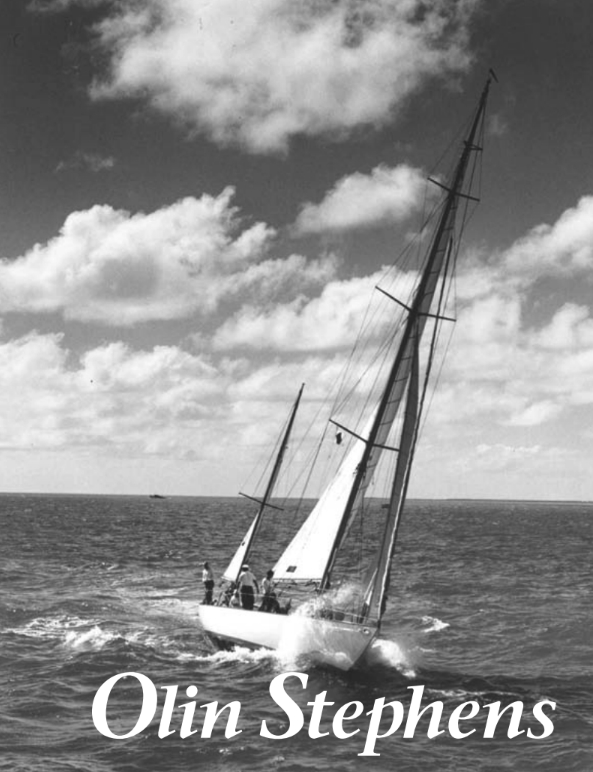
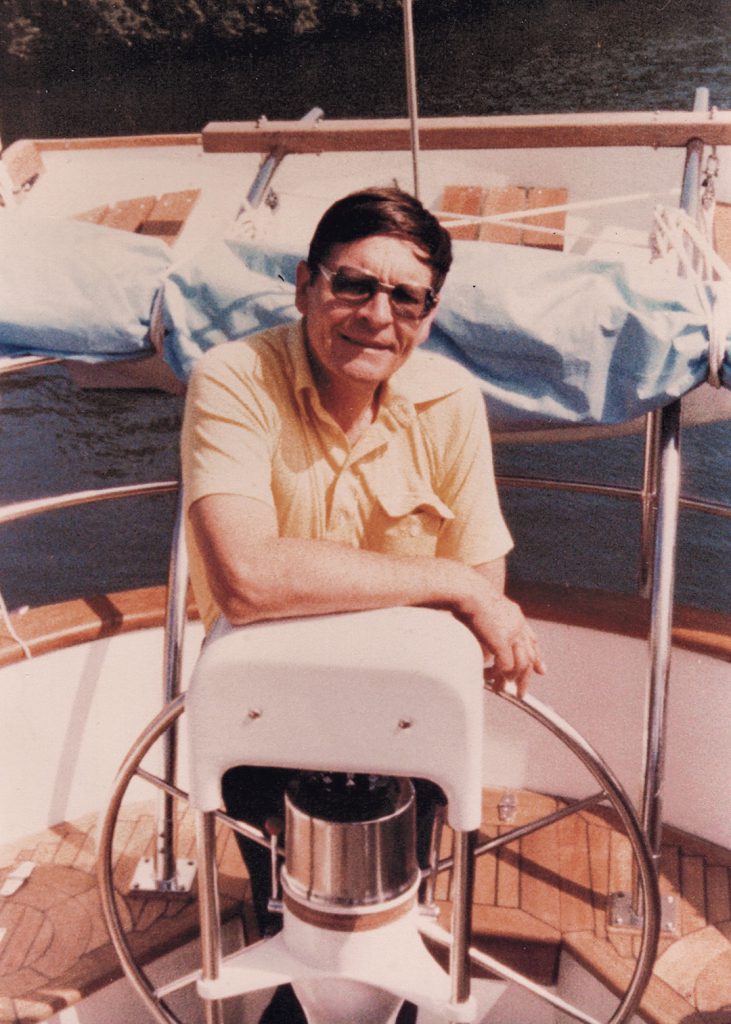
His nametag for the 15th annual Chesapeake Sailing and Yacht Symposium held in Annapolis gave his affiliation simply as “retired.” But for famed yacht designer Olin Stephens, that word’s not in his vocabulary. At the age of 93, after one of the most illustrious careers imaginable, he is still actively pursuing his lifelong passion — designing fast, safe sailboats, whether for racing or cruising.
“I was really lucky with racers,” he says modestly. “I had no real difference in my approach with cruisers. There’s nothing radical or different in my designs. I had grown up seeing boats built at City Island, where they used bent frames instead of cut ones. The boats were lighter and just as strong. They also had the ballast on the outside of the boat, where it would do the most good, and not on the inside.”
Given his long record of racing success, it was hardly just luck. Olin Stephens designed five boats that won seven America’s Cup races, and collaborated with Starling Burgess on the J-Boat, Ranger, that won the Cup in 1937. That makes six boats and eight Cup victories, surely a record no one else will ever approach. For the icing on the cake, he skippered Columbia to victory in the 1958 Cup race. His boats also have won just about every famous bluewater race there is: Whitbread, Fastnet, Newport-to-Bermuda, and the Transatlantic, to name a few. Everyone knows about the tragic 1979 Fastnet Race in which 15 sailors died and five boats sank in a violent storm. Which boat won that year? Tenacious, skippered by Ted Turner and designed by Olin Stephens, of course. In short, Olin Stephens has done it all.
Boats fascinated him
In his autobiography, All This and Sailing, Too, Olin writes: “As far back as I can remember, I wanted to design fast boats.” From the age of six, boats fascinated him, especially after he took his first sail. As a youth, he spent time at boatyards, sketching hull designs that appealed to his eye and soaking in all he could about boat construction and design. Of those early days Olin says, “I found that the Scottish designers built good boats that also were good to look at.” So early on, he had an appreciation for the beauty of a well-designed boat, an appreciation he would carry forward throughout his career in his own designs.
A case of jaundice forced Olin to leave MIT after a year, and he chose not to go back because he wanted to pursue his boat-designing dream. In 1927, at the age of 19, he started his career drawing small-scale accommodation plans for brokerage boats for Henry J. Gielow in New York. A small beginning, it was at least in the chosen field of a young man who had sketched boats his whole life. Within a short time he found an opening with Philip Rhodes and became a draftsman for the famous designer. He had little formal training in drafting, but he learned quickly. A few months later, he resigned from Rhodes’ firm and struck up a partnership that was to last.
Through his father, he met Drake Sparkman, an established yacht broker who was well connected in the sailing community. Olin became the head of design for the company. He writes in his autobiography, “The arrangements were informal and experimental, to be extended or not, depending on how things worked out.” As we know, things worked out just fine for the company they simply called Sparkman & Stephens.

The famous Dorade
Success came quickly. In 1929, Olin designed for his father a racing boat named Dorade. He and his brother, Rod, sailed her to a surprise victory in the 1931 Transatlantic race, and then added top honors in the Fastnet race shortly thereafter. Dorade’s success gave the new firm of S&S instant credibility, not to mention a ticker-tape parade for the Stephens brothers when they returned to New York.
From there it was a short step for Olin to work on America’s Cup designs. In 1936 he worked on Ranger in collaboration with Starling Burgess. As with Dorade, his early success with Ranger led to more than 40 years of unparalleled success in America’s Cup designs.
In addition to producing outstanding boats, Olin Stephens also turned out a fair crop of designers who worked for him at Sparkman & Stephens. Says Bill Shaw, an 11-year S&S veteran and later long-time head of Pearson Yachts, “We, the people who went to that wonderful school I call S&S, had one of the finest educations in yacht design one could ask for. Olin’s main impact was, year after year, coming up with well-found boats that could go fast. In particular I can remember working with him on a preliminary design for a customer, and Olin could meld the traits of one boat with the traits of another in his mind. He could tell a customer how long a boat was going to be after just listening to the accommodations the owner wanted. He would sketch out the boat in his head. He’s an absolute genius. S&S had a bent toward cruising boats like Finisterre. She was designed as a world-class cruising boat that also could go fast.”
Speed is another contribution to safety that Bill learned at S&S. “A slow cruising boat really is dangerous if you think about it,” he says. “The crew is out there that much longer, so more things can go wrong. Olin knew how to design a fast boat.”
Cruising and racing
Dual-purpose boats were much more common in the early days of S&S than today. According to Bill, S&S designed many dual-purpose boats the owners could “cruise or race, depending upon the crew and gear they had aboard. The boat was fast either way.” Modern race rules have changed that dual-purpose approach, he notes. “Boats today are designed to a particular rule, like the IMS, for a single purpose. If that boat doesn’t turn out to be as fast as expected, the boat loses its appeal. They’re almost throwaway designs today.
“Olin has always served on about every rules committee possible, emphasizing safety. He’s still very influential in all aspects of the sport.”
Bill has many memories of the tank testing that S&S helped popularize for boat design as early as the 1930s. “Once, while working on the Columbia design, Olin and I drove to New Jersey to test six or seven models in the tank. Olin was also interested in automobiles, and back then he drove a convertible that only sat two people. After testing, we had to bring the chosen model back to the office. The only way we could get it in the car was for me to get in first, then turn the model upside down in the car with my head inside the hull. I had one hand on the stem to keep it from poking a hole in the roof. That’s how we drove back to New York.”
He adds, “There is one thing people should know. Olin employed people like me to work on designs. But the boats were Olin’s ideas and his designs. We just pushed the pencil on paper where he told us to. He was the driving force. He was the one responsible for all those successful boats.”
David Pedrick is another “graduate” of what Bill calls the S&S school. “I started working there in 1970 as a fresh graduate of the Webb Institute,” David says. “I began as an intern. It was a wonderful opportunity for me personally.” Early on, David worked on the Courageous America’s Cup program with the tank testing. That led to his becoming full project manager for the boat’s construction. “Olin gave me a lot of scope to do what I could under his watchful eye. It was a good tutelage for me,” he says. Courageous went on to win the America’s Cup in 1974 and 1977.
David says, “The intuitive sense of shapes the water will treat kindly is something Olin has cultivated since he was a young man. He’s been able to apply that intuitive approach with the technology of the day in a number of successful projects. He was an early advocate of tank testing in his work with Ken Davidson in the 1930s. He also was one of the first to study sail forces to propel the yacht, examining the power needed to drive the hull versus the resistance of the water on the hull. He’s never satisfied with the status quo. He always wants to move forward.”
Always open-minded
David notes another key personal quality of Olin’s. “He has always been open-minded,” he says. “In 1974, just before the start of the Bermuda race, he and I were standing on the dock in Newport looking at all the boats entered in the race. Olin told me you could look at the rigs and tell the S&S designs, with their stout masts and single-spreader rigs. Most of the other boats had multiple spreaders and cleaner-looking rigs in general. Olin knew he was missing the boat, so to speak, on rig design.”
David points out that Olin had an eye for beautiful and graceful shapes. “He felt that Mother Nature prefers beautiful shapes, so he stressed beauty in his designs and not just brutal performance.”
Olin’s love of beauty also extended to automobiles, as previously mentioned. While a student at Webb Institute, David remembers when Olin came to speak at the school. David was impressed by the white Mercedes Olin was driving. “Years later, when I was working for him,” he says, “Olin drove me someplace in his white Porsche. He had a bandage on his hand, and I asked him what had happened. He told me he had cut his hand changing the oil in the Porsche. It struck me as funny that a man of Olin’s success and stature would be changing the oil in his car. But it’s typical of how down-to-earth he is. Other “graduates” of S&S are Bill Tripp, German Frers, Gary Mull, Bill Langan, and Al Mason. That’s not a bad group to be in.
Made famous by his racers, Olin also turned out a number of noted cruising designs. His emphasis has always been on cruisers for the open sea, not necessarily on coastal cruisers. When listening to him, you get the feeling that he thinks the high sea is where all boats belong, or that they at least ought to be designed totake bluewater conditions.
“Cruising boats need to be strong,” he says. He didn’t have to add that they also need to be fast. Talk to him about cruisers, and the conversation invariably winds its way back to speed, safety, and rating rules for racers.
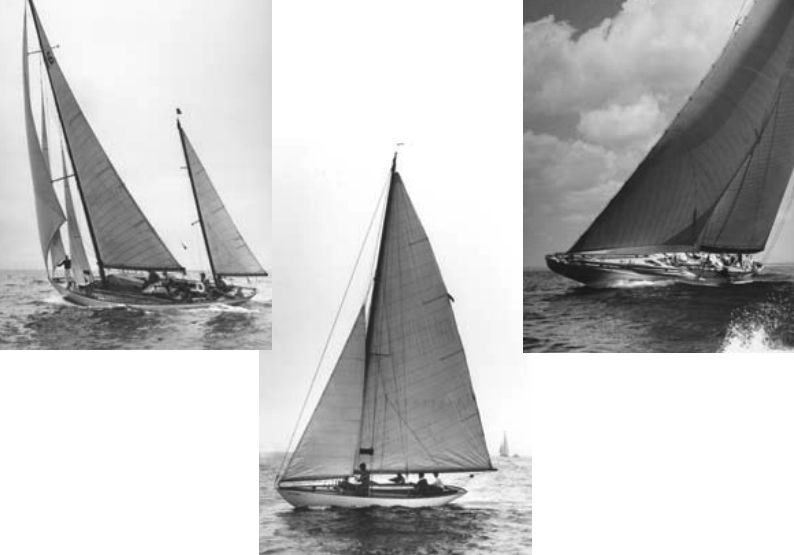
It’s clear Olin doesn’t care how an owner intends to use the boat, as long as it’s fast, safe, and comfortable.” Brilliant was designed as a seagoing cruising boat, he says. “She was not designed as a racer even though she won her share.” Today, Brilliant, built in 1931 at the Nevins Yard in New York where a young Olin sketched so many boats, is a training vessel for Mystic Seaport. Despite her cruising roots, she continues to win races to this day.
Another fast cruiser
Finisterre is another cruising design with race credentials. Olin designed her as a centerboard cruising boat, but she still won the Newport-to-Bermuda Race three times. The boat popularized centerboard designs despite Olin’s reservations about them. “Centerboarders have their place,” he says, “but in a rough sea those boats will not necessarily right themselves, and that’s not safe. Winged keels are a good design alternative today. The wings can be made heavier to supply ballast down low where it does the most good.”
As both Bill Shaw and David Pedrick point out, most boats built until fairly recently were dual-purpose, meant to race and cruise. “In those days not so long ago,” says David, “boats were true racer/cruisers. There were many more overnight races a few years ago, and many people actually went offshore in their boats. The boats had to have cruising amenities. For example, when Tenacious used to race, the crew included a full-time cook. Not so today. Now racing boats are stripped out with no compromises for cruising.”
Today, Olin is critical of current designers of cruising boats who borrow too much from the racing side. “Too many cruising-boat designers today copy racing designs even though the racer may have been built to meet a particular rule,” he says. The result usually is something else he can’t tolerate: a boat that may be fast but is uncomfortable at sea and probably unsafe to boot. In Olin’s design scheme, comfort is an aspect of safety, and safety is always at the forefront of his mind.
“The Cruising Club of America (CCA) sponsored the Bermuda race for years, but their designs were mainly cruising boats,” he states. “It’s still a good rule. It didn’t give every boat a chance, but it did result in a good boat. Running Tide is one of my best designs. It was fairly light for the time, too. The CCA gives the best all-round boats I think. Today there’s so much emphasis on the space factor. There’s almost too much room below for people to bounce around in at sea. The new materials are light and make for a fast boat, which the new rules encourage. But ultimately the designer has to do what the owners and sponsors want. The safety factor isn’t there today, in my opinion. For example, my rigs were heavier than they needed to be. You don’t find that much anymore.”
Beginning in fiberglass
S&S collaborated with many production builders down through the years and was involved in the very beginning of the fiberglass boat era. In 1957 S&S designed the New Horizon sloop, one of the first commercially successful fiberglass boats. When asked about Ray Greene, the man often thought of as the father of fiberglass boats, Olin says, “Yes, I remember Ray Greene and that boat. It was an unfortunate-looking boat, but it did pave the way for the new material.”
It was the Tartan 27, another S&S design in 1960, that overshadowed the New Horizon (at least in Ray Greene’s eyes). But it led to a long association between S&S and the company that was to become Tartan Marine. “We had a long, very happy relationship with Charlie Britton at Tartan,” says Olin. “We shared many mutual ideas about good boats. He also built solid boats, and that was important to us. Swan is another outfit we had a long association with, starting in the late 1960s.”
Many production builders came to S&S for at least some of their designs. In addition to Tartan and Swan, the list includes Grampian, O’Day, Seafarer, Hinckley, Columbia, Dufour, and Siltala (Nauticat). S&S also designed the Rainbow 24 for the Annapolis Sailing School.
“My brother Rod was terrific at inspection, at keeping the builders in line,” says Olin. “That was important to us — to maintain quality if our name was going to be associated with a boat.”
Olin often has lamented his lack of formal design training despite his long list of successful boats. When asked how formal training could have improved his work, he says, “My designs probably wouldn’t have been much different if I had continued with my formal education. Starling Burgess had a few formulas he used, but his approach wasn’t that different from mine even though he had more formal training than I did. But today I have trouble keeping up with all the math people use. I can’t always follow their formulas to conclusion. Today it’s hydrodynamics, and fluid, and sail dynamics that matter, and not so much naval architecture. That’s where it’s at today, and you need to understand math to get the most out of it.”
Today’s designers
Asked about designers he likes today, Olin gives a qualified response. “There are lots of good designers today. Bruce Farr comes to mind, even though I don’t much like his designs. Bruce King is one. German Frers is another one; he worked at S&S. I got to know his father in Argentina, and that led to the connection with us.”
One is tempted to over-analyze, and certainly to overstate, Olin Stephens’ contributions to sailing when the plain fact is that his record speaks for itself. From a pure aesthetic view, one can make a case that perhaps his most noteworthy contribution is his intuitive combination of beauty and performance in boat design unmatched by anyone else.
David Pedrick points out a key aspect of Olin’s contribution to the science of boat design, an aspect that continues to this day long after Olin stopped putting pencil to paper. “Olin is very generous with his knowledge. He shares what he knows with others because he knows it will push thinking to the next level. That’s what he’s always reaching for, the next level. He’s an amazing man.”
When not working at his job for the government or singlehanding his 1989 Pearson 27 in the Annapolis, Md., area, Steve writes for marine publications.
Thank you to Sailrite Enterprises, Inc., for providing free access to back issues of Good Old Boat through intellectual property rights. Sailrite.com