How to mount a heavy-duty vise on a folding workbench
Issue 22 : Jan/Feb 2002
There are a few legendary tools that may have little obvious use when you see them in the hardware store but win your heart totally when you have them at home and use them for a while. One is the Black and Decker Workmate, a full-height workbench compact enough when folded to live behind an apartment door. The other is a full-size, heavy-duty, industrial-strength machinist’s vise . . . the kind with jaws four inches wide, opening preferably to a full five inches, and weighing 40 or 50 pounds.
The Workmate lets you stand upright at your task. It took humankind many millennia to become vertical bipeds, and we should not give it up easily. We do not do our best work on hands and knees.
A really massive vise can come close to making up for the lack of a second person to help hold things. The cast iron does a good job of damping serious pounding when that is necessary and can absorb the force of really energetic filing or hacksawing. Your effort goes into shaping the workpiece, not shaking the table. If the vise is of genuine high quality, it will open and close by means of a lead screw with acme square-cut threads capable of applying enough force by tightening pressure alone to straighten many bits of bent hardware or to press a new ball bearing into, for example, a water pump housing compact enough to fit within the jaws.
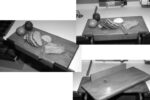
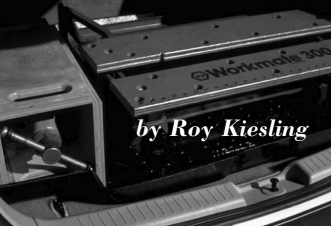
Mating the big vise to the Workmate so the pair could ride to the harbor in the car trunk (see photo at left) was one of those simple ideas that opens the floodgates to innumerable problems.
“Just bolt the vise to a piece of scrap two by four,” was the suggestion of well-intentioned friends, but it doesn’t work. The mounting footprint of the vise is much wider than a two by four, and much wider than the maximum opening of my Model 300 Workmate. Some kind of a sandwich, two boards of different widths, was indicated. Unfortunately, a heavy vise mounted atop a longish, narrow board, has the dynamic stability of a bowling ball. You don’t want it anywhere in your car any more than Nelson wanted an untethered cannon on his gun deck.
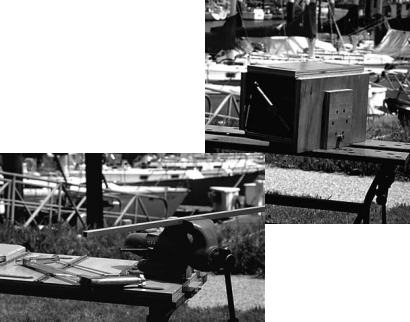
Reasonably stable
My solution to the challenge is shown in the photos. Folded for transport, the boxlike shape is reasonably stable in vertical and horizontal positions and has few projections to do damage. The slotted handholds are not merely an affectation; the thing is heavy, with a varnished surface slippery to wet hands. The possibility of dropping it on a foot is not acceptable.
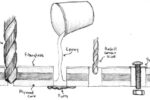
The project required several square feet of 3⁄4-inch plywood and a bit less than five feet of stainless steel piano hinge. Two small aluminum dowels locate and stabilize it for closing, and it is held shut for transport by a lathe-turned brass thumbscrew with knurling. (This was a pleasant winter-evening project that I turned out on my lathe, but any 1⁄4-inch-diameter hex head bolt could be used.) It screws into a brass-threaded insert that is a common hardware store item. I also considered using a toggle-type latch as used on luggage and toolboxes. Anyone likely to take on this project would have ideas of his own, perhaps even a suitable latch in a scrap box.
The square piece with the strangely scalloped corners (to give relief for the hinges) gives rigidity when it is folded for transport. Design and construction went along together as a single process, requiring frequent disassembly and modification, rather like a tailor-made suit. Bringing it to completion has brought that special satisfaction that goes with doing something that most non-sailors would regard as far more trouble than it is worth. Now that it is done, I am confident it will earn its keep.
Roy Kiesling was introduced to sailing on San Francisco Bay in J24s and later crewed regularly on Monterey Bay on a C&C 30. He crews on passages between Santa Cruz and Seattle whenever he gets a chance. He spent a few years operating high-altitude satellites for Lockheed and has been senior product advisor for West Marine Catalog.
Thank you to Sailrite Enterprises, Inc., for providing free access to back issues of Good Old Boat through intellectual property rights. Sailrite.com