With more countries introducing regulations, holding tanks are an issue that won’t go away
Issue 22 : Jan/Feb 2002
Traditional marine heads that discharge sewage straight out through a skin fitting are notoriously unpleasant things to work on, even during planned maintenance, let alone when having to clear a blockage or fix a leaking pump at sea. Storing sewage on board, quite apart from requiring extra cost, weight, and space, very obviously increases the opportunity for additional things to go wrong with the potential for even greater unpleasantness. This is, perhaps, the unconscious reason (rather than because of any widespread lack of concern for their environment) that boatowners as a group are reluctant to acknowledge, let alone address, the problems associated with boating sewage pollution.
In freshwater canals, rivers, and lakes, where the water is often warm enough for swimming and clear enough for visual pollution to be obvious, there is general agreement that holding tanks serve a useful purpose. To varying extents in different countries a combination of legislation, innovation, investment in pumpout facilities, inspection, enforcement, and peer pressure is helping to clean up inland waterways.
In unconfined ocean areas the situation is often very different — there is only rarely any just cause for concern about the additional “nutrients” being added to the water: no one drinks the water, in many places it’s too cold for swimming or too turbid for sewage to be obvious, and the area is well flushed by tides and currents. Particularly if the local city pours untreated effluent into the sea on a grand scale, it’s easy to dismiss calls for blanket restrictions on conventional marine toilets as environmental nonsense and political grandstanding.
On the other hand, we all know of relatively enclosed marine waterways, such as breakwatered harbors, locked marinas, and popular sheltered coves, where the water sometimes is used for swimming (by maintenance divers or children, at least). It’s also used by some boaters for rinsing dishes and is maybe even desalinated for drinking. Any nearby beaches are sure to be playgrounds for children, and people do still collect their own shellfish. In such situations, pollution by a high concentration of small craft is often offensively obvious and, without a doubt, constitutes a health hazard to the local community, tourists (including boaters), and eaters of local seafood (finned fish as well as shellfish). Restrictions on overboard discharge of untreated sewage in such locations is logical and will inevitably be introduced and then enforced in more and more countries.
While pioneered in developed countries, restrictions (and fines) are growing in relatively underdeveloped ones, too, especially where marine tourism is an important part of the local economy. Whether you inwardly rail against obvious hypocrisy, or cynically suspect enforcement is motivated by a wish to extract fines rather than to protect the locals’ health and environment, flouting regulations is likely to become increasingly difficult and expensive.
In your home waters you may, of course, just await regulatory developments, but no one wants to cruise in constant fear of the official knock on the hull after using the head in port. So when building a new yacht or equipping one for foreign cruising, there is much to be said for being prepared. Even where there are no restrictions or no one to see they are enforced, being able to swim around your own boat in paradise without suddenly encountering a cloud of pollution is a very real point in favor of holding tanks.
There are broadly two ways of dealing with the problem — either store the sewage on board in a holding tank until it can be pumped into dockside facilities or discharged offshore or treat it on board to kill pathogens and then discharge it into the water. Both systems have their advantages, but onboard treatment is relatively complicated and not universally acceptable. So despite the non-availability of onshore pumpout facilities in many areas, holding tanks are the most reliable option, particularly when they are installed as a general precaution against future problems in a variety of foreign destinations.
Holding tank systems
No-discharge systems, without any ability to pump out through a skin fitting, are favored by environmental purists, but these are only practical where a pumpout facility will always be available when required. This generally restricts their application to vessels that only operate in canals and other heavily controlled waterways and to short-term charter boats with sufficient holding tank capacity to tide them over between turn-arounds at base. Such restrictions are, in any case, easily circumvented with a portable pump and hose operating to the deck fitting or even with no more than a length of hose if the boat has a permanently installed discharge pump.
Porta Potti and other self-contained toilet systems may provide a workable solution for daysailing, particularly on yachts with small crews, but larger yachts that spend considerable time at sea require a convenient method of self-discharging the tank and/or bypassing it entirely. These “optional discharge” holding tank systems are the ones that primarily concern us here.
Optional discharge
These systems vary considerably in detail and complexity, but essentially they allow the user to choose whether the sewage is discharged immediately into the surrounding water or diverted into a holding tank. The accumulated tank contents can subsequently be discharged through a deck fitting to the shore, sucked out through the same fitting by a shore pump, or discharged through a skin fitting when the yacht is back at sea. These systems are the most versatile and, in conjunction with the ability to padlock valves to prevent discharge through the hull, should be acceptable even in rigidly inspected no-discharge zones. In principle, such systems might also allow for chemical treatment of the sewage in the holding tank prior to discharge into the water, but in practice even where this is legally acceptable, a special tank is probably mandated so that dosage and hold time can be controlled.
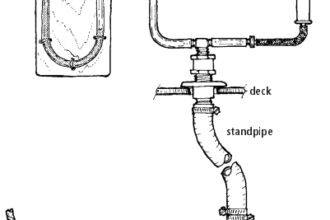
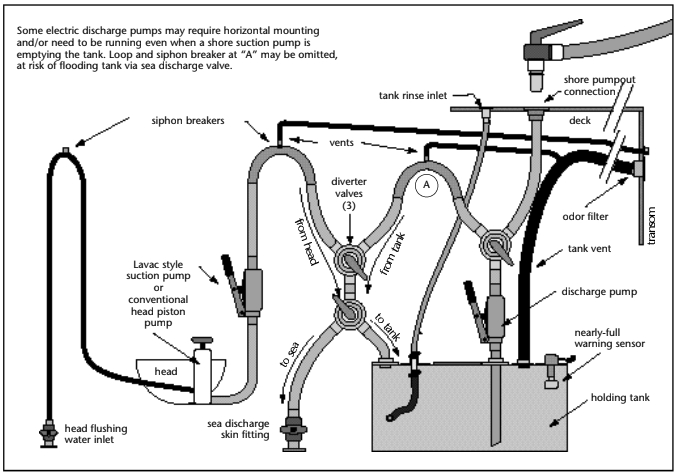
The plumbing of holding tanks is simple, although there are refinements that help to ensure a good working system. A generalized schematic for a below-waterline optional discharge system, compatible with standard manual or electric marine heads, is illustrated in the schematic on Page 23, but it’s probably worth seeking information from firms that specialize in such matters when designing a custom system — mistakes can be nauseating as well as expensive.
Tank capacity
The quantity of flushing water used by a toilet depends on the type of head and on how thoroughly it’s flushed after use. A rough rule of thumb is 12 liters (3 gallons) per day per crewmember using conventional marine toilets, but the Lavac vacuum system tends to use considerably less flushing water. As far as I’m aware, the SeaLand Vacuflush (a relatively complex and bulky electrical system) is the most parsimonious, using about a half liter (1 pint) per flush.
In practice, the crew size is variable, and the duration of holding required in a port may depend on the weather as much as anything else, so a bare-minimum volume based on the usual crew for a weekend should be increased manyfold if space permits. Doubling or trebling the tank volume requires relatively little additional material or cost and doesn’t increase the cost of the valves and other plumbing items at all. The holding tank cannot be too big but can very easily prove too small. Since it will be empty at sea, the sewage weight is not a real concern, and the larger the tank the less frequently pumping out will be needed. It would there fore be the more likely to be accomplished routinely whenever the yacht happens to go to sea, rather than having to use dockside pumpout facilities or break out a well-dug-in anchor just to pay a quick visit offshore.
In principle, the holding tank can be anywhere in the boat, although manual heads may be noticeably harder to pump if the tank is at the far end of the boat. Pumping is easier and back-flow less likely if the tank top is lower than the head’s bowl, but this is not often possible, especially when retrofitting a holding system to a smaller boat.
The space beneath forepeak bunks is often a convenient location, particularly for retrofitting to smaller yachts, because a full tank on or near the centerline does not induce a significant list, and the usual place for the head — forward of the saloon — is nearby. The disadvantage of the forepeak location is that the vent run to the transom is relatively long.
On larger boats, listing is less of an issue, and there is more likely to be space available beneath the sole. It is possible to connect several heads to one holding tank, but having just one connected should satisfy officials, provided any other heads on board can have their valves locked off.
Tank construction
Holding tanks can be made from a variety of materials, but fiberglass (GRP), stainless steel, and polyethylene moldings are the most common. Sewage is corrosive, so aluminum or mild steel tanks should be avoided, and even stainless steel can corrode at the welds. Polyethylene tanks are only available in a limited range of sizes and shapes, so many custom tanks are made of GRP. These should be strongly constructed, preferably with epoxy internal coatings. They should not be integral with the hull because of potential osmosis and odor problems, but I’ve seen GRP tanks laid up in situ, inside a female mold constructed from epoxy-sealed plywood. GRP tanks can also be made over a polystyrene foam male mold, covered in plastic wrap with the foam subsequently dissolved away with a solvent.
Baffles should be avoided because they reduce the effectiveness of rinsing and may accumulate debris. Since the tanks can usually be legally emptied soon after leaving port, baffles are not needed for slosh or noise control in ordinary tank sizes. Adequately thick tank walls or external ribbing can render baffles unnecessary as far as internal bracing is concerned.
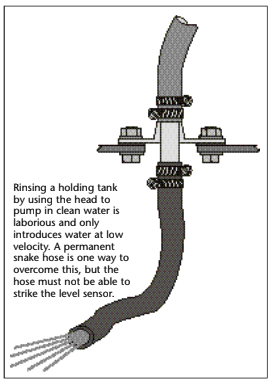
Complete emptying of the tank is only possible if the outlet is at the bottom with a low loop below it, but having all openings in the top is often more practical, reducing the chance of a leak, and allowing for plumbing maintenance without having to drain the tank. Especially in a tank that will only be used occasionally, some means of rinsing it is desirable to minimize odors and the chance that dried lumps of sewage will cause blockages later. Filling the tank with clean water pumped in via the head and then discharging may provide sufficient rinsing but is time-consuming.
Note that it’s generally illegal to directly connect a drinking-water supply hose to anything that has to do with sewage. I’ve seen one large yacht in which the deckwash pump could be diverted into a short flexible hose within the holding tank. This snaked around in reaction to the water jetting out of it and played a high-pressure jet around inside the tank.
Unpleasant as the prospect may be, it’s only prudent to provide a maintenance access panel on top within reach of all inlets and outlets to the tank. A supply of disposable latex gloves and an activated charcoal fume mask (as used by spray painters to filter out solvents) are worth storing with the head maintenance kit. The disasters you prepare for don’t seem to happen.
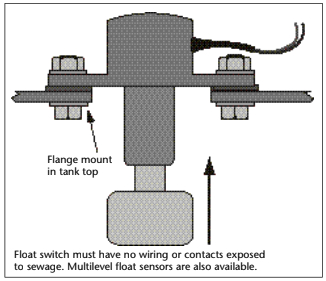
Visual level inspection is possible with translucent polyethylene tanks, provided a side of the tank can be seen, but some electrical method that actually warns when the tank is approaching full is desirable. Ordinary pivoting float switches are not reliable in this application but those with vertical acting float probes seem to fare better. Some models can also warn when intermediate levels are reached. A sealed observation port in the lid provides a foolproof back-up to electronics and may also double as the maintenance access.
In general, overcoming any problems will be less traumatic if float switches and all plumbing enter the tank via externally bolted flanges that allow them to be withdrawn even if the tank is full as shown in diagram at right.
Flexible tanks
Flexible tanks may seem to be an attractive solution for occasional use, and their degree of fill is self-evident, but be warned that sewage odors may eventually prove to be a problem. Connections to flexible tanks are often weak points, and the tank itself is vulnerable to chafe. Given the consequences of a leak, a properly constructed rigid tank is probably a wiser long-term choice.
Valving
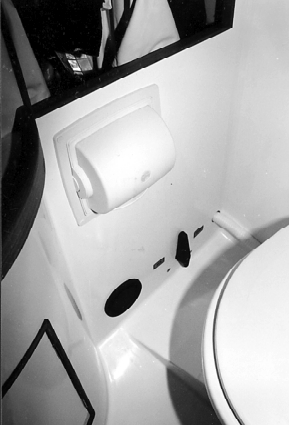
Optional discharge systems require the head discharge to be divertible either to the holding tank or to the sea-discharge skin fitting. The tank discharge needs to be directed either to the sea or to the deck pumpout fitting. Unless the tank discharge has its own sea valve, another two-way valve is needed so the tank can be discharged through the normal head-outlet skin fitting. Diverters are preferable to a Y-fitting and two ordinary valves because operation is quicker and the opportunity for mistakes reduced. In either case, to minimize flow friction and blockage potential, use valves that have a clean bore of the same diameter as the connected pipes or hoses. As with all marine head discharge plumbing, these valves may require periodic dismantling to remove mineral deposits and should be installed so this can be done easily.
I’ve read that periodically flushing systems with heavily diluted muriatic acid or water containing 30 percent vinegar may combat mineral buildup (and odors) but I’ve not tried this and can’t recommend it. Where time permits or when cleaning up old pump joker valves, soaking in a jar of vinegar will soften the mineral deposits that accumulate inside marine plumbing.
Pipe work
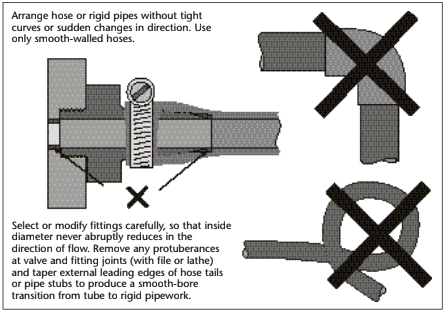
Blockages are most likely to occur in fittings where the bore suddenly reduces, so it pays to file away any molding ridges in pipe fittings and to use hose tails that have a fine external taper. Always use bends rather than elbows in plastic fittings and support hoses in gentle curves. Hoses must have smooth bores — do not use corrugated hose. Where possible, use rigid PVC pipe for long runs and support hoses or pipes so they drain either into the tank or into the next diverter valve. Sewage or even condensation pooling in a vent hose sagging between supports will breed odors. With care and a little practice, a hot-air gun may be used to create gentle curves in rigid PVC piping. In the interest of neatness and easy maintenance, buy the correct fitting for the job, rather than cobble the pipework together from whatever the chandler happens to have in stock. Plumbing supply companies have a far greater range of plastic pressure and sewage fittings.
Pumpout connection
A deck pumpout capability may not seem essential if you expect to always discharge the tank at sea, but apart from the sheer inconvenience of going to sea for just an hour, you may learn that marina operators take a dim view of foreign yachts that appear to be suddenly decamping. In some countries, boaters might have to officially clear and then re-enter the port. A pump will be needed in any case, since even where the tank can be installed above the waterline, relying on gravity to empty it is likely to lead to blockages.
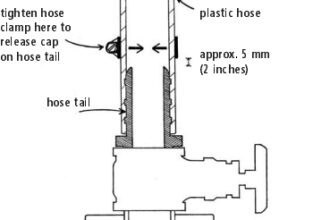
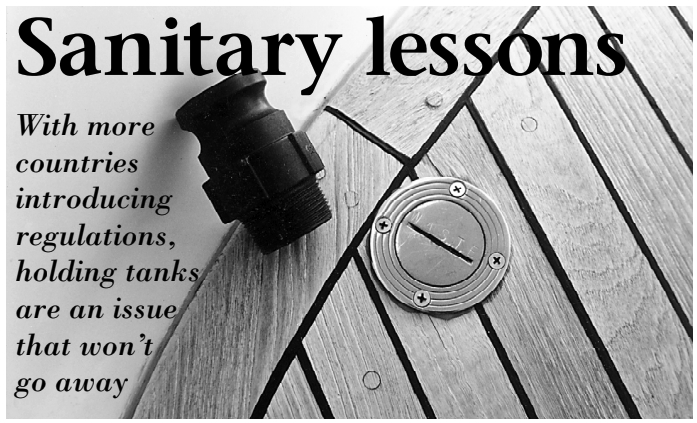
Over the years, there have been several systems in use in various countries for connecting dockside suction pumps to boat deck fittings. Most required threading in one half of a quick-connect fitting before clipping on the hose, but a simpler “push-in probe” system incorporating an O-ring is gaining a degree of international acceptance. For cruising in foreign countries, install a deck fitting that is compatible with probe and screw systems and carry a mating threaded fitting that could form the basis of an adapter in case you are faced with some other system (see photo on Page 22).
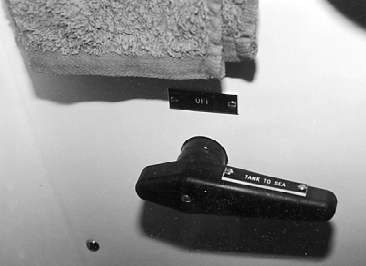
Discharge pumps
Most solids and toilet paper tend to be broken into relatively smaller pieces just by passing through a normal head pumping system, but larger pieces sometimes remain intact, and settlement and stratification may occur within a holding tank. The tank discharge pump must therefore be able to deal with sludge and small solids. Large-bore diaphragm pumps (manual or electric) are generally quite good in this situation, but problems will arise if standard electrically driven rubber impeller or centrifugal pumps are used. Special macerating pumps are available for this application, and some folks also use them as the normal electric head discharge pump to reduce the visual pollution caused by a conventional head or to break the solids up for onboard treatment. An electric pump makes light work of what can otherwise be a long and arduous stint of manual pumping, but note that some electric pumps may need to be running even when a shore suction pump is connected.
Tank vents
Undersized tank vents are a frequent source of problems since they may lead to back pressure (and perhaps to back flow) when trying to flush the head and can also lead to the development of a partial vacuum when the sewage is being pumped out of the tank. This can collapse the tank or hoses associated with it, including the vent line itself. Small-bore lines are relatively easily blocked by insects (especially mud wasp nests) or kinking. A 1-inch-bore vent should be considered the minimum for any sewage holding tank.
The vent outlet must, of course, be well above the tank level and the waterline and not within the boat’s living spaces. The transom is usually the most suitable place for the vent as odors are carried away on most points of sailing and when anchored. The vent line may have a high loop but should have no low loops or sags where water can accumulate and block it. Flexible vent lines should be non-collapsible types intended for sewage and well supported to prevent sags from developing. Rigid PVC vent lines are reliable, relatively lightweight, cheap, and fairly impermeable to odors. The vent should be fitted with an activated-charcoal type filter, larger in diameter than the vent line since the filter inevitably has some resistance to air flow.
Odors
Even an ordinary marine head, in which contact with sewage is intermittent, can develop persistent smells due to the permeability of flexible hoses. The problem can be much worse with holding tank systems, not only because pipework contact with sewage vapors is continuous but because bacteria working on the sewage generate additional odors.
Various disinfectants, deodorizers, or treatment chemicals are available to prevent or mask odors. Those added in one dose (pumped in through the head) need to be replaced each time the tank is pumped out, but there are also dispensers that use liquid or tablets designed to be fitted before or after the toilet pump to combat odors in the whole system. These work whether or not the holding tank is in use. Some of these products claim to reduce mineral buildup as well.
Traditional strong latrine odor-suppressing chemicals, such as phenol, are now considered to be environmental pollutants and should not be used. Bleaches may damage pump components, but in extreme cases it may be worth trying to sterilize hoses and so on by soaking them for a few days in heavily chlorinated fresh water.
Most odors reach the boat’s interior through flexible hoses or from leaks at pipe joints (perhaps only leaking while the head is actually being pumped). The traditional way to find where such odors are escaping from the system is to wrap the suspected hose or joint with a damp cloth for a while, removing the cloth, and giving it the sniff test.
As far as hoses are concerned , some temporary relief may be obtained by sheathing the offending section in aluminum foil held in place with packaging tape, but the best long-term solution may be periodic replacement of the hose, using the best smooth-bored sanitation grade you can find. Hoses should be kept as short as possible and be arranged so water does not lie in them. Rigid PVC pressure-grade pipe work should be used where possible with O-ring unions to allow for dismantling where necessary. Activated charcoal filters in vent lines should help with odors above decks but, as mentioned earlier, the filter should be large-diameter, particularly if the holding tank might be emptied by an electric or dockside pump.
Siphon-breaking vents in high loops are another potential source not just of odors but of bacteria-laden air from the holding tank. Use of a siphon breaker with its own poly-pipe vent tube leading to the transom removes this risk.
Holding tank systems should be rinsed after discharging, preferably with fresh water, particularly if the tank will not be in use again for some time. Even clean salt water left to stagnate in pipes will eventually smell. So flushing out any marine head with fresh water before leaving the boat locked up is a worthwhile practice.
With the benefit of on-board desalination, it may be practical on larger craft to operate a vacuum-type head using fresh water to reduce odor and mineral buildup. Charter boats running harbor cruises and so on often run conventional marine heads using fresh water drawn from a tank for flushing to reduce odor and long-term corrosion problems. Presumably salt water is an unwelcome additive to municipal sewage systems, particularly those that provide secondary or tertiary sewage treatment and discharge into freshwater rivers.
Even systems that are odorless on board create a stench and visible pollution during discharge of accumulated sewage into the water. This should only be done when well away from shore or other boats and preferably while your own yacht is moving upwind. Don’t be tempted to sneak discharge a holding tank at night in a marina; the culprits are easily identified, there are plenty of potential informants, and it’s the very place where regulations are needed and likely to be enforced.
Inasmuch as they can be used to completely avoid discharge into the water, holding tanks, perhaps in conjunction with locks on hull discharge fittings, should satisfy local regulations in any country. The disadvantage is that you may have to go to sea or shift to a pumpout berth every few days to legally discharge the tank. You may hear about various alternatives to holding tanks that seem to offer a way around this problem, but unfortunately they are far from universally acceptable and are becoming less so.
The U.S. experience
The U.S. has been legislating about MSDs (Marine Sanitation Devices) since 1972. Holding tanks are classified as type III MSDs, a group that also includes some innovative non-discharging systems, such as those that recirculate the flushing water, and even some that incinerate the sewage. Apart from self-contained, portable Porta Potti-type units, type III MSDs are the only systems allowed to be used in no-discharge zones. As pumpout facilities become more numerous, increasing areas of the U.S. are being declared no-discharge zones. If you can’t find a pumpout in these areas you are supposed to sail outside the three-mile limit before discharging a holding tank.
Treat and discharge
In most other U.S. marine coastal areas, small craft are still allowed to use what are called type I or type II MSDs, which treat the sewage chemically, biologically, or with heat to reduce bacteria levels before discharge and to macerate and disperse the sewage to the point where no “floaties” are big enough to see. In areas where these systems are legal, they allow boating to continue without the hassles associated with holding tanks, but they are relatively complicated devices and the legislative trend, not just in the U.S., is to move toward a no-discharge policy. Ostensibly this is because treated waste still contains some bacteria, adds “nutrients” to the water, and may also discharge some active chemicals into the environment. Such systems are certainly worth considering for cruising within areas where they are legally acceptable. The Internet can be a good resource for obtaining unbiased reports on the maintenance and operational problems of these systems.
Aussie is a freelance writer and professional engineer based in Sydney, Australia. He has built four yachts of various materials, including his current 44-foot lift-keel aluminum cruiser, Starship. He and his wife and children circumnavigated via South Africa, North Europe, the Mediterranean , and Panama between 1988 and 1993.
Thank you to Sailrite Enterprises, Inc., for providing free access to back issues of Good Old Boat through intellectual property rights. Sailrite.com