An easier way to thread a new line through your mast
Issue 23 : Mar/Apr 2002
Threading a new electrical cable or halyard down the inside of a mast is tricky — especially if you have internal halyards and cables for it to tangle with along the way. The usual method is to create a “mouse” by running a lead sinker down on the end of a length of fine line (heavy fishing line will do) then using this mouse line to pull the new cable or halyard back up. In theory, if you make sure all internal halyards are tight before you start and heel the boat a little, you can slide the sinker down the lower side without having it snag on something en route.
But life’s rarely so simple. If a passing powerboat throws up some wash while you’re in the middle of the operation, the sinker can swing away from the edge and create havoc around your halyards before it settles back down again. And how can you tell if you have a wrap or two up there? Chances are you’ll only find out when you need to get that sail down in a hurry and the halyard jams solid.
A friend recently showed us an alternative. He attached a steel nail instead of the sinker to the end of his mouse line, and he used a strong magnet on the outside of the mast to coax the nail down the inside. Because the magnet held the nail against the aluminum all the way down, movement of the boat was no longer a problem. The magnet method can also be used on a horizontal (unstepped) mast or a hollow boom. I should point out that our friend’s mast was a simple one without many fittings; if yours is crammed with hardware and you find the nail snags on fastenings, you may have to custom-make something more streamlined to replace the nail. Try bending either end of a small piece of steel flat-bar to make a sled shape, for instance.
Masts whose electrical cables are held captive by an internal conduit present an additional problem. Obviously, neither the pull of the magnet nor the weight of the sinker will be sufficient to draw the mouse line down through a tightly packed conduit. The easiest solution is to disconnect an existing wire from the junction box nearest to the foot of the mast and securely attach two lengths of mouse line to the end of it. For this exercise the line needs to be fine but strong, so it won’t break if you give it a good yank. A 1.5-mm nylon or polyester braid is ideal. Pull the wire out through the top of the mast. Leave one of the mouse lines attached to it, but connect the other mouse line to the new wire. One at a time, draw both the old and new wires down through the conduit by pulling on their respective mouse lines.
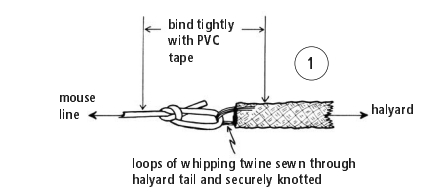
The success of all three methods — particularly the last — depends on how securely you attach the mouse line to the cable or halyard. If your halyard has a looped tail (most professional riggers splice one in the end for this very purpose), tie a bowline through the loop and bind the knot tightly with PVC tape. In a couple of minutes you can make a medium-strength, temporary looped tail (see Diagram 1).
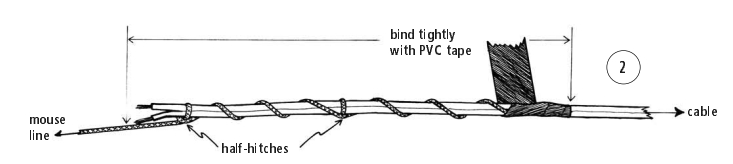
For electrical cables, wire halyards, and rope (where you need a stronger attachment than a looped tail), form a half-hitch approximately 18 inches from the end of the mouse line and slide this over the end of the cable. Keeping tension on the half-hitch, spiral the free end of the mouse line up the tail of the cable, forming additional half-hitches every 3 or 4 inches. Continue spiraling until you run out of length, then tightly bind from the end of the mouse line to the end of the cable with PVC tape, so the joint is as streamlined as possible (see Diagram 2). This is also a good way to marry steering cables to a mouse line when checking or replacing them.
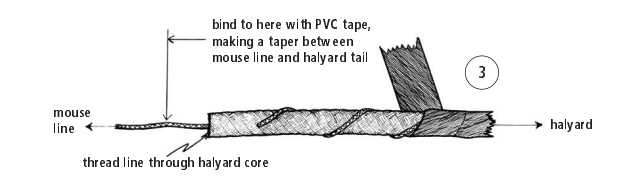
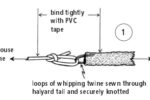
If you’re trying to work a rope halyard through a narrow masthead sheave and find the joint I’ve just described to be too bulky, use a skewer or marlin spike to thread the mouse line up through the core of the halyard, exiting about an inch from the end. Spiral the remaining foot of line tightly around the halyard and bind with PVC tape (see Diagram 3).
Niki Perryman and Jamie Morrison left Australia in 1992 to cruise in their 35-foot Lion-class sloop, Siandra. After crossing the Indian Ocean, they spent several years exploring Europe and the U.S. East Coast … heading south this winter just ahead of the cold weather.
Thank you to Sailrite Enterprises, Inc., for providing free access to back issues of Good Old Boat through intellectual property rights. Sailrite.com