What to expect when the Coast Guard comes aboard particularly in the aftermath of September 11, 2001
Issue 23 : Mar/Apr 2002
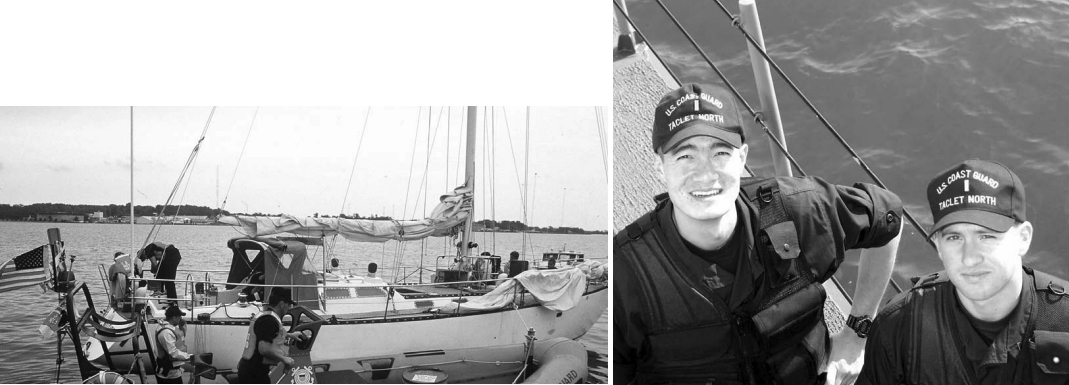
Most of the time, when your rearview mirror is full of blue lights, you can bet the officer observed some sort of traffic violation. In fact, the police cannot stop you without probable cause. Not so for the U.S. Coast Guard. This is a difference with a distinction.
The Coast Guard’s authority emanates from a variety of federal statutes that afford members of this service much broader enforcement powers than their shoreside counterparts. Federal law permits members of the Coast Guard to board vessels subject to the jurisdiction of the United States at any time for the purpose of making inquiries, examinations, inspections, searches, seizures, and arrests. For recreational boaters, this can mean an afternoon interrupted for no reason at all.
Most of us have suffered through the discomfort of a traffic stop, but a Coast Guard boarding is a different ballgame. Knowing what to expect may help you streamline the boarding process, calm your guests, and get on with your afternoon.
A typical boarding is initiated by the approach of a Coast-Guard vessel and their signaling of intent to board your boat. During the day, you can identity the Coast Guard by their ensign and red racing stripe on the bow. If the boarding is at night, remember that the Coast Guard may patrol without running lights, so you should ask them to illuminate these characteristics, although they probably will have done so already.
Once the Coast Guard representatives have identified themselves and announced their intent to board, the Coast-Guard vessel will maneuver closer. Getting the boarding team on your boat is the Coast Guard’s problem, so follow their cues and directions to the extent you feel they do not compromise the safety of your vessel. Remember, while federal law requires that a vessel underway heave to, or maneuver in a manner to accommodate a boarding team, you are still the master of your vessel and bear the attendant responsibilities. Depending on the circumstances, the Coast Guard will usually have the vessel operator maintain a steady course and slow speed while they jockey into position.
Request compensation
No matter what the conditions, transferring personnel between vessels at sea can be risky. If the Coast Guard damages your boat while landing the boarding team (or for that matter at any time during the boarding) you may request compensation. Some individuals like to ask the boarding officer for compensation forms even where no apparent damage is noted. Then, on returning to the dock, a full inspection can be performed.
The boarding team will generally consist of one officer and one or more Coast Guard personnel. If you have guests aboard, it’s a good idea to let them know that the members of the Coast Guard team will be armed and that you’ll need everyone to cooperate as you direct. It’s not a bad idea to let your guests know that, unless they are questioned directly, as captain you will do the speaking.
Once aboard, the Coast-Guard boarding team begins by conducting a quick sweep of the vessel to identify any obvious hazards. After that, the visit starts to feel a lot like your typical traffic stop. One difference is that your boat may still be making way, so it’s a good idea to have someone else take the helm.
The Coast-Guard personnel will ask to see your yacht’s registration or documentation and will, in most cases, conduct a cursory examination of your vessel. On the recreational side, they will look to ensure compliance with personal floatation device (PFD) requirements, check for fuel leaks, and otherwise give your yacht a once-over. Unless something catches their eye, or you’re returning from foreign waters, you can pretty much expect the Coast Guard to leave your closed spaces and personal items untouched.
The unwritten goal of the boarding team is to complete a boarding report (the 4100 in Coast-Guard parlance), and the more assistance you can give them the sooner they’ll be on their way. This report resembles a patrolman’s automobile accident sheet and is a checklist of federally mandated requirements that the Coast Guard wants to make sure you have satisfied. It generally covers safety fundamentals. It’s not a bad idea to obtain a copy of the form from the Coast-Guard Web site in advance, so you know what to expect. These safety precautions should be at the forefront of every prudent skipper’s mind anyway.
Terminated voyage
If the Coast-Guard boarding team determines that an “unsafe condition” exists, they may exercise their authority and terminate your vessel’s voyage. What this means is that if your boating soirée got underway with insufficient PFDs or fire extinguishers, if you are displaying improper navigation lights, or if your vessel does not meet fuel and engine ventilation requirements, you may find that the Coast-Guard team issues you a citation and, worse, terminates the voyage and follows you back to port.
If you should be confronted during the inspection with a violation, there’s no reason to panic. The boarding officer usually has the choice of issuing a warning rather than a notice of violation. As a result, it pays to keep your cool and reason with the officer. Often the boarding team will give you a break if, for example, your flares have expired or your oil-pollution and garbage placards are available but not displayed as required. On the other hand, if you have fewer PFDs than required, don’t expect much leeway.
The Coast Guard is able to assess monetary penalties for the violations it finds, although the process for doing so is complicated. Once a notice of violation is issued, a copy of your boarding report is forwarded to the commander of the district in which the violation arose. Upon review, the district commander has three choices: (1) take no action; (2) issue a letter of warning; or (3) forward the violation to an independent hearing officer. If it is sent to the hearing officer, the evidence will be reviewed and where it is found to sustain the violation, a letter of notification will be sent to you advising you of your rights and setting forth a proposed fine.
Appropriate evidence
You can simply pay the proposed penalty or submit a rebuttal statement with any accompanying evidence you feel appropriate. When you submit a written statement, you have the choice of contesting the entire violation or seeking a reduced penalty. If you feel the written statement doesn’t do your side of the story justice, you can request a hearing. Whatever path you choose, read your letter of notification carefully as it will have specific time limits by which you must make such requests.
A word about the worst-case scenario seems appropriate. On any occasion where government interests and individual rights clash, the legal waters can be murky. The savvy skipper will remember to protect his own concerns while accommodating the demands of the Coast
Guard. Be smart and cooperate as much as possible. Let the coasties know if you recently had a courtesy inspection by the U.S. Coast Guard Auxiliary or if you have additional safety equipment aboard. Assist them in completing the boarding report. And promptly identify and produce any weapons you may have, when they ask.
At the same time, volunteering too much information can open the proverbial cabin door and risk exposing you to unintended violations. If the boarding has turned serious, and you face penalties for operating while intoxicated or where drugs are involved, you may want to consider invoking your right to remain silent and seek the aid of your attorney. All too often, statements and admissions made at the time of an incident come back to haunt you. (We encourage our readers neither to operate their boats while intoxicated nor to allow illegal drugs aboard –Ed.)
When you return to the dock, take a moment to review the boarding report. If there are any violations or warnings identified, fix them immediately. It’s a good idea to save proof of your prompt repair by maintaining the receipt or work order, and noting it in the vessel’s log. In this way, should you get boarded again, you’ll be able to demonstrate that the problem was promptly corrected. If you are facing a violation, such proof of immediate repair might help you petition for a lesser penalty.
Coast-Guard boardings are about as much fun as beating your way up a weather shore. Still, they have their uses, and all skippers worth their salt will use the threat of a boarding to make sure their vessels meet the Coast Guard’s minimum requirements.
John was raised on the shores of Rhode Island and got his first sailboat, a 15-foot Lawley, at the age of 12. Launch driving and sail charters in the summers were followed by an upgrade in his USCG license and a five-year stint as a captain for a New England-based towing and salvage company. Leaving the wheelhouse behind, he now practices admiralty and maritime law in New York.
This article is meant to convey information, it is not considered to be a legal opinion.
Thank you to Sailrite Enterprises, Inc., for providing free access to back issues of Good Old Boat through intellectual property rights. Sailrite.com