Issue 25 : Jul/Aug 2002
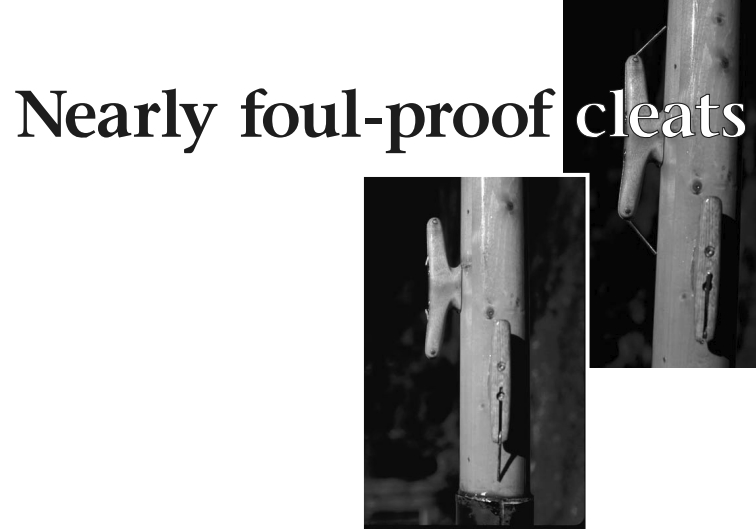
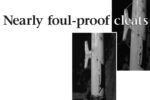
Having had my wind-whipped luffing sheets, halyards, and numerous other lines foul on cleats, I came up with a solution to this dilemma: a foulproof wooden cleat.
A groove cut in the top houses a bent brass wire rod “finger” much like a multiple-size Allen wrench, as shown in the cutaway view at bottom right. The finger is normally folded into the groove cut in the cleat. A line can be belayed in the usual manner. When the cleat is not being used, I extend the fingers, which allow lines to slide over the cleat without snagging.
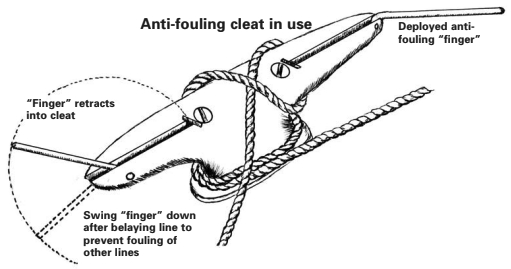
I obtained the soft brass 1⁄8-inch rod from a hobby shop. It required no heat to soften it up when forming the eye. Flat 1⁄8-inch brass or aluminum stock will also work. A piece of hard close-grained wood, such as cherry, may be used if you don’t like to polish brass.
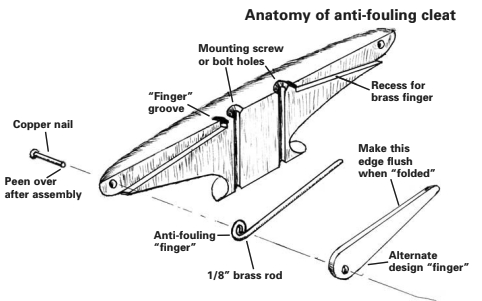
After laying out the size and shape of the cleat, I first cut the groove using a table saw, then did the shaping of the cleat and rounded it until it pleased my eye. As a retaining pin for the “finger,” I used a copper nail with the head trimmed off a bit and peened the nail’s other end after assembly. I guess it cost me less than a buck (brass rod at a hobby shop can be expensive.)
Is it 100-percent foulproof? I don’t know. I can picture a bight catching on the shoulder at the end of the horn if the lead is close to horizontal. But if it is shaking like a luffing sheet, it wouldn’t stay there long. So let’s assume it’s 95-percent foulproof.
Thank you to Sailrite Enterprises, Inc., for providing free access to back issues of Good Old Boat through intellectual property rights. Sailrite.com