Part Three from the cruising chef with a focus on catching and preparing finned treasures of the sea
Issue 25 : Jul/Aug 2002
I am not what could be called a sport fisherman. Whereas sport fishermen envision their catch leaping above a sparkling sea, I picture mine surrounded by onions and carrots. When the fish leaps, I begin to salivate. I may not be a sportsman, but I know how to put fish on the table.
My idea of a fishing rod is a 12-ton sloop with a large two-speed ocean reel hose-clamped to the stern rail. My idea of light line is 60-pound monofilament with a heavy leader. I haul fish in and make them into fillets.
If a fish is too big to reel in I turn on the engine and tow it for a few miles until it drowns. I learned this useful technique one morning while single-handing across the Atlantic. As is my habit when single-handing, I slept at dawn and awoke to a gorgeous day with a very light wind and no swell and the dark outline of Flores, the western-most island of the Azores, in sight. I kept getting the feeling that something was amiss. At last I discovered that the fishing line was bar tight and that something very, very large was towing me back toward the United States at a slow but steady pace.
Normally I would just cut the line, but I was close to land and had visions of giving away the fillets of whatever was out there to my friends. It was time for the engine. After towing whatever was on the line for about an hour, resistance ceased. I reeled in a monster tuna, weighing perhaps 300 pounds. Its eye was as big around as a teacup.
There was no chance of hauling it aboard by brute force. I gaffed it, tied the gaff to a halyard, and threw the halyard on a winch. I was lifting the fish, but the small, cheap gaff was at its limit. I could also hear the block at the masthead squealing in protest. Something was going to give. I ran a line through its gills, secured the line to a shroud and got to work with a machete and saw. I eventually ended up with about 135 pounds of very fresh tuna, which might not have been the lion’s share, but it was nevertheless a very good piece.
I am always on the lookout for circling or diving birds, weed patches, or jumping fish. If these areas are not too far off course, I like to troll around them. In areas of current such as the Gulf Stream, a big swirl of debris often indicates an eddy whose edges are packed with fish.
The secret of being a good trolling fisherman is hauling in your lure and checking it frequently. Every hour is not too much. The more often you do so, the more fish you will catch. Otherwise seaweed and debris get caught on the lure, rendering it ineffective.
Trolling lures fall into two categories for a sailor: lures for a speed of five knots or more and lures for lower speed. When a boat is moving above five knots, the lure goes by the fish like a shot, and only the creature’s instinct causes a reaction. Feather and plastic lures looking only slightly like fish do well. If the lure goes slower, the fish are able to swim up to it and have a better look. When they see a feather jig going three knots, they seem to say, “What is that?” In this case, the lure needs to look more authentic and have much more action, like a big freshwater bass lure.
Kinds of lures
I’ve used feather jigs, squid jigs, yarn jigs, can lids, spoons, coins, and long-shank hooks wound with rag and wrapped with Christmas tree tinsel. Light-colored lures with a flash of red, blue, or green work well on bright, sunny days. Darker lures do better on an overcast day.
I prefer a #7 Owner hook with a five-foot 175-pound wire leader. This short-shanked, extremely sharp hook is of the highest quality. Expensive hooks such as this should not be stored in your tackle box, mixed in a rich stew of dissimilar metals and sea salt. They are better off living with your sewing needles. I also use #9 stainless double hooks on a wire leader attached to a heavy swivel. These hooks are not as good as the Owners and can straighten out, but they don’t rust. So they outlast the Owners. I maintain a supply of 6-inch feather jigs in a variety of colors and eight plastic squids for moonlit nights. I usually do not troll on dark nights, however, because the critters I have caught bit me, scared me, and nearly drowned me, and I don’t like messing with vicious animals at close quarters on a pitching deck in poor light.
I use 6- to 8-inch bass-type lures for low speed and prefer mackerel imitators. These look like little fish. I usually replace the lightweight freshwater treble hooks with larger double-stainless hooks by cutting the trebles off and slipping on the doubles, which are then moused with stainless wire. As the boat speeds up, you can tell it’s time to change to a feather jig when the bass lure begins jumping clear of the water.
The best way to land a bluewater fish is to grab the wire leader at the swivel with a gloved hand and fling the fish aboard. Gaffing is OK, but requires skill. The fish sees the gaff and struggles. The gaff can miss, driving the fish into a frenzy. Many fish are lost this way, but once the gaff goes in, the fish stiffens and is easy to land.
The force of tossing a fish through the air onto the deck will temporarily stun it, allowing you time to slip it into a plastic garbage bag. The bag calms the fish and contains the blood and mess that follows. Send sensitive crew below. Beat the critter on the head with a winch handle three or four times. Don’t be shy. Meaner is kinder. If you are just too kind to be so brutal, toss a shot of rum into the critter’s gills. This kills it instantly — and what better way to enter the Pearly Gates than stoned on rum?
Immediately take a chisel, screwdriver, or short, heavy knife and sever its spine just behind the head. Once the spine is cut, the fish stops jumping around. Work right through the garbage bag. Use a hammer if necessary. Work a knife around in the wound to make the fish bleed. Close the bag. Allow the fish to bleed a few minutes.
Ninety percent of the fish I have taken by trolling in deep water were tuna and dorado (called mahi-mahi in the west or dolphin fish in the east), with an occasional wahoo thrown in. Closer inshore, I often get bonito and mackerel, which I am not fond of eating. If I keep a mackerel, it will probably become bait.
Bottom fishing
At anchor I use cod sets which consist of a dozen or more baited round hooks on 2-foot leads set at 4-foot intervals with a 3-ounce sinker at the end. I keep a bag of wine corks handy and push the hooks into the corks as I bring them aboard. I usually bait with pieces of small fish.
I drop the set after dark, preferably into water deeper than 30 feet. If the set is to be dropped near the boat, I frequently chum by grinding up whole baitfish and periodically tossing the mess over the side. This brings small fish, and they bring the big fish.
If the set is not attached to the boat, it should be attached to something heavy like a small anchor (with a float) so the fish don’t swim off with the set. Pick up the set at dawn because the hooked fish are vulnerable to sharks. You get rock cod, sea bass, and ugly fish like sculpins, which are very tasty. You also get the occasional ray or skate whose wings are very, very tasty. I also love to use collapsible crab pots, but it’s getting harder and harder to find clean waters to fish for crabs, and you don’t want to eat crabs taken from a harbor unless you like the taste of oil.
Cleaning flat fish
Members of the very tasty halibut family begin life like other fish with an eye on each side of the head, but as they develop the eye on one side migrates to the other side so that the fish, instead of having a right and left side has an up and a down side.
- With a sharp knife trim away the fins that run around the edge of the fish.
- Slip a small sharp knife under the skin at the tail and cut through both sides from tail to head.
- Connect the cuts.
- Pull the skin free by pulling it off from tail to head. Keep your hand close to the body so that you pull forward, not upward. Use a small sharp knife to assist.
- Cut away the guts and run your finger along the backbone to remove any dark red clots.
Scaling round fish
This is easier when the fish is wet. It’s helpful to have someone stand by with a bucket of seawater to assist you. Scaling should be done before gutting, filleting, or steaking the fish because the guts fill out the abdominal cavity and make the job easier. Hold the fish down by its tail and slide the knife or scaler in short strokes toward the head. A scaler works much better than a knife. Be sure to get the base of the tail, around the fins, and under the head. Wash thoroughly in seawater. Feel all over to be sure all the scales are removed.
Tuna and swordfish have short, heavy bones and are often steaked:
- Scrape to remove excess tiny scales and slime.
- Gut the fish and trim away the fatty belly strip.
- Wipe the skin with a paper towel.
- Chop the rear section of the fish free, at the anal vent. This portion will be filleted.
- Place the fish on a cutting board and slice it like a salami, creating steaks about 3⁄4-inch thick.
Filleting large round fish
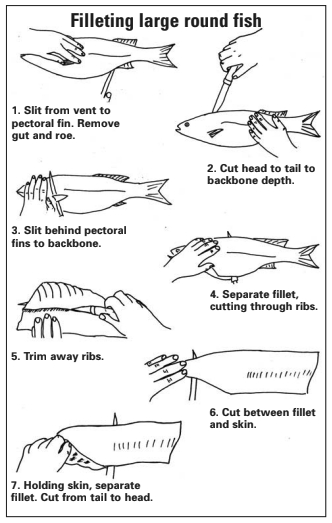
A round fish, such as dorado (mahi-mahi) and wahoo, is the kind that has all of its parts in the usual places. The best place to dress the fish is on the cockpit seat so you can kneel in the cockpit. Make bold, decisive cuts so you don’t have many ragged edges and flaps of meat (see illustration above).
- Cut from anal vent to pelvic fins. Gut the fish and save the roe. Male mahi-mahi have a bold, blunt head. The “roe” they produce is milt and is not tasty.
- Make a deep cut to the backbone from head to tail, bumping the knifepoint along the backbone.
- Make a deep cut behind pectoral fins to connect dorsal and ventral cuts.
- Separate the fillet from the body, cutting through the ribs.
- Trim away the ribs.
- Skinning. Rinse the fillet and pat dry. Place it on some newspaper spread on the cockpit seat. Place the fillet next to the edge of the seat so that the knife handle (and your hand) will be clear of the seat. Hold the tail end of the fillet and slip your knife between the skin and flesh. A large carving knife is better than a filleting knife for this purpose. Hold the tail end of the fillet and make a cut between meat and skin large enough to grab the skin.
- Grab the skin and saw forward with the knife, angling it slightly downward. A helper can assist by slightly lifting the fillet as you work so that you can see what you are doing.
- Soak the fillets in several changes of seawater to remove the blood.
Lateral lines
Some fish, including mahi-mahi and tuna, have lateral lines the color of dark, raw beef, which run the length of the fillet. This is unpleasant and strong tasting. Trim it away. This usually leaves you with four long fillets.
Preparing small fish
The recommended way to cook small fish such as pilchards or smelts is to roughly gut and spit them, make two oblique cuts through the skin on each side and toss them on the grill over very high heat or open flame for a few minutes. This cooks them and scorches off the scales.
Gut small fish by slipping a very sharp knife into the anal vent, then sliding the blade toward the head until it is stopped by the pelvic (fin) bones. Cut the pelvic fin bones away by sliding the knife under them. Tear the guts from the abdominal cavity with a quick pull. The fish is then simultaneously gutted and decapitated by bending the head back and twisting it off after the backbone snaps. Remove any clinging viscera, and be sure to remove the blood lines under the backbone by gouging them out with a fingernail. Rinse.
Cooking your fish
Marinating: Soaking fish in various mixtures of wine, garlic, vinegar, and onions for a few hours prior to cooking accomplishes several goals. It helps reduce the fishy odor and taste of dark-fleshed species such as mackerel. If you’re using lemon juice and salt as the marinade, you can make a delicately fleshed fish firmer, reducing its tendency to disintegrate. A good marinade also imparts some of its flavor to the fish.
When is it done?
Fish cooks much faster than meat or fowl. Fish is most effectively tested with a finger poke or a spoon. For poached, baked, or grilled fish, slip a spoon between segments and give a slight twist. The segments should separate easily, and the interior should steam. The flesh should be opaque, not translucent. If fluid wells up when the fish is opened, it needs a little more cooking. Fish is done when it is white to the center but still moist. If a fish falls apart when lifted with a spatula, it is overcooked. Firm-fleshed fish, such as swordfish and tuna, never become as tender as snapper or sea bass.
Poaching
This is an excellent cooking method for fish. It leaves the fish succulent and moist and is very forgiving of overcooking. When poaching, be sure the fish is not too thick. Poached fish is usually not turned over because it will fall apart. If the portions are more than 3⁄4-inch thick, it is better to divide the fish to make it thinner. Fish can be poached in plain water, but a combination of herbs, onions, leeks, and wine is preferable. The liquid should simmer but never boil while the fish is in it. The poaching liquid may be thickened into a fumet (concentrated broth) or thickened with a roux (thickener like gravy).
Another approach is to remove the fish, then mix a bit of the poaching liquid with a big dollop of mayonnaise. Heat and stir for a few minutes. Pour back over the fish and vegetables.
Poached fish is never completely covered by the poaching liquid. A good description of how much liquid to use comes straight from the nautical chart: “uncovers and is awash at low tide.” We almost always use a slope-sided frying pan with a lid for poaching. Pour the liquid off, and slide the fish onto a plate.
Poaching technique
Butter the bottom of a large frying pan. Add poaching liquid and boil. Add fish, reduce heat. Simmer until done. Cook 5 to 12 minutes depending on thickness.
Poaching in sauce
Fish may be poached in any sauce, such as tomato sauce, which does not break when simmered. Fish marinara is hard to beat. Seafood can be poached in a delicious curry sauce. But poaching in a sauce that has been thickened breaks the sauce.
Pan frying in oil and butter
Butter burns at low temperature and is therefore a poor choice as a frying liquid. Fry fish in peanut oil and add a little butter for flavor. Always use fresh oil. To test the temperature of the oil, drop a pinch of flour into the pan. If it skips on the surface and sizzles, the oil is ready. Add fish and brown quickly on one side, turn and reduce heat.
Size of pieces
If the fish or fillet is more than two inches thick, it must be cut up, steaked, or in some way made thinner. Thick, meaty fish may also be partially pan fried on both sides until slightly brown, then baked in a 350° F oven for five minutes per pound.
Breading and coating
Fish to be fried may be first dusted with flour, cornmeal, cornflakes, or matzo meal before cooking. Pat a fish dry, dip it in egg and milk, and then shake in a plastic bag with flour or breading mix.
Breading mixes for fried fish
These combos can also be coated with melted butter and poured over a fish that is to be baked:
Oriental: Three cups chow mein noodles, crushed.
Almond: one cup cracker crumbs, one-half cup blenderized almonds.
Potato chip: one bag (4 ounces) potato chips, one cup crushed cornflakes.
Tortilla chip: one cup spicy tortilla chips, one cup cracker crumbs, chopped hot pepper to taste.
Fried fish roe
Fresh roe is one of my favorites. I love its gluey taste, and I am delighted to see big roe sacks in a fish I’ve caught. Fry the roe, slice it thinly lengthwise, and slip it inside an omelet. The well-known gourmet James Beard said that the only way to cook roe is simmered in butter for seven minutes on each side.
Braising
Braising fish involves frying in a breading or batter until golden, then adding a little sauce and sautéing. The sauce bonds to the breading. You could just sprinkle on a little beer, soy, parsley, and garlic.
Broiling
Fish is usually broiled by just brushing it with a little oil and placing it under the broiler. Sauces or coatings are usually added at the last minute; otherwise they burn. If you want to oven-cook a fish with a sauce or coating, it is usually baked, then broiled for a minute to give the top some color. Extremely delicate, thin fillets can be coated with a breading mix and cooked using this technique.
Baked or roasted fish
Oven-baking fish is a great cooking technique but it heats up the boat. Baking or roasting on a grill eliminates this problem. Fish can be roasted on the grill but must be kept moist by placing them in an oily liquid and basting them frequently. Bake in a 400° F oven until opaque. Use the spoon to test for doneness. Bake about 10 minutes for every inch of thickness, measured at the thickest spot.
If you don’t have an oven, these recipes can be cooked in a heavy casserole dish on a burner flame diffuser at medium heat for the same period of time. A fork should be frequently slipped around and beneath the fish, covering the bottom of the pan with liquid to prevent burning.
Sharks and other exotic fish
Sharks, even small ones, don’t like being caught and have difficulty with the concept of being dead. A blow on the top of their head kills them but does not eliminate the possibility that a dead shark won’t suddenly lunge out and ruin your day. Their incredibly durable nervous system makes them dangerous for a long
time. Ram an oar down their throats
so they can’t bite you.
Preparation
Makoes, threshers, and leopards are the most commonly consumed species and dogfish are usually the ingredient in fish ’n chips. Shark meat is always skinned, as the skin shrinks during cooking and breaks the meat.
Use of a marinade
Shark meat is very lean and contains ammonia. It should be soaked in an oily acid marinade. It grills well, like swordfish, and can be coated with red pepper marinade while cooking, but not soy-based marinades, which are too salty. Serve with mayo, pesto, white sauces, hollandaise, cheese sauce, mushrooms in butter, marinara, or salsa.
Rays and skates
The cruising yachtsman has the advantage of frequently finding these creatures on sand and grass flats, especially at night. They offer an easy target for a spear fisherman as they lie on the bottom, half covered with sand. Once you have eaten them, you will want more.
Danger
Rays, once landed, should be killed with a blow between the eyes. This is more than just a humane act; rays have a sharp spine in the base, not the end, of their tails, which should be broken off immediately with a pair of pliers. Although the spine is not poisonous, it is covered with a mucous membrane that causes great pain and infection. The ray’s sting is much worse than its bite since rays have no teeth. Skates have neither teeth nor sting.
Cleaning
The edible portion of skates and rays is in the wings, which should be cut away close to the body. The wings may be skinned and used as any fine-flavored fish, but they are also quite delicious as a substitute for scallops. They may, therefore, be cut into bitesized pieces and used in any scallop recipes. Finally, rays are excellent for stretching a thin supply of crab, shrimp, or lobster meat in recipes where the flaked meat is mixed together, such as fritters and pates.
The puffer, the world’s deadliest delight
The puffer is a blowfish which, when inflated, looks like a grapefruit with fins. They discourage predators by looking much larger when inflated than their original size. The spines also stand out menacingly when the body is inflated.
Catching blowfish is definitely not the angler’s idea of high drama. Considering their tiny fins and comical vestige of a tail, it’s easy to understand why they don’t put up much of a fight. I sometimes wonder how they manage to swim at all. The blowfish’s idea of resistance is to take water or air into its body until it looks just like a balloon. When inflated, they offer about as much sport as hauling in a soggy tennis ball. But more frequently than not, they get so excited when hooked, they forget to inflate until they are landed. Then they are more comical than ever, puffing away, getting larger and larger in your hand.
Anglers hate blowfish. They have tiny mouths that nibble away the bait. This tactic drives most sportsmen away, but if they knew how delicious blowfish are, they might decide to stay. Since they have tiny mouths, blowfish require a very small hook with appropriately sized bait. They bite with vigor, and you can pull them in one after another since they seem to travel in schools. Blowfish will take any bait, but seem to enjoy shrimp tails or tiny beach crabs most of all.
The Pacific puffer, in addition to inflating itself, further discourages its enemies by poisoning them. The gall bladder of some Pacific varieties contain a toxin 25 times more deadly than curare, enough to poison 40 to 50 people! The Pacific puffer is so poisonous that the Japanese government licenses puffer chefs to prevent mass poisoning. Nevertheless, many a puffer gourmet has died, fork in hand.
One might logically ask why a fish so deadly is consumed with so much delight by so many. The answer is simple: the puffer is exceedingly delicious. Served raw in thin, translucent strips as sushi, it is sweet, gelatinous, and delicately flavored. Steamed, it melts in the mouth. It is a joy in any stew and a cut above poached pompano, which is a fish not to be sniffed at. Perhaps the puffer’s flavor is further enhanced by the risk one takes.
Fortunately the North Atlantic puffer is not poisonous and is commonly sold in markets as “sea squab.” The fish is nearly boneless, and the drumstick-like fillets contain only the backbone. They may be cooked like any delicate white fish. A more delicious critter is hard to find.
Fresh tuna and swordfish
Fresh tuna and swordfish have very firm flesh and cook similarly. Fresh tuna and swordfish taste similar to lean veal and can be treated as such. These fish beg to be marinated and grilled. They can be braised or roasted with tomatoes, onion, and paprika; served in a stew with potatoes, carrots, and chicken stock; or pan fried in butter and served with a white sauce.
The firm flesh resists the spoon test, so when you use the spoon, look for liquid welling up in the separation. This indicates the fish is not quite done.
Thank you to Sailrite Enterprises, Inc., for providing free access to back issues of Good Old Boat through intellectual property rights. Sailrite.com