Hard work converts a classic Hinckley from total wreck to total delight
Issue 25 : Jul/Aug 2002
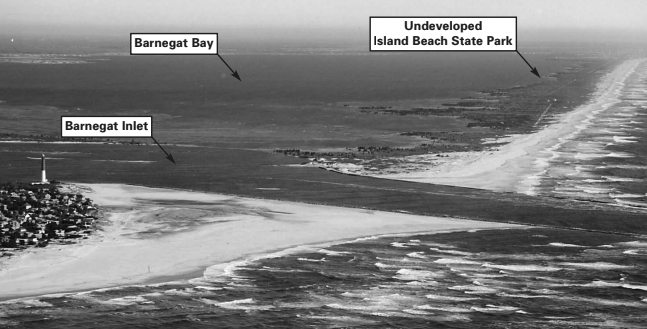
For sailors, one of the worst nightmares is to be driven into the breakers of a lee shore. At 2:35 a.m. on the night of September 26, 1992, in torrential rain, a howling gale from the northeast, and huge seas, the 1963 Hinckley Pilot 35 yawl, Katsura, was driven into the surf of Island Beach State Park, on the New Jersey coast. As she entered the shallow water near the beach, she lost her rudder and was hurled in a downward plunge from the crest of a breaker onto the hard sand bottom. Of the four men on board, one was washed overboard and drowned. Another, tethered to the boat, was thrown beneath the boat and killed. The remaining two were able to fight their way through the raging surf to the beach.
Hundreds of shipwrecks are strewn on the flat, sandy bed of the continental shelf off the coast of New Jersey: old square-riggers, World War I and II victims of U-boats, commercial fishing vessels, and recreational craft.
During the last week of September 1992, Hurricane Danielle moved up the East Coast. Just south of New Jersey, Danielle took a turn inland. Although the brunt of the diminishing storm was then over land, gale-force winds, heavy rain, and high seas were recorded all along the coast of New Jersey. It was in these conditions that four men, sailing a classic Hinckley fiberglass yawl, were returning from a race in Newport, Rhode Island. Their route was down the New Jersey coast to Cambridge, Maryland. They planned to enter Delaware Bay, just south of Cape May, New Jersey, then sail up the bay to the Chesapeake and Delaware Canal, which would bring them to the north end of the Chesapeake.
Experienced sailors
The boat was owned by lawyer Myron Mintz, 51, and captained by Paul Burch. Both were from Alexandria, Va. With them were two friends, Steven Gallin, a 48-year-old real-estate developer from Potomac, Md., and Thomas Hinds, 32, also of Alexandria. All four were experienced sailors who had made this passage before.
The Katsura had left Martha’s Vineyard two days earlier in good weather, but off the coast of Long Island they had begun to experience the effects of Hurricane Danielle. Five hours before the grounding, as the storm clouds marched down on them from the northeast, the yawl lost her mizzenmast over the side, due to a rigging failure. This carried away her VHF and GPS antennas.
Just a half-hour before the tragedy, as the wind was increasing, the mainsail became fouled and couldn’t be lowered. Their efforts to start the engine were fruitless. To compound the problems, Katsura was off Island Beach State Park, a barrier island on the New Jersey coast. This island is undeveloped and at night is completely dark, unlike the rest of the shoreline south of New England. From offshore, on a dark moonless night, it’s hard to tell an island is there.
At the bottom of a trough, as their boat was closing on the beach, she hit hard on the bottom, tearing away her rudder. This ruled out any chance of escaping to seaward. Engulfed in the surf, she took a crushing blow to her port side as she was dashed onto the bottom. Tom Hinds, Steve Gallin, and Paul Burch were thrown into the water. Owner Myron Mintz was in the cabin when the boat entered the breakers. As Katsura was pushed toward the shore by the surf, Myron and Tom were able to make it through the breakers to the beach, but Steve and Paul perished. Myron and Tom found their way through the sand dunes to a deserted state park pavilion and its pay phone, where they summoned help. Two hours later the scuba team from the Seaside Park Fire Department located Steve’s body about a half-mile down the beach from the wreck. Katsura, on her side in the surf, took a pounding all night.
High and dry
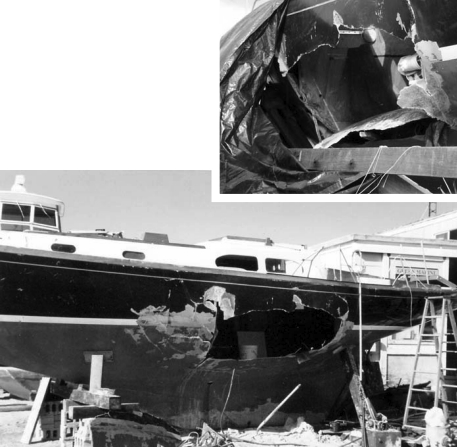
By daybreak, the wind, rain, and high seas had begun to ease as Danielle was downgraded from hurricane status. When the higher-than-normal tides from Danielle’s low-pressure system subsided, the battered and ruptured hull of Katsura, filled with sand, was left high and dry up on the beach with a 4-foot by 10- foot hole in her port side. Salvors, using a bulldozer, were able to drag the forlorn wreck up to the parking area next to the beach pavilion. This caused additional damage, including a large hole on the starboard side. The hull was then lifted by a crane onto a flatbed truck and hauled away.
At this time, Thomas Green III, and his wife, Michelle, were returning to New Jersey from a Caribbean vacation. Tom had admired the charter yachts he had seen in the islands. “The nicest boats we saw were the Hinckleys,” he said. Tom was determined that if the chance ever came to purchase one of these top-of-the-line yachts at a good price, he would. The weekend Tom and Michelle returned home, the front page of The Asbury Park Press showed the picture of the Hinckley on the front page, wrecked on the beach just a few miles away. When the insurance company declared the Katsura a total loss, Tom made a $750 offer for the holed hull, which the insurance company accepted.
Found a home
Tom is not just a dreamer. He has been around the water and boats all his life. He started working at a local marina when he was 13, working there for 12 years. After that he worked for a fiberglassing company, honing his skills in fiberglass repair techniques. He is now in marine construction, building docks and bulkheads.
Tom built a large workshop on Cedar Bonnet Island, along the causeway going to Long Beach Island, N.J., from where his business is run. Above the workshop is the Greens’ home. This home and workshop is located just a few miles south of where Katsura was wrecked. In Tom’s workshop, the ruptured hull of the 35-foot Hinckley found a home.
The Hinckley Company, one of the oldest yacht builders in the U.S., was founded in 1928. It is renowned for its semi-custom sailboats and attention to detail. In November 1997, the Hinckley Company was purchased by the private investment firm of Bain, Willard Cos., of Boston. Two years later they also bought the Ted Hood Companies. The Hinckley Pilot 35, designed by Sparkman & Stephens and built in Hinckley’s plant in Southwest Harbor, Maine, is a classic yacht. The first wooden Pilot 35 was launched in 1956, the first fiberglass Pilot 35 in 1963. Katsura was one of those first fiberglass hulls. Although the last fiberglass Pilot 35 was built in 1975, these yachts are still in demand by sailors who have an eye for beautiful and traditional lines. Hinckley built 125 Pilot 35s, both sloop and yawl rigs. Production ended in 1975.
The fiberglass Pilot 35 has an overall length of 35 feet 9 inches, a waterline length of 25 feet, a draft of 5 feet, and a beam of 9 feet 6 inches. The displacement is 13,500 pounds, and the yawl rig has a sail area of 553 square feet. The hull’s sheerline is particularly attractive, complemented by the low cabin trunk, spoon bow, and sloping transom. Belowdecks the Pilot 35s have teak-and-holly cabin soles as well as the superb cabinetry and joinery work that is a hallmark of the Hinckley craftsmen.
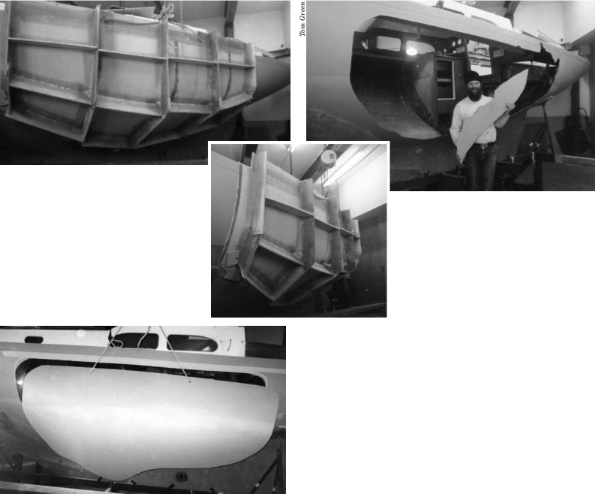
Dave Fox, Tom’s friend and helper, top right, stands next to the hole in the port side where the fiberglass has been cut back to solid laminate.
The new section of the hull, at left, laid up in the mold, is lifted into place.
Resurrection
With this classic boat safely stored indoors at his shop, Tom and his high school chum, Dave Fox, began the long restoration process that would ultimately restore the battered hull to a like-new state. Katsura was in good hands.
First they made a cradle. This was designed so a low-bed trailer could drive beneath the boat, and the hull could be lowered onto the trailer. Next, the hull was sandblasted. Then, using hydraulic jacks, the 5,500-pound lead keel was removed and the bolts checked as a precaution. “We were afraid that during the grounding these bolts may have been damaged,” recalls Tom, “but due to the way the keel was keyed into the hull, the bolts were in perfect condition, and the keel was then replaced and rebedded.”
As part of the complete rebuilding process, the interior was gutted, but every piece of undamaged woodwork was saved to be refinished and reinstalled. This gutting was a necessity; there was sand in every crevice of the hull. They removed all exterior woodwork and hardware from the hull to be refinished or replaced. The engine, too, was removed and rebuilt.
Tom was fortunate to have been able to recover the large section of the port side of the hull that had been ripped away. This section was temporarily glassed in place, then the hull was faired with auto-body repair compound and sanded to a perfect finish. It was then waxed several times, and a fiberglass mold was laid up over the temporary repair. This mold, which was strengthened with wood braces, then provided the form for laying up a new fiberglass hull section. The area of shattered fiberglass around the port-side hole was cut back to where the laminate was solid, the new section of hull was cut to the same shape, fitted into the opening and glassed in place. The resultant repair was strong, true, fair, and perfect. Dave, a perfectionist, painted the hull using Interspray 800.
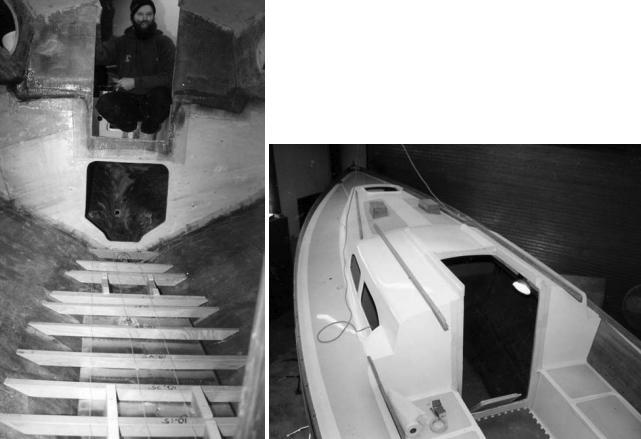
The deck of the Hinckley has been refinished, at right, and undamaged teak that could be salvaged has been refurbished. Where necessary, new teak has been installed.
Woodwork sheathed
With the holes in the hull repaired, new, heavier bulkheads were fabricated and strongly glassed in place. Floor joists and stringers were also replaced, and all interior structural woodwork was sheathed in fiberglass. New water and holding tanks were fabricated and glassed in place, and many creature comforts were rebuilt and upgraded, including a larger refrigerator with R-50 insulation.
They planned to replace the spars that had been destroyed or lost during the storm with carbon-fiber spars. They had to construct a new rudder to replace the one that was lost in the grounding. New bow and stern pulpits, to replace the mangled ones, were constructed.
During this restoration time Tom was in frequent touch with the Hinckley Corporation by phone and through personal visits. He found them to be extremely helpful and cooperative.
Although there is still some work to be done on the Hinckley, most of the major repair problems have been taken care of, and this classic hull will soon be returning to her natural element. “I’m looking forward to sailing her with my dad,” says Tom. On summer weekends he and his dad race O’Day Mariners at the Surf City Yacht Club on Long Beach Island. He says the Hinckley will be a definite step up. But before the restored Hinckley is launched she will be given a new name. “I’m going to name her after my grandma, Kitty,” Tom says. Obviously this Hinckley will become part of a close-knit family.
When will the resurrected Hinckley be sailing again? Dave says with conviction: “You can’t put a date on these things, because then you start rushing to meet that date, and you don’t do a good job.”
Like the legendary Phoenix that was resurrected from the ashes, the battered hull of the classic Hinckley has come to life again. This restoration is in good hands.
Thank you to Sailrite Enterprises, Inc., for providing free access to back issues of Good Old Boat through intellectual property rights. Sailrite.com