Adding years of life to a tired 30-foot wooden ketch
Issue 28 : Jan/Feb 2003
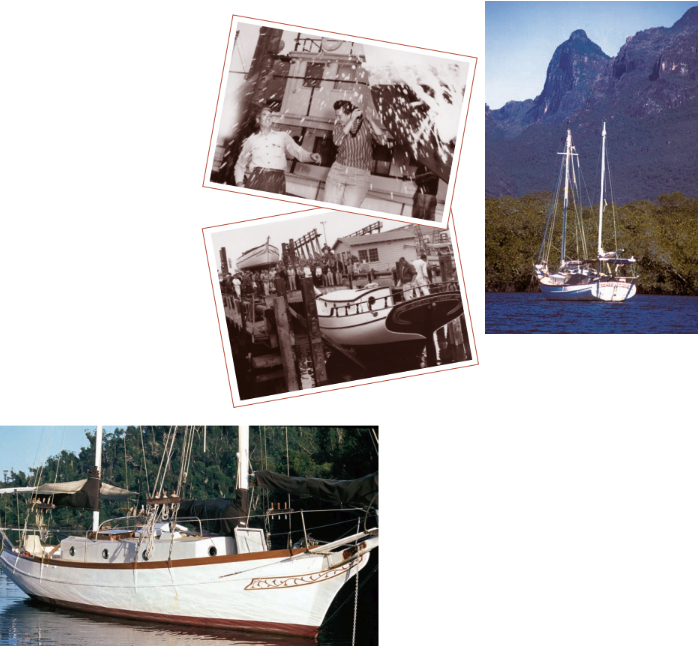
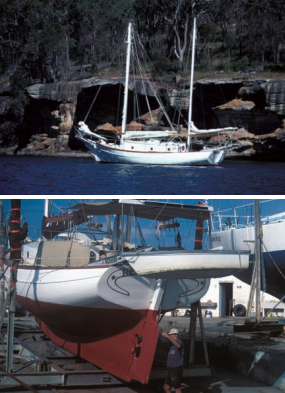
I first fell in love with Renee Tighe in Townsville, North Queensland, when American circumnavigator Earl Koepke brought her to anchor near my own boat. As she swung to wind and tide, I could not see an ugly bone in her body. She seemed perfect with her beakhead, crescent sheer, tumblehome quarters and champagne-glass transom. The year was 1969.
Less than 10 years later, married and cruising on my third yacht, we came to anchor in lovely Madang Harbour in Papua, New Guinea. While rowing a stern line to a coconut palm I suddenly realized we were in good company; Renee Tighe was similarly moored just a biscuit-toss away.
She had completed her circumnavigation in Florida, where Earl sold her to an Australian. He then sailed her back across the South Pacific to her new home (and would later continue his passage to Australia). Now used as a weekend plaything, Renee was looking a little sad. My wife immediately shared my love for this much-traveled little ketch.
Another 10 years passed before she was ours. Dilapidated, smelling of rot, leaking, in need of refastening and with the probability of worm in her keel, we bought her at a price only servants of classic wooden boats pay. Renee was more than just a pretty little yacht with a big past, she was a well-documented piece of American maritime history that could not be abandoned.
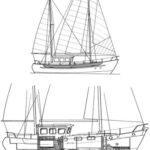
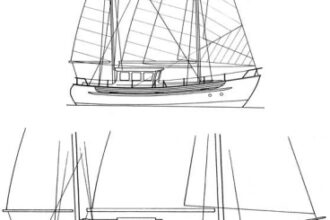
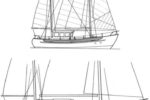
Renee Tighe was designed by Hugh Angelman and Charles Davies for Californians Bill and Renee Tighe. Known as the Alpha, or A30 class, she measured 30 feet by 11 feet, 4 inches by 4 feet, 6 inches (the draft had increased to five feet when I purchased her). Bill and Renee built her in Santa Ana with some unexpected help from a friend, Willard Buchanan. Willard’s name was to live in American commercial history.
First of many
Launched on December 14, 1957, in company with her twin sister, August Moon, Renee was among the first of many vessels built by a company then jokingly called The Willard Boat Works. This would later become The Willard Company, designers and builders of fiberglass and aerospace products.
Bill and Renee kept their little ketch until 1964 when she was sold to John and Fabia Schreiber, who cruised Mexico while raising a family aboard. Then Earl Koepke bought her and sailed her around the world.
In 1988, my family and I had just completed our own world circumnavigation. Renee Tighe came on the market within days of our selling our boat. She was to prove the perfect therapy for a restless sailor. I rented a small plot of industrial land and hauled her out for major repairs and restoration.
Having bought her more on emotional impulse than good common sense, I did not survey her below the waterline. I presumed the worst because all her deadwood was of Douglas fir (also known as Oregon pine). I had never been convinced by this uniquely American habit of using softwood in such a worm-prone area. I expected to find most of her backbone eaten away after 31 years in the water, much of it in the tropics.
It was thus a totally unexpected bonus when, after drying and burning back to raw timber, I found not a sign of worm. But that was the only good news.
Internal rot
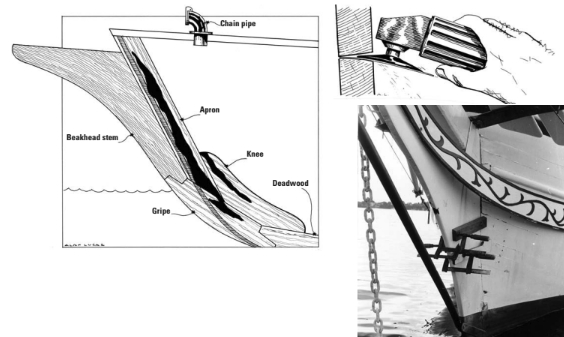
Douglas fir had also been used in the apron and gripe, both of which appeared to be wholesome. But test drilling soon exposed hearts of rot, a condition already suggested by the topside strakes showing their seams in the entire bow area. Most fastenings had been released by the rot, and the strakes remained in place almost by habit alone. Major surgery was indicated.
In planning this part of the restoration, I forced my mind away from traditional methods and instead thought laterally.
A big, thick apron on a small boat represents a lot of unnecessary mass in the limited chain locker. Furthermore, it prevents incoming chain from settling in one place and often snags it on the way out. Also, the tight corners created where apron, strakes, and frame meet are hard to clean and are like reservoirs for freshwater dripping from the chain’s deck pipe. There had to be a better way.
I chose to tear all of the apron out as well as most of the gripe and then fair and sand the remaining surfaces of inner topsides and the back of the remaining stem. All the fastenings that would not knock out were cut flush, leaving a smooth, continuous surface forward of the first frame. Any strakes riding proud from the stem were forced back into position with external battens and clamps.
After I filled and faired all fastening holes inside, I fiberglassed the entire area forward of the first frame, using chopped strand mat and polyester resin. This was laminated up to 1⁄2 inch thick behind the stem, tapering back to about 3⁄16 inch at the frame. At this stage, I secured all unfastened topside strakes with through-bolts of around 3⁄16 inch diameter.
Uncluttered locker
I then fit a false apron against the fiberglass behind the stem and glassed this into place with a similar thickness of laminates which buried the inside end of the through-fastenings. The result was a very strong structure which not only held the strakes more firmly than ever before, but produced a relatively large, smooth-sided and uncluttered chain locker.
Next, I turned my attention to the decks and cabintop, which were leaking at every joint. Because it was made of plywood, I fully expected to find the edges rotten beyond recovery. To my amazement, no rot whatsoever was found in any of the plywood. To the contrary, it looked so clean and new that it could have been delivered the day before. All plywood was, incidentally, made entirely from Douglas fir. My respect for Oregon was growing daily.
The cabin sides, along with all hull strakes, were Philippine mahogany, a well-respected timber for use on vessels of Renee’s era. Despite its good reputation, there were patches of rot in some planking and a small part of the cabin sides. The only comparable timber easily obtained in Australia was Meranti, a wood known to rot easily.
Meranti does, however, have two extreme standards — sometimes in the same plank. Where it tends toward gray, it is very poor, but where it tends toward red, it is usually of good quality. I always chose red, which had the color and grain closest to Philippine mahogany. After inspecting and refastening the deck and cabintop plywood where necessary, I fiberglassed the entire area from toerail to toerail in five laminates of two-ounce chopped-strand mat and polyester resin. This covered the outside cabin sides forever and killed all temptation toward excessive areas of brightwork, but it produced a leakproof “roof” for the whole boat.
Original material
This anti-traditional behavior toward the restoration ceased belowdecks. There, I replaced nearly everything in its original position, using primarily original material. But first, all fittings, save a couple of bulkheads, were removed so the hull could be stripped and treated. This was internally drenched in copper naphthenate solution, a rot-proofing agent that has worked well for me in the past. Only varnished areas, such as the internal cabin sides were treated with epoxy to avoid the green stains of copper.
The stripped and saturated interior needed to sit for a few months, obliging me to concentrate on the outside of the hull. It desperately needed refastening even though most screws were in fair to good condition. I purchased about 2,000 14-gauge silicon-bronze screws two inches long, and set about this most tedious of tasks.
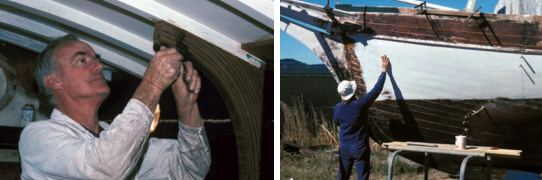
Because each screw behaved differently — whether extracting the old or inserting the new, I quickly found that anything of a power-assisted nature was too insensitive. I thus used a hand-brace for every removal and replacement, and the act of kneeling for much of the work, pushing hard against the bilge, nearly crippled me. I had to alternate the work with something easier and in the standing position.
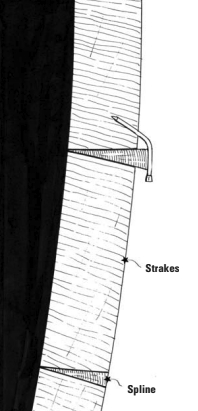
Having long before decided to spline all topsides, the garboard, and a few feet in from both bow and stern below the waterline, this seemed the logical occupation to offset the pain of refastening. It also promoted a sort of contest within myself to reach a certain stage with one before starting the other.
Simple angle grinder
Because of this ad hoc attitude, I chose not to properly tool-up for the job of splining. Instead of buying or fabricating a special router or saw blades and organizing myself around full-length guide battens, I used a simple four-inch angle grinder fitted with a 60-grit sanding disk.
This produced an unexpected benefit. The sanding disk curved into the seam to produce slightly convex sides. Then, when tailoring the splines to their respective seams, the opposite effect of concave spline sides resulted. My impression was that less glue squeezed out when they were driven home.
Before any seam could be shaped with the angle grinder, it had to be raked clean of all caulk and putty. This was achieved using a large rat-tail file with its pointed end bent to a right angle. This bent end was given a slight edge on the grindstone as well as a shape close to the ideal V for the spline. This roughly shaped seam was then finally cleaned out and improved with the angle grinder and sanding disk.
Because the strakes were of such soft Meranti timber, care was necessary when using the angle grinder. The trick was to keep it moving and to resist using too coarse a grit. It was vital to move against the rotation, lest the disk jam and cause damage to the job and possible injury to me.
As soon as I had prepared an area of seams and finished their mating splines, I drenched all the work in penetrating epoxy and allowed it to cure before gluing. For the latter task, I used epoxy glue. I knifed off the excess glue before it had set hard, and planed the protruding spline fair. Any spline that threatened to drift out during the cure was held in place with clenched steel nails.
No splits or bulges
Although clumsy, the angle-grinder system of splining worked well. The hull was so stable that nine years later no seam had split nor had any spline bulged. This was true of the topsides and those seams splined below the waterline.
From the garboard up to just below the waterline and fore and aft to the end splines, the original caulk was left in place. I suspect it was Willard’s original work, for every seam in that area, on both sides, was neat and tidy and obviously undisturbed by time. It was a very tight part of the hull and needed no further work beyond stripping the old paint and applying penetrating epoxy.
Years later, with a full understanding of just how stable the hull was, I knew I could have Dynelled the entire hull without its peeling off because of plank movement. But at the time it seemed sensible to leave one large area on each side in its original condition to allow for some swelling, or shrinkage, depending on how dry the bilges proved to be.
I doubt if such liberties could be taken with hardwood planks. Depending on the species and age, hardwood tends to move a lot more than softwood, especially if it has a poorly defined grain, as in the case of Philippine mahogany.
And while on the subject of hull movement related to restoration decisions, it was interesting to note that Renee’s engine-shaft alignment remained perfect before, during, and after her 15 months in an open yard. I doubt this would hove been the case had her backbone been of hardwood.
Covered and ignored
Renee’s original engine was, I believe, a gas-powered unit that was replaced a few years later by a Perkins 4-107 diesel. This was replaced by a Lister 30-horsepower diesel in the late 1970s. During my ownership, it ran like new with not a moment’s trouble. It was covered and ignored during the restoration.
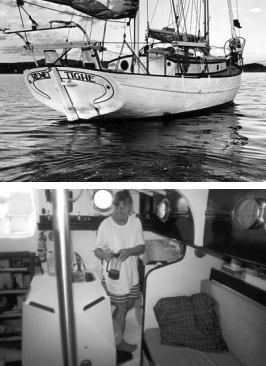
Belowdecks, Renee was typical of her era in that her two saloon settee-berths were set so high that even tall people had trouble placing their feet on the sole while sitting. And unless you were extraordinarily short, your head would bang against the cabin sides when you leaned back.
Despite a golden opportunity to correct this very uncomfortable feature, I restored them as original and then spent a number of years regretting my decision. A mini-refit in the water six years later corrected the problem but meant that her large, fiberglass water tanks (which were in immaculate condition) had to be cut down to fit the lower bunk level.
And so Renee’s interior was replaced pretty much as it was at her launching back in 1957 with most timber and plywood reused. Sadly, a rather unique wine locker that folded down to become the saloon table, sighted aboard in Madang 10 years before, had gone. Gone, too, was an interesting longitudinal galley locker over the engine box which appears in original photographs.
The galley was one feature neither my wife, Patricia, nor I liked very much. Not because it was cramped, but because its sole was crossed by large sawn frames. We seemed to be forever tripping when entering or exiting the galley with all that that implies when carrying hot liquid or food.
Like white oak
The frames were all sawn hardwood of a species forgotten by her builder but similar in appearance to white oak. Built of futtocks bolted together in traditional style, they had suffered very little from the years and needed only a scattering of sister bolts. Their width gave all strakes an excellent landing, which dictated the use of the already-mentioned screws in their fastening.
The main mast was removed for restoration and laid alongside on sawhorses. Its grain suggested spruce but, like the mizzen, it was probably Douglas fir. Whatever, it had a little rot at the hounds but was otherwise perfect. Even the heel and keel step — an area that nearly always rots — were in prime condition.
Renee was rigged as a ketch with a gaff mainsail and Bermudan mizzen. A thoroughly useless topmast sat butted to her mainmast top and was held there with a single, thick copper rod. I suspect it was a crude attempt at replacing a rotten top section in the past, and I worried that the hole drilled into the cap would have become a haven for rot.
Once more, Douglas fir (if it was not spruce) took me by surprise, for there was no sign of rot, so I plugged and capped the hole and discarded the topmast. The only downside of this decision was that the mainmast was now the same length as the mizzenmast (when set back into the boat), giving her a schooner look. I nevertheless continued to call her a ketch.
Perhaps the most unusual feature of the rig was the mainsail gaff. Normally attached to the mast with jaws and parrels, Renee’s was attached with mast track and a slide. Despite the track and slide being oversized, compared to normal sail track, I nevertheless would have thought it unable to cope with the lateral strains imposed by the gaff when under full sail.
The fact that she had sailed this way for countless thousands of miles over the decades decreased my fears, so I decided to stay with it. The lack of wear and tear on the mast without jaws was certainly a bonus, but the pleasure of having a fast-dropping gaff when sailing off the wind had been diminished.
Never failed
But the beautifully cast ball-joint gooseneck never failed over the thousands of miles I added to her record, and the gaff was definitely easier to lower than any Bermudan mainsail I had ever used. Moreover, without jaws the gaff could not apply leverage between the lower shrouds and the mast when it was up and working, which is a problem with many traditional systems.
All the standing rigging had been replaced by the previous owner with 1×19 stainless wire some 15 years before. Remembering that stainless work-hardens when allowed to flop, it was definitely the wrong choice because the gaff rig is, by its very nature, a soft, floppy rig. Knowing all this, I was nevertheless encouraged by its good condition and chose to continue using it.
In no way am I promoting my actions, but it has to be said that the same wire was still going strong when I sold Renee 10 years later. It certainly challenged the philosophy of replacing stainless rigging wire every eight to 10 years to satisfy insurance demands (a fact that was personally irrelevant because I never insure my boats).
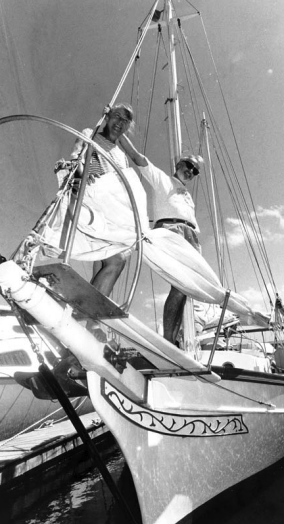
Renee was reborn in July 1990 when she was lowered by crane into Brisbane Water, 20 miles north of Sydney. It was the beginning of eight years of flawless service under my ownership and only came to an end when Patricia and I were free to resume living aboard on a full-time basis. Then Renee proved too small and had to be replaced.
In 1998, Patricia and I started building our ultimate boat, a 50-foot, shallow-draft centerboarder based on the Chesapeake Bay skipjack. (This story will be told in a future edition of Good Old Boat. — Ed.) Toward the end of the year, the capital tied up in Renee had to be freed, and we sold her. I had one last sail on her delivery trip.
Owning such a beautiful little craft had been a joy and a privilege. Of the many boats I have built or restored over the years, she was the most satisfying for the way she responded. She never ranked as a work of art either in the way she was built or the way she was restored, but as a design trendsetter and a real head-turner, she had few peers.
Thank you to Sailrite Enterprises, Inc., for providing free access to back issues of Good Old Boat through intellectual property rights. Sailrite.com