Eight Boy Scouts breathe life into an ailing dinghy
Issue 28 : Jan/Feb 2003
The truck backed into our driveway. Two men unloaded the most dilapidated, weatherworn wooden sailboat I had ever seen.
Like two little boys who just found a set of broken golf clubs in the garbage, Linn Larsen and Jim Beaudoin could envision the potential locked deep under the worn boards and dull paint of this abandoned dinghy. They unloaded the 8-foot sailing pram and lifted it onto sawhorses. “Boys will be here every Monday night . . . for a while,” they announced.
The boys were the members of Boy Scout Troop 51 of the Lakes District of Pacific Harbors Council in Lakewood, Washington. Jim is the development director. For the next several Monday nights, a group of teenagers would turn our garage into a boisterous refinishing dry dock.
This adventure began with the donation of a dinghy to the local Boy Scouts council, which encourages boatowners to donate their unwanted sailboats, motorboats, and yachts. Most donations are well-maintained boats that have been retired or replaced by newer models. Rather than go through the pain of finding a buyer and negotiating a sales price, an owner can donate the boat to Pacific Harbors Council. The council reconditions the boat, if necessary, and looks for a buyer. The owner writes off the fair value of the donation from taxes.
When Jim received this particular donation, he knew that professional reconditioning would be too expensive. It was an old El Toro-style wooden sailboat. The sails were in excellent condition. He figured that with a labor-intensive refinishing effort, this boat could set sail again.
Project for novices
Jim called Dick Booth, an experienced shipwright and an assistant scoutmaster. Dick considered the condition of the dinghy and agreed that it would be a great project for novices. The troop could turn the abandoned sailing pram into a coveted first prize for the annual popcorn sales contest. As a bonus, the teenagers could surprise scoutmaster Ron Pierce with a fully reconditioned sailboat when he returned from fighting in Afghanistan.
Dick knew the boat was the right kind and size for the boys. It had rough epoxy work on it, but they could remove most of the epoxy and prepare the boat for a new finish. This abandoned dinghy provided a short-term project and — whether a success or failure — it offered a learning opportunity. If the boys failed to finish or inflicted more damage to the boat, little would be lost.
“The point was to give the boys a different kind of challenge,” Dick explains. “It helps develop these boys, young men actually, by taking them out of their circle of comfort and putting them into a project where they have no experience.”
Indeed, the teenagers had no carpentry, sanding, or painting skills. Most had never sailed, some had never been in water more extensive than the YMCA swimming pool. At the first garage meeting of Troop 51’s inexperienced boat-refinishing crew, they outlined the size of the project and planned the stages of refinishing. There were five steps: determine the condition of the boat, set a goal, assess their skills, review the time limit, and stick to the budget.
Sound and seaworthy
As they walked around the boat, raised on sawhorses, Dick pointed out the parts of the boat: rigging, rudder, mast, hull. He showed the boys that the boat was sound, seaworthy, and functional. Their goal was to make it more presentable and desirable and to complete it in time for the popcorn sales awards ceremony. They had a budget of less than $100. What they didn’t have in dollars, they had to contribute in elbow grease.
Dick recognized the difference between a professional job and a teenager’s first project. “An owner or professional would have removed all the epoxy to the bare wood,” he says. “But our goal for this project was to do the most economical treatment.”
The first night they assembled their screwdrivers, wrenches, paint brushes, sandpaper, blocks, varnish, paints, and an electric sander. They inspected the boat to determine what work needed to be completed. They elected to remove most of the gear but leave some that would not interfere with sanding or painting.
Working with wood was the most important technique the boys learned. Each job was divided among the eight boys. Dick relayed basic woodworking instructions.
While the other boys used sanding blocks, one teenager smoothed the rough fiberglassing with the electric sander. “Sometimes, when less-experienced sailors observe a small leak, they tend to fiberglass over the whole thing rather then address the problem leak,” Dick told the boys.
In the Sea Scouts program, a troop might receive full training on the selection of paint and varnishes. Sea Scouts sand, scrape, caulk, and paint until their boats are trim and shipshape. But this was not a Sea Scout troop, and the members of this neighborhood troop learned as they went along.
Varnish and paint
One teenager learned about working in dusty environments. “When you sand an old blue boat, you end up with blue snot in your nose,” says Marty Hile, senior patrol leader. The boys used an alkyd varnish for the seats and polyurethane marine paint for the hull.
As the boys painted, conversations were of the new Harry Potter movie and the new Microsoft Game Box. Conversation paused only when one would report a drip or uneven surface. The conversation would veer from the subject as a boy pointed out a spot he could see from his angle and level of light that needed attention from another boy across the boat. The spot would be touched up and conversation returned to new video and computer games.
“It was most surprising,” says Dick, “to see them work as a team. They put down newspapers to protect the floor. They inspected each other’s work to make sure the painting was smooth. I was impressed.”
“What surprised me was how slow the paint was to dry,” Wyatt Larsen remembers. “It just took longer than I thought. It made the breaks longer when we went outside to shoot baskets or play Nerf war. That was cool.”
The refinishers followed each coat of paint with a light sanding. Dick remarks, “We took someone’s collection of wood and gave these youth some basic carpentry skills. They found a spirit of teamwork and turned that wood, which was on its way to the scrap heap, into a nice little sailboat. It’s important to mentor young people. It’s important to pass on your skills.”
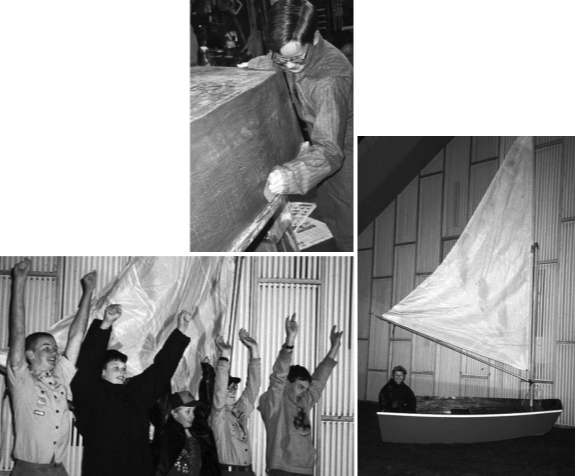
Bottom line: one castoff dinghy, an investment of less than $100, and more than 50 hours of work from eight eager boys resulted in a sparkling blue sailboat, christened Blue Snot, that became the coveted first prize for the troop and created eight proud boat refinishers.
Thank you to Sailrite Enterprises, Inc., for providing free access to back issues of Good Old Boat through intellectual property rights. Sailrite.com