This compatible couple makes mainsail handling a snap
Issue 34: Jan/Feb 2004
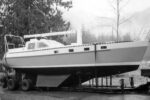
WHEN SAILBOAT OWNERS UPGRADE their sail-handling systems, the first thing they usually do is add a jib roller-furler system to the boat. When my wife, Dee, and I purchased Cinderella, a Bristol 29.9 sloop, it came with three good hanked-on jibs so it seemed a shame to waste that resource by going to a single-sail furler. The main, however, was completely blown out, probably original, and more than 20 years old. It had to be replaced. Our top priority was a new mainsail.
After negotiating a few dollars off the purchase price of the boat, we spent the savings on a Doyle 2+2 cruising main. This presented us with a new problem. Our previous boats had worn-out mainsails that could be easily dropped and quickly tied off to the boom. The new Doyle sail was hard and stiff and simply refused to be tied in the same manner. We needed to flake the sail every time it was dropped. Flaking the sail involved hanging off the boom, swaying around in the wakes of passing motorboats with some risk of being tossed overboard. When the sail was down and in the process of being flaked, it blocked the helmsman’s view.
At the beginning of our second season with the boat, I fashioned a set of lazy-jacks to catch the main as it was dropped. This wasn’t much help. The lazy-jacks (“lousy-jacks,” Dee called them) would catch part of the sail, but some of the sail still spilled off the boom. Additionally, they caught the battens when the sail was hoisted unless you were pointed absolutely dead into the wind. They did not assist in flaking the sail; in fact, they made it more difficult. The lazy-jacks needed to be tensioned for dropping the sail then loosened to flake the sail. Once they were loosened, the sail would fall onto the deck again. At best, they allowed us to delay flaking until we were safely on a mooring.
Several drawbacks
Several of our friends’ boats are equipped with the Doyle StackPack system. We looked into this option and decided the system had several drawbacks. It’s expensive to retrofit to the sail (about $650). It’s complicated, having significantly more hardware and rigging than the lazy-jacks. It would have some negative effect on the performance of the mainsail, a minor issue to us since we don’t race often, but why give up any performance? Lastly, the StackPack system is a “stuff and zip” device that pretty much precludes proper flaking of the sail, a practice that I wanted to continue since I believed it would extend the life of the sail.
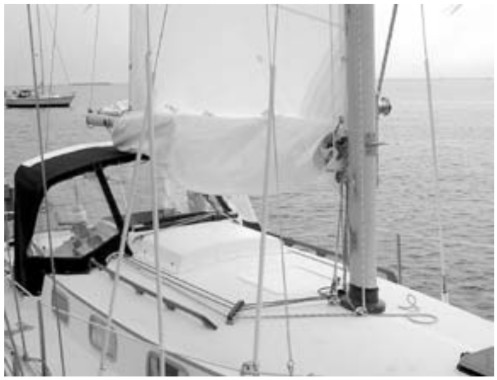
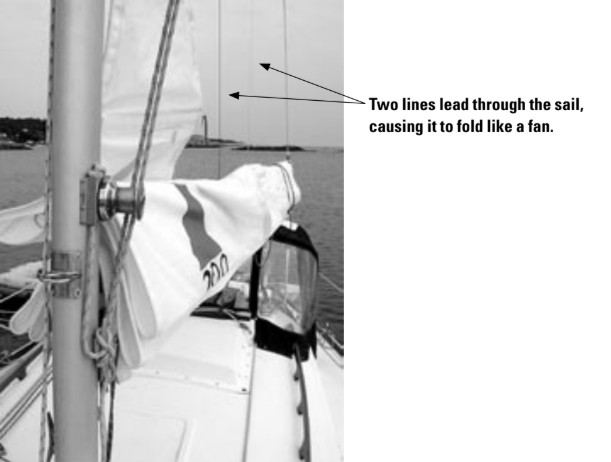
An alternative solution was the Dutchman sail-flaking system. I had heard of this product but had never seen one and did not understand how it worked. After making several phone calls and studying Dutchman’s webpage http://clients.sailnet.com/dutchman/ sailflaking/sfindex.htm, I realized it’s a simple and elegant concept. To understand it, take a piece of paper and fan-fold it four times. Punch a skewer through the folded paper and voilà! You have the principle of the system. The Dutchman achieves the same effect by adding droplines that come down from the topping lift to the boom, weaving through the sail at points even with the track slides and parallel to the mast. As the sail drops, it fan-folds onto the boom and is held in place by the vertical droplines. In terms of implementation, its most complicated and expensive component is the set of special grommets that have to be placed on the sail. It also requires the sail cover to be modified to allow for the droplines.
Plain grommets
Once I understood how the system worked, my initial thought was to build the system myself using plain grommets in place of the special Dutchman-provided grommets. The cost of the system, installed by a professional sailmaker, however, was quoted at $425, and building it myself, which would probably cost $200, would put a nearly new $1,500 mainsail at risk. It seemed a better idea to let the professionals do this job. We had Doyle Sailmakers of Marblehead, Massachusetts, do the work, and they did an excellent job.
One complaint I would make about the Dutchman system is that it comes with a replacement topping lift that forms a continuous loop with special fittings that attach to the vertical droplines. This special topping lift provides for adjustment of the droplines so they can be positioned directly above the line of grommets in the sail. While achieving the desired function of adjustability, the double line and associated fittings are quite heavy and flap and bang around on the sail, catching the roach and otherwise cluttering things up. Once I had the adjustments completed, I solved this problem by removing the Dutchman-provided topping lift, taking measurements for the droplines from it, and replacing it with a standard single-line topping lift with the droplines tied in at the appropriate points. This much lighter system works fine and does not interfere with the roach.
The Dutchman system solved our sail-raising, sail-dropping, and sail-flaking issues. I had more grandiose objectives in mind, however, and decided that a single-line reefing system and lines led aft, combined with the Dutchman, would provide us with the ultimate in mainsail control. Both of our previous boats had traditional slab reefing, as does Cinderella.
Not well-shaped
I know how to lower the main onto the reefing hook and then tension the main halyard and outer reefing line to complete the reef. The problem is that this never achieves a very well-shaped sail, and it requires some pretty fancy footwork at the mast just when conditions are deteriorating and staying in the cockpit would be advisable. It also requires close coordination between the helmsman and the reefer, a subtle set of commands that always seemed to break down between Dee and me.
A single-line reefing system works by using one continuous line to tension the luff and the leech of the sail simultaneously. This line starts at the end of the boom, goes up to the reefing cringle on the leech of the mainsail, down to a turning block on the boom, then forward to a second turning block on the forward end of the boom. It continues up to the reefing cringle on the luff of the mainsail, down to the deck, and back to the cockpit where it can be controlled. Tensioning this line, while lowering the mainsail halyard, causes both ends of the sail to come tightly to the boom and the reef is achieved (see illustration below).
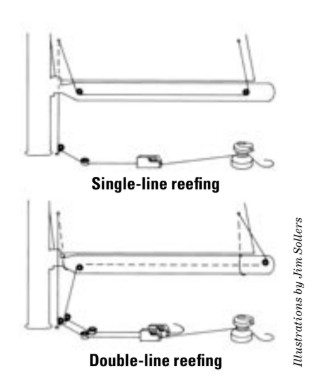
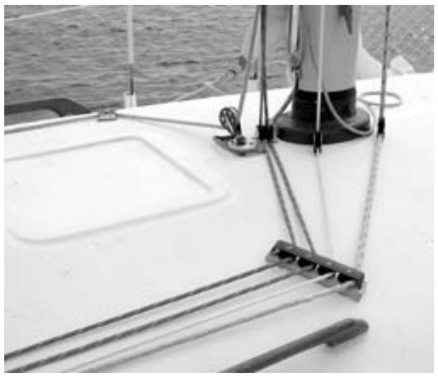
To build the system I would need to lead four lines back: two reefing lines, the main halyard, and the topping lift. I studied the problem for several months. I wound up purchasing three turning blocks, a double cheek block for the boom, a three-line rope clutch, a four-line deck organizer, one cam cleat, and a small winch. I also needed two, much longer, reefing lines and a new topping lift. All this hardware was not cheap. The total cost of materials came in at about $700.
Plan carefully
I don’t think there are any set rules for how you go about planning and placing all of these items. The only rule I used was to plan carefully and think ahead as far as possible to avoid mistakes. One concern I pondered over at length was whether to through-bolt all the components to the coachroof, which would involve cutting into the headliner, or to use screws that are screwed directly into the outer layer of fiberglass. I decided to compromise on this. All hardware with a vertical load (turning blocks) would be bolted using long bolts and large backing washers. Any hardware with side loads would be secured with screws and caulking. (All, that is, except the winch, which was located in a position where I could use bolts.) My reasoning was that a vertical load creates tension while a side load creates sheer. Screws work well in sheer-load conditions but bolts better withstand tension.
I also worried about the size and strength of each of the components I was installing. I had no guidelines as to what the actual loads on any of these components would be. I was particularly concerned over the loading on the upright double turning block that would handle the two reefing lines. This component would be handling loads somewhere near the load of the mainsheet. Line size (5⁄16-inch yacht braid) and deck space dictated a small block. The component I ultimately chose had a working-load rating of only 600 pounds. I’m still concerned this may be too weak, but Dee and I don’t cross oceans or sail in hurricanes. If I underestimated the loads and wound up with materials that are on the light side, I can at least say that nothing has broken yet and we have sailed many times in reefed conditions.
Little winching
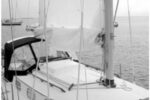
The completed system works very well. We can hoist the main from the cockpit by hand-pulling the halyard. A little winching is required for the last 2 feet. The boat does not need to be pointing into the wind, as there are no lazy-jacks to foul. Dropping the sail requires only that the topping lift be tightened so the Dutchman droplines are tensioned. Once you’ve found the right position for the topping lift, a mark on the line allows you to get the tension right every time.
Getting the main to drop and flake perfectly does require that someone go forward and pull down the sail. Without assistance, the sail drops about halfway, then stalls out. By standing at the mast you can assure a full drop and start each fold of the sail, left-right, left-right, as the sail comes down. And it works so well! Dropped in this manner, the sail is nearly perfectly flaked onto the boom at the time of the drop, and the helmsman never loses forward visibility. I can do it by myself quite easily now. I come into the wind, secure the helm, go to the mast, drop the main, go back to the cockpit, and resume course with a perfectly flaked main — in less than 20 seconds.
The combination of the Dutchman with the single-line reefing system shows its mettle when the wind comes up and it’s time to put a reef in the main. Without coming off course, I ease the mainsheet until the main luffs. I then ease the main halyard and slowly lower the sail while simultaneously pulling in on the reefing line. When the forward reefing cringle comes down to a prescribed point on the mast, the point where the boom normally rides, I lock the rope clutch for the halyard. The reefing line is then put on the winch and tightened until the aft end of the sail is fully tensioned and the boom is pulled up to the reefing point on the luff of the sail. At this point I can retighten the mainsheet; the reef is complete.
Ease and crank
Shaking out the reef is just a matter of easing the mainsheet again, putting the halyard on the winch, releasing the reefing line, and cranking the sail back to the top of the mast. The advantage of the Dutchman is that as the sail drops, the lines catch the flakes and keep them right on the boom. There is no need to tie in reefing points unless I know we are going to be sailing for days in crazy conditions.
Dee is still pushing for a roller-furling headsail for the boat, and I admit it would be a big convenience. Changing the headsail when the conditions change is a hassle, but I know we have our problems half solved. The mainsail controls work wonderfully, adding convenience and safety. When it’s time to reef the main, we do so immediately, secure in the knowledge that we can shake out the reef or add a second reef quickly and conveniently. When it’s time to drop and store the main, we have the solution for that too. The single-line reefing system, combined with the Dutchman sail-flaking system, has greatly improved our boat.
Thank you to Sailrite Enterprises, Inc., for providing free access to back issues of Good Old Boat through intellectual property rights. Sailrite.com