This small little-known company built one of the first fiberglass auxiliary sailboats
Issue 34: Jan/Feb 2004
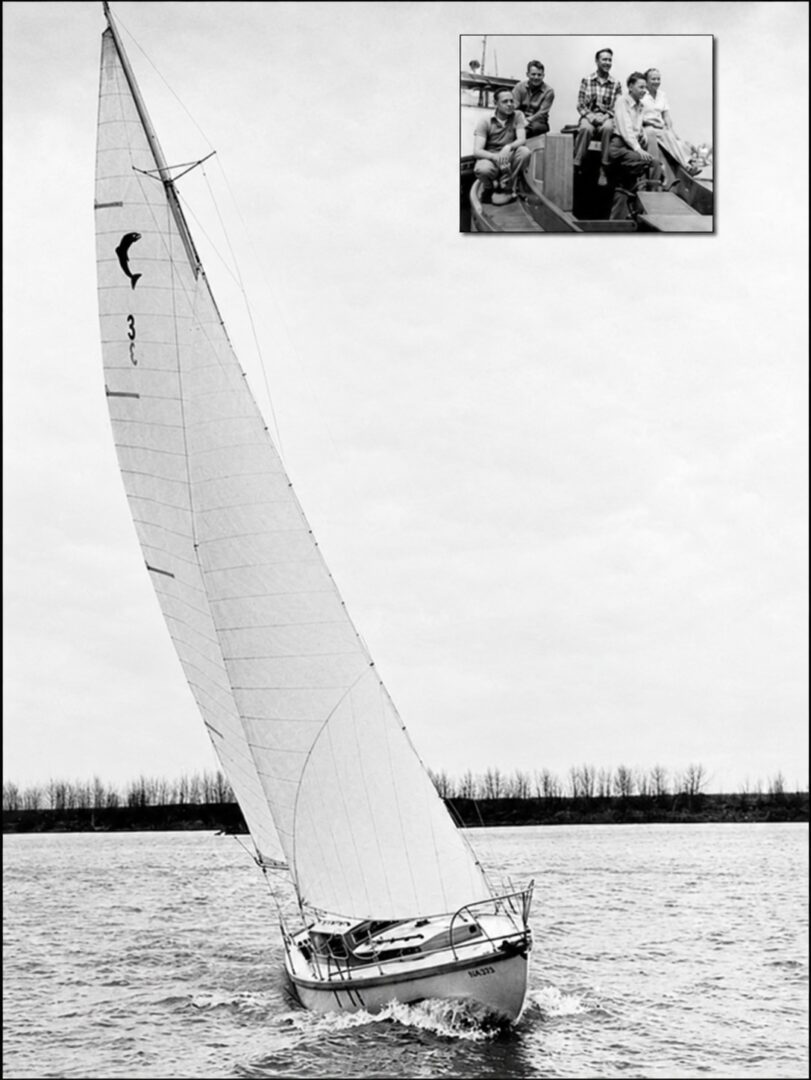
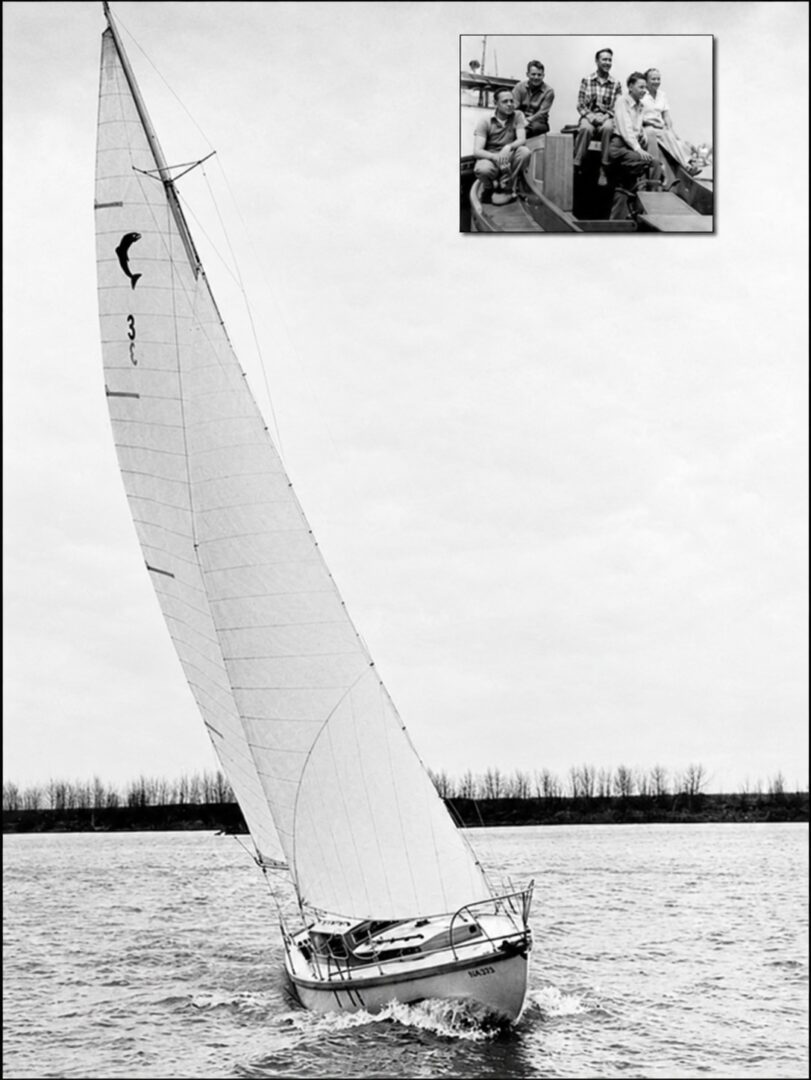
IN 1956 FIVE ENTERPRISING GENTS, MEMBERS OF THE ROSE CITY Yacht Club (RCYC) in Portland, Oregon, began combining concoctions of liquid chemical compounds and resins. By the time they were done mixing their brew and applying it to rolls of a recently developed woven fabric, they had produced not a witches’ brew but one of the first fiberglass auxiliary sailboats. The sailing world hasn’t been the same since.
That was 11 years before Mr. Robinson (Murray Hamilton) advised young Ben Braddock (Dustin Hoffman) in the movie, The Graduate, that he’d do well to find his future in plastics. After the Portlanders christened their first sloop, a 34-footer they named the Chinook class, they founded Yacht Constructors, one of the first manufacturers of fiberglass sailboats produced in series.
The development of polyester-fiberglass boats began during World War II. The first production boats — mostly dinghies and small runabouts — appeared right after the war, in 1946 and ’47. With the Chinook, the Portlanders entered the market the same year as Californian Fred Coleman and the 40-foot Phil Rhodes-designed Bounty II.
Fifty years later, at age 89, Wade Cornwell, one of the five founders of Yacht Constructors, Inc., still occupies a desk in the company’s offices. During the intervening years, marinas across the country have filled with sailboats made of fiberglass, the dominant boatbuilding material today. The obituaries of many of its progenitors, however, are numerous. Gone are Cal, O’Day, Ericson, and Pearson. Not so Yacht Constructors. Now under the ownership of Hans Geerling and operating as Cascade Yachts, the small shop still manufactures sailboats and a number of powerboats.
A brainstorm at the club
The formula the yacht club group followed to success was simple, Wade Cornwell says. “We started with a good design, a strong hull, and attention to detail.”
Interestingly, the endeavor did not originate with a dream of starting a boatbuilding company. Its genesis was a gam session between 11 RCYC members during the club’s annual spring cleaning. Each professed an interest in building his own boat. Their object was to cut in half the purchase price of a new boat and at the same time produce a lower-maintenance vessel. “A problem with wooden boats,” Wade emphasizes, “is that they require lots of maintenance,” especially in the rainy Pacific Northwest. When it came time to pay the piper, however, only five of the 11 men anted up.
These five came from vastly disparate backgrounds. Wade Cornwell was a purchasing agent at Union Carbide. Tom Green was an engineer and plate shop foreman at the Hyster Company. Merle Starr, Ph.D., was a physics professor at the University of Portland and an amateur astronomer. All three were past commodores of the Rose City Yacht Club.
They were joined in the enterprise by Jarvis Gould, a physician and hospital administrator, and Henry Morton, an advertising executive. None had experience working with fiberglass, but Tom Green and Merle Starr, after talking with a truck manufacturer and a fishing boatbuilder who worked in the medium, were convinced that fiberglass was the material that should be used for their project.
Tom Green, the floor boss and overseer of the construction effort, is described by Wade as “easygoing, because everything mechanical came easily to him. Merle and Tom were the primary drivers behind the effort to experiment with fiberglass.” Merle he remembers as being “exacting, with a dry sense of humor, smart, and professorial.” Wade says that he, Jarvis, and Henry “were gofers. We did whatever we were told.”
One thing they had to do was overcome skeptics of fiberglass who derided it as cheap plastic. “Bottle boats!” they scoffed. Both to satisfy themselves and to learn, the group experimented with various resin-hardener-glass fiber combinations. A test strip of the final product, a long, thin piece of woven roving and cloth, is still prominently displayed near Wade’s desk.
“We tested the laminate by firing a .38-caliber pistol into it from a distance of 10 feet,” he says. “The slug only penetrated 50 percent of the hull’s thickness. A 30.06 rifle cartridge fired from a distance of 10 feet produced a perfect hole, but the laminate didn’t fracture.” Tough enough, they concluded, and forged ahead.
Because the group was preparing to build for themselves, each member had a vested interest in producing a high-quality product. Each also was motivated by the desire to own a fast, comfortable, seaworthy boat — not by profitability. There was no interference from bureaucrats or a corporate infrastructure; they spent their own money, made their own decisions, and continued their professional careers, spending evenings, weekends, and holidays on construction. “We didn’t spend much time at the club,” Wade says.
The design
The five builders were clear about the characteristics of the boat they wanted. They were serious racers interested in increasing boat speed over their current boats. The easiest way to increase speed is to reduce displacement. Still, the boats had to stand up to the prevailing northwesterly winds on the Columbia River, where 25- to 35-knot breezes are common. Wind blowing upstream 80 miles from the ocean funnels at a place called The Gorge, the boardsailing capital of the U.S. And the boat had to be strong enough to handle crossing the Columbia Bar at Astoria, where the Coast Guard tests rescue boats because of the near-certainty that they will be rolled 360 degrees.
Because stiffness was imperative, they gave no thought to constructing a retractable keel, which might have been an easy choice considering the river’s shallowness. Instead, they specified a long keel, which they planned to fill with cement and metal, and a centerboard.
The next challenge was finding a designer who could incorporate their requirements into a single design. Though eventually home to Bill Garden, Bob Perry, and Laurie Davidson, the northwest in 1954 was hardly a hotbed of yacht designers. Group members wrote letters to numerous yacht designers requesting assistance. The only architect to respond was Frederick Geiger of Philadelphia, Pennsylvania. One of his designs was the 34-foot Vigilant class sloop, a handsome yacht that enjoyed great popularity on Chesapeake Bay.
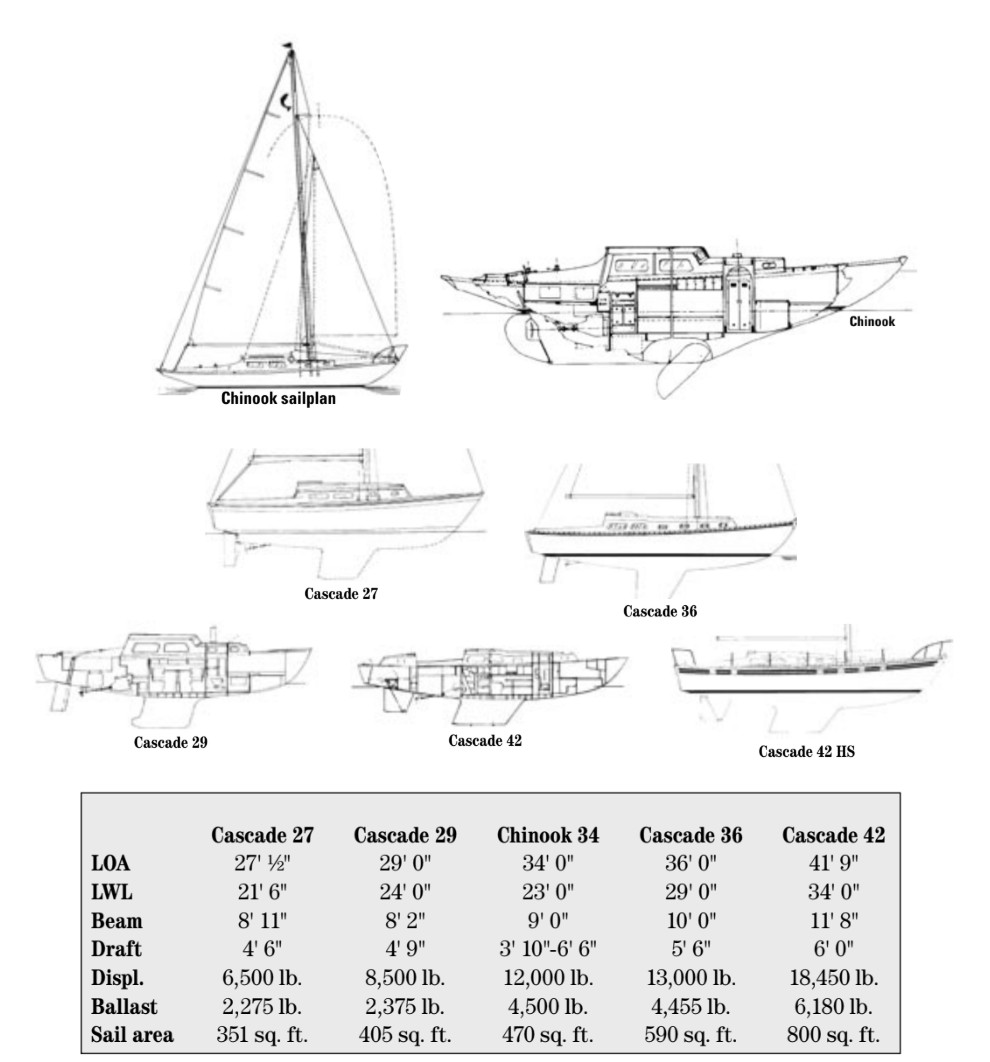
The group agreed on Frederick’s design because it was traditional, sleek, and had a shallow draft. The keel/centerboard configuration gave a draft of 3 feet 10 inches with the board up and 6 feet 6 inches board down. The entire transaction took place between strangers who had never met.
Frederick had zero familiarity with fiberglass, but the task of converting a wooden boat design to fiberglass failed to daunt the group. By rounding some corners and tweaking the design until it fit their needs, Merle and Tom eventually produced construction drawings.
Work commences
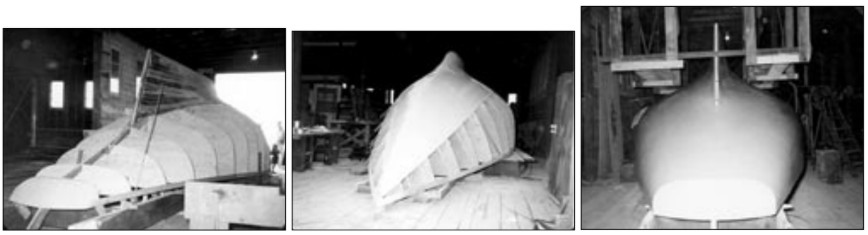
In early 1955, the group drew up a contract for the sharing of expenses and labor. They drew straws to determine the order in which each member would receive his boat. (Jarvis Gould got the first one.) They next spent months working to construct a wooden male plug from which the fiberglass female mold would be taken. Constructing a plug is an exacting, time-consuming process, because any imperfections in the plug are transferred to the mold and on to the hull unless corrected.
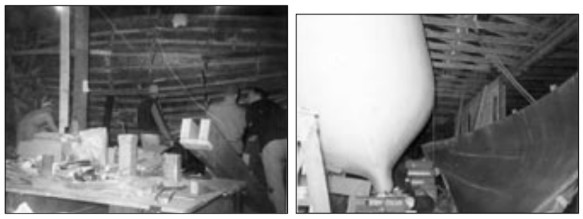
The plug was completed in September, followed by the mold, and the group commenced laying up the first hull. Rather than using chopped strand mat, which is cheap and easy to apply but is not as strong as continuous fibers and takes a long time to build up adequate thickness, the group used woven roving for the bulk of the laminate. Two layers of fine cloth were used on the outside to minimize fairing.
Five professional men rolled resin from #10 paint cans and hand-squeegeed the excess, producing a 50-percent glass-to-resin content. That is surprisingly close to the 60- to 70-percent target of today’s builders. They installed ballast, floors and engine, and the outline of an interior. Cabin sides were made of mahogany. There were fixed berths for four. Headroom was 6 feet 4 inches.
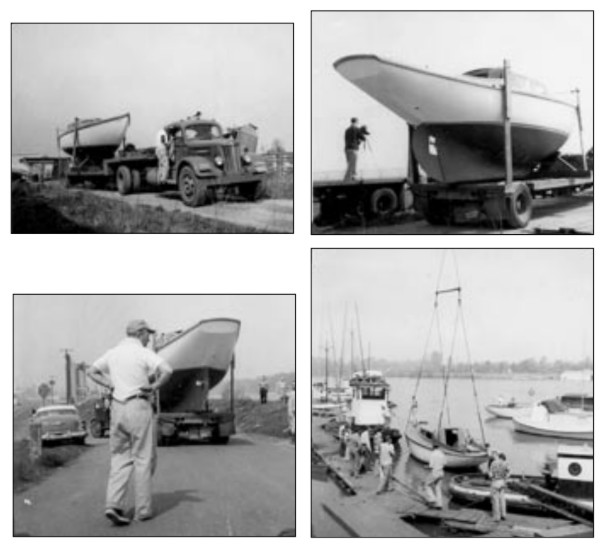
Hull No. 1 was successfully launched on April 20, 1956, at a cost of $4,500, less than half that of a comparable wooden vessel. They named the class Chinook after “the biggest, fastest, sleekest, and best-tasting salmon in the Columbia River system,” Wade says.
The Chinook is a beauty. She has a gently sloping sheer, a long cockpit, generous overhangs, and a squarish, stepped cabintop that is very classy. The fractional rig has a single set of spreaders and jumper struts to keep the unsupported section in column. Sail area is 470 square feet with 327 feet in the mainsail and 143 feet in the small, club-footed jib.
Hull No. 2 followed that summer. At launching, her sturdiness was tested when she was dropped 15 feet into the water by a crane operator. No problem.
All five were sailing by 1957, and the Chinook quickly established a winning record on the racecourse, with Tom and Merle winning 12 of the first 15 races they entered.
Building for others
Once all five members had their boats, three expressed interest in starting a business. Henry and Jarvis, satisfied with the unencumbered ownership of their boats, abandoned the enterprise, leaving Merle, Tom, and Wade to continue.
A three-page article in Yachting magazine produced hundreds of inquiries. An order for hull No. 6 came before the end of l957. There was little risk for the principals. Wade, Tom, and Merle maintained full-time employment, so they weren’t going to miss any mortgage payments if the company folded. They had their boats, and they were paid for.
Three years after launching hull No. 1, the business was incorporated as Yacht Constructors, and the first two employees were hired. Work proceeded on hull Nos. 7, 8, and 9. Interestingly, Tom and Merle continued in their careers until reaching retirement age. Wade eventually joined the company on a full-time basis as general manager only because Union Carbide was downsizing, and his name was on a list of employees designated for layoff.
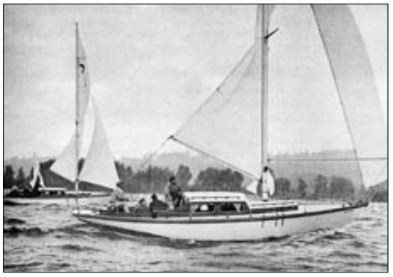
At the dawn of fiberglass boatbuilding, many sailboat builders offered kit boats. Yacht Constructors was probably the first to do so.
“We thought the best way to go was to produce hulls and decks with several interior options for do-it-yourselfers,” Wade says. A typical owner might buy the hull and deck and as many other components as he could afford — keel, rudder, bulkheads, tanks, and everything else that goes into a finished boat. Plans and raw materials like polyester resin and fiberglass were also available for purchase.
The result was a win-win situation. The shop avoided having to hire employees from the various disciplines (glass layup, woodworking, electrical, etc.), the buildup of costly inventory, and overhead. An owner eventually completed a sailboat capable of cruising in deep water and maybe saved enough money to start a cruising kitty.
Yacht Constructors was perhaps somewhat unusual in the number of boats actually completed. We’ve all seen the bare hull sitting unmoved and unloved in an empty lot next to a construction shed, symbolic of a project that ended with an unfulfilled dream. That was not the case in Portland. “We’ve only had three or four boats that were not completed,” Wade says proudly.
Prospective owners also took part in the evolution of the boats. “Five hundred people have built our boats, and they were all thinking,” Wade says. For example, customers concerned with aesthetics asked that the chainplates be relocated inboard from the outside of the hull, and so they were. Chainplates were bonded to a Y-shaped strap encapsulated in fiberglass. “We have never had a failure,” Wade adds.
Weight of the boats was kept light despite the use of 3-inch mahogany floor timbers, mahogany bulkheads and rails, teak-and-holly cabin soles, fir subflooring, marine plywood for the deck, and a spruce mast and boom.
Adding to the model line
About this time fin keels started to replace traditional full keels. In Southern California, Bill Lapworth’s Cal 40 was dominating racecourses with its fin keel and spade rudder.
Enter Bob Smith, a designer who apprenticed at the prestigious New York design firm of Sparkman & Stephens and who had participated in the design of the famous yacht Dorade. Bob migrated to Portland and in 1961 was racing a stylish prototype for a 28-footer of his own design that caught Yacht Constructors’ attention.
“It was a different style than the Chinook, less traditional and stiffer,” Wade says. Bob was commissioned to draw lines for the Cascade 29 (see Good Old Boat, November 2002), which was introduced in 1961. In 1964, a bare hull sold for $1,775.
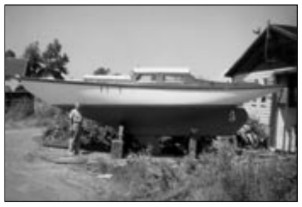
The company next commissioned Bob to draw designs for a center-cockpit 42 (1964), 36 (1967), and the Cascade 27 (1978). The 42 was offered in an updated aft-cockpit version called the 42 HS, as well as a 44 by adding on a stern extension. With the delivery in 1968 of Chinook No. 70 to an owner in Maryland, that model was discontinued. A 9-foot 6-inch Cascade Dinghy also was offered for a time. By the late 1960s, boats were being shipped to all points of the compass, including Venezuela and the Philippines. Tanzer Industries in Quebec, Canada, was licensed to produce 50 boats, as was a Japanese firm.
“National distribution was simple because railroads hadn’t figured out how much money they were losing on shipping,” Wade says. “We were shipping boats from coast to coast for $500, a charge that eventually increased to $10,000.”
The 42’s keel was cast iron while the 29’s was welded steel plate, both problematic and inferior to lead, which is denser and corrosion-resistant. Eventually, the plywood decks were replaced with decks of molded fiberglass.
A variety of auxiliary engines were installed, including the Atomic 4 and Unimite 4 gasoline engines, and the small Volvo Penta MD 1 and larger Westerbeke 4-107 diesels.
Through it all, the company’s employee population did not exceed one dozen, including the three hardworking principals.
“We had no desire to compete with the big guys,” Wade says. “We were never tempted.” Unlike a lot of other boatbuilding companies that succeeded right into bankruptcy, Yacht Constructors stayed small and endured.
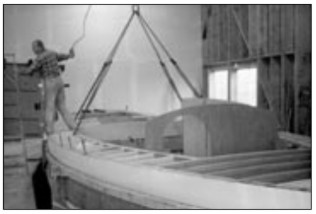
Enter Cascade Yachts
At the ripe young age of 75, Wade, the sole survivor of the original group, sold the company to Hans Geerling, who renamed it Cascade Yachts, Inc. At the time, it was the oldest U.S. production boatbuilder under continuous ownership. That’s really technical nitpicking though, since Wade still goes to the office every day and sits at his desk.
The company continues to operate in the same 7,200-square-foot building, and its yard is filled with boats under repair. A Cascade 29 is currently undergoing extensive renovation there by its owner.
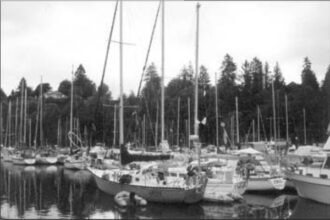
Only minutes away by ground transport, but decades away in time, several Cascade sailboats, including Wade’s own Cascade 27, occupy berths in Columbia River marinas.
Good old boats? You bet. A good old company? That, too.
Thank you to Sailrite Enterprises, Inc., for providing free access to back issues of Good Old Boat through intellectual property rights. Sailrite.com