Issue 32 : Sept/Oct 2003
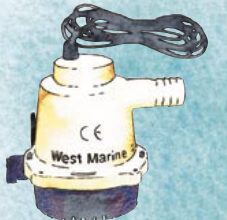
Paint this picture in your mind: You are at sea after dark, the waves are a bit more than you like, and the shaft packing is leaking. It’s not life-threatening. The automatic bilge pump can handle it. Then the pump stops!
Now you are lying on the cabin sole while the boat is bouncing about. Your job is to reach into the bilge with cold salt water up to your armpit and figure out why the *@#%^$# pump stopped working!
When our Nor’Sea 27, Guenevere, adopted us, the bilge pump was held in place in the deep bilge with a small board screwed into the side of the compartment. This board had an L-shaped bracket on the bottom of the board that the pump was attached to.
About two years ago, I came home to the boat to find the bilge-pump circuit breaker popped. During the troubleshooting, I had to remove the pump by removing the screws and fishing out the pump. As it turned out, a small screw had found its way to the impeller and jammed it. Once removed, all worked well.
After that incident, I began thinking about what that job might be like at sea in heavy weather. It gave me a chill, so I began thinking about how I could improve the pump mounting to make removal easier. A few weeks ago I was helping a friend rewire her fuel pump aboard her Rafiki. I noticed she had a short length of aluminum tubing holding her pump in place. That looked a bit better than a board that was bound to give out sometime soon. But it still had two screws holding it in place. I went off in search of a better idea.
A better idea
At first I thought about using a short piece of stainless-steel rail tubing. I thought that would work better than the aluminum tube. As I was looking at the rail tubing in the local marine store, the better idea hit me.
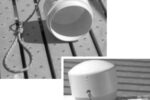
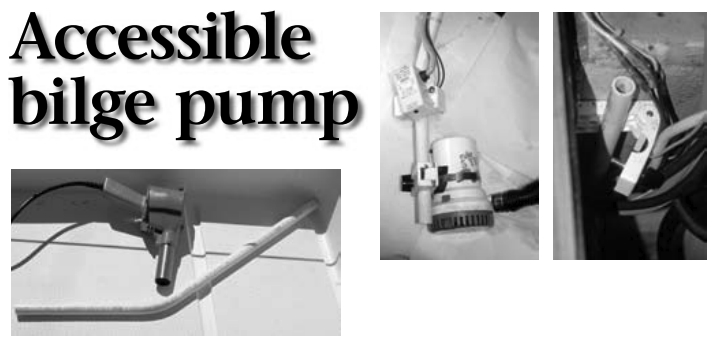
I bought three 7⁄8-inch plastic rail clamps for about $70. I had a short length of 7⁄8-inch stainless-steel tubing on the boat and intended to use it, but it didn’t fi t very well because of the curve of the bilge. I thought of having a local rail shop bend it for me, but I had an even better idea. I bought a piece of 1⁄2-inch Schedule 40 PVC pipe at the local hardware store for about $3. I used my trusty heat gun to make two shallow bends in the pipe so it would fit the bilge. It ran from where the old board was attached to where the pump needed to be.
I mounted clamps at the top and bottom of the PVC pipe. Then I used two screws through the rail clamp to hold a hose clamp large enough to go around the top of the bilge pump, thus securing it to the pipe. I used a fender washer with each screw. A small square of inner-tube rubber protected the pump motor and allowed the clamp to hold the pump securely.
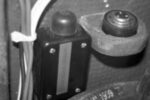
I used the third rail clamp to mount a Water Smart pump switch. As it turns out, the mounting holes on this switch are spaced just right to allow it to use the pre-drilled holes in the rail mount. I chose this switch because it runs the pump for an extra 8 seconds after the water level drops below it.
This is important in the Nor’Sea, as the deep bilge is very narrow. If a float switch is used, the pump will often cycle from the water that drains back down the outlet hose. By mounting the new switch with the rail clamp, I can adjust it up and down to get it at the exact position needed.
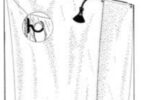
Once it was all mounted up, I ran the wires up the PVC pipe, and secured them using plastic electrical ties. To check the pump these days, I need to loosen just one wing nut and pull up on the PVC pipe. PVC will last almost forever if you keep it out of the sun. This is not a problem for our bilge!
Thank you to Sailrite Enterprises, Inc., for providing free access to back issues of Good Old Boat through intellectual property rights. Sailrite.com