Where to find that affordable ocean voyager you long for
Issue 38 : Sept/Oct 2004
There are three sources of moderately priced cruising yachts:ex-racing boats, ex-charter boats, and secondhand cruising yachts.
The first category is yacht racing, the game of trying to outsail a group of similar vessels around a set of buoys or competing with other boats from one point on a coastline to another, usually for an afternoon or for a day or two. Yacht racing is responsible for enormous improvements in sails, winches, foul-weather clothing, and the general streamlining of boats above and below the water. Yet I don’t believe the artificial standards of racing yachts are a logical way to find the best vessels for the sea.
Racing-boat designs have long been based on faddish racing rules that produce groups of similar yachts designed to compete with one another like horses on a track or greyhounds on a racing oval. The important things for racing boats are speed and a low rating. If it’s a one-design class, the emphasis is on sailing tactics and yacht gear. Hovering on the edges of all this are the naval architects and boatbuilders, who have a direct financial stake in winning yachts. A winner sells best.
Racing criteria
What have been the guidelines of racing in past years?
When the racing criterion was waterline length, the bow and stern overhangs became excessively long and unseaworthy. The overhangs meant that when the yacht was heeled in a breeze, her immersed waterline was longer and she sailed faster. Yet her rating was based on her waterline length when measured sitting upright at a dock.
When the racing criterion was fixed sail area, the naval architects drew plans for high and efficient sailing rigs on light hulls with heavy keels to give stability to the tall rigs. Since the sail area was critical, the designers read the rules with the intensity of Supreme Court justices and took advantage of every loophole in the rules, particularly with regard to unmeasured sail area.
When the racing criterion was displacement, the builders produced light-weight, fragile hulls that would go fast in light to medium air. In strong winds the yachts stayed home. If they attempted heavier weather, they sailed at risk and broke apart, as have recent entries in the America’s Cup competition.
When the racing criterion is based on overall length, the designs feature ugly-looking plumb bows and sterns to maximize waterline length. When this is combined with no restrictions on beam and only lip service to self-righting regulations, the results seem good at first but end up being dreadful. The current yachts in the Around Alone and Vendée Globe singlehanded races are extremely beamy and use the weight of water ballast tanks, canting ballast keels, or both to balance an enormous amount of sail that powers the boats to incredible speeds.
Stable upside down
Unfortunately, these ocean racers are not self-righting and float nicely upside down, a deplorable trend that’s caused half a dozen widely publicized sailing disasters. Personally, I think the designers and race organizers should be put in jail. It seems to me that the first responsibility of a naval architect and a race sponsor is to get the crew home alive.
The result of all this competitive sailing is that yacht brokers have plenty of ex-racing boats that have been outmaneuvered by the rules. Yet these boats are available and perfectly good for less intensive, non-rule-oriented sailing. And they’re much cheaper than a new yacht that’s specially designed and built for long-distance voyaging.
An aging thoroughbred can still make reasonable time around a track, but just as a veterinarian checks a horse, a tough surveyor should evaluate a used yacht, no matter what her history and her seller’s claims.
Unlike a used car, the mechanical aspects of a yacht account for only a small part of its value. The hull, deck structure, keel, rudder, and rig will last for decades — unless they’re terribly abused and neglected — particularly since 90 percent of present-day boats are constructed of fiberglass and have aluminum spars. The engine, sails, head, and electronics may need attention, but these things can function at three-quarters throttle for years. If the electric wind-direction indicator doesn’t work, it’s not the end of the world. Like me, you can always put a meter-long red ribbon on a pivot at the top of the VHF antenna at the masthead.
Racing yachts tend to be lightly built, and the cockpits — sized for a big crew — may be large and able to hold too great a weight of water for ideal safety at sea. The accommodations, galleys, and chart tables of racing boats are often poor to marginal in order to save weight. Because of minimal joinerwork, the stowage spaces are undeveloped for all the supplies and spare parts that cruising vessels carry. You may need to build in drawers, cupboards, and lockers, but these can be added gradually.
Since a used racing boat represents a smaller amount of material and labor and was built under rules that may be going out of style, her price is lower. In August 2003, I could buy a 5-year-old 35-foot fiberglass racing yacht for $99,000 (new cost: $150,000 to $160,000). If I chose a 1985 model — 18 years old — I could spend as little as $55,000, according to one magazine.
Charter boats and wrecks
A second source for a less expensive cruising yacht is a charter company. Old charter boats are cheaper because they’ve been heavily used by a succession of short-time customers who hired the yacht for one or two weeks at a time. Charter boats come from the factory generally lightly equipped except for upgrades in anchor windlasses, increased freshwater tank capacity, engine-driven refrigeration systems with stainless steel holding plates, and more durable cabin soles and companionway steps to take the wear and tear of many people.
In a single year the engine, sails, winches, head, galley stove, and seat cushions get plenty of use. Often a charter company serves as the agent for a private party who owns the yacht and leases it back to the charter company, which pays the owner a negotiated fee based on usage. The charter company takes care of all maintenance and berthing and makes the vessel available to the owner for 5 to 6 weeks a year (sometimes up to 14 weeks).
A typical bareboat yacht is chartered for 27 to 30 weeks a year for 5 1⁄2 years, after which she is sold. During much of this time the charterers push the vessel hard because they want to go to as many places as possible. Perhaps some 600 people will have lived on the yacht for short periods. It’s just the opposite with private owners, who use a vessel much less intensely.
After a few seasons of chartering, the boat tends to lose her luster; the gelcoat on the hull becomes chipped from banging into docks and other yachts. The paint and varnish look grungy; the white sails become gray and baggy. Compare a taxicab with your own automobile. Which would you rather own?
Certainly an ex-charter yacht needs to be surveyed. If the inspector finds a problem, it may be smart to get another opinion from a second surveyor or a boatyard manager. The hull should be checked at close range, from a distance, and from all angles. A 4-foot flexible batten can be run up and down the outside of the hull to spot old wounds. There’s nothing wrong with a repaired hull if the problem has been dealt with properly. However, hull repairs should be thoroughly looked at inside and out — even if the surveyor has to take some ceiling or joinerwork apart.
What’s available? Start telephoning the charter companies. Check their websites. Be prepared to fly out at once to inspect their offerings. If you’re handy with tools and a paintbrush, the prices of retired charter boats can be attractive because used boats change hands for about half the new price.
Discount 30 percent
A new 35-foot Beneteau, with tax and a few extras, costs about $130,000. The price of a five- to six-year-old Beneteau from a private owner on the open market is about $95,000. However, you can purchase a five- to six-year-old Beneteau from a charter company for $65,000. This is $30,000 — or roughly 30 percent — down from the open market and a 50 percent discount from the new cost.
If you find something you like, fly in your own surveyor (not the charter company’s). Often when a company decides to sell, they want to do it quickly and without fuss. Time and cash offers are generally the buzzwords, and you’ll have to take her away from the company dock in a few days. This works against many purchasers, who like to poke around and think about a purchase for months and are not used to flying to distant locations and doing business quickly and for cash.
The buyer of a small charter boat should put aside $13,500 for the following:
- survey ($500)
- engine overhaul ($2,000)
- new galley stove ($1,000)
- replacing some or all of the standing rigging ($3,000)
- new sails ($5,000)
- painting and miscellaneous ($1,000)
- haulout and bottom painting ($1,000)
Insurance write-offs
Yachts that are damaged by hurricanes or other causes and sold by insurance companies are in the same category. Often an underwriter will sell a severely damaged vessel cheaply because of the cost of getting her to a boatyard and making difficult repairs that an owner may challenge. Such sales are usually on an “as is, where is” basis.
Sometimes this gives a person who is a hard driver an opportunity.
Some years back, the renowned sailor and author, Don Street, anchored his 44-foot wooden yawl, Iolaire, in Lindbergh Bay on the south shore of St. Thomas in the Virgin Islands. Don thought the bay was sheltered, but a 30-knot weather system blew up from the east. An associated southeast swell hooked around nearby Water Island and swept into the bay.
Don learned that his vessel had been driven ashore. He rushed to the bay and found Iolaire on her side near the beach in three feet of water. Initially she was OK, but attempts to pull her into deeper water failed. She was soon holed and filled with water.
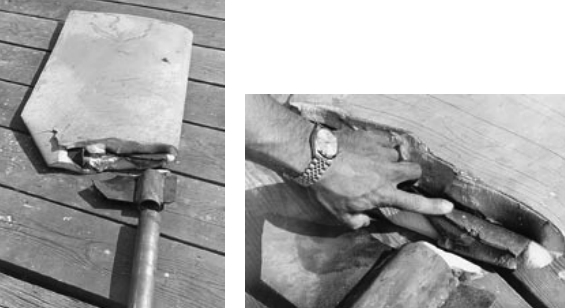
Iolaire’s port side was a mess; there was a hole large enough to crawl through that measured 8 feet long and 3 feet from top to bottom. Attempts to jack her upright would have destroyed the hull. A simple grounding had turned into a disaster.
The insurance adjuster took one look and declared the yacht a total loss. At the same time the manager of the hotel in Lindbergh Bay demanded that the wreck be removed from the beach at once. The insurance company wanted closure, so Don bought the vessel “as is, where is” for $100, with the responsibility for her removal.
Stripped interior
Don borrowed two ship jacks from a boatyard and rounded up a collection of wooden blocks and short 2 x 4s and 4 x 4s, plus a number of large wooden wedges. Then, together with friends, he stripped out the interior joinery of the yacht and quickly knocked together several stout athwartship X-frames in the interior to keep the hull from collapsing. Using wooden supports, jacks, and wedges (driven with a 10-pound sledge), and pushing against the outside planking where it was supported by the X-frames, Don and his helpers gradually raised the hull from 50 degrees to a vertical position. Fortunately, the weather remained calm.
To patch the hole, the men used ordinary 3-inch-wide, 3⁄8-inch-thick tongue-and-groove boards placed horizontally. The workers painted the edges of the hole with roofing tar, slapped on a tongue-and-groove board, and nailed it in place. As each new board was added, the edges were smeared with roofing tar. After the hole was closed, Don covered the patched area with canvas soaked in tar.
“The hull was weak in the area of the patch,” Don recalled when I interviewed him. “However, there was little load on it because of the X-frames we’d put in place in the interior. The yacht was not sailing, so there were no rigging loads on the hull. The only function of the patch was to keep the water out.”
Meanwhile Don hired a big crane from the West India Company for one day ($425). In a series of lifts, the crane maneuvered the yacht into deeper water. The temporary patch held nicely, and the wooden yawl was whisked off to a nearby boatyard. Three carpenters plus their helpers put in 11 new planks, 22 frames, a stout bilge stringer, plus a rudder and a new interior.
Outwitted them all
Iolaire was soon sailing again. With grit, determination, round-the-clock vigilance to deter looters, and a little luck, Don had outwitted both the insurance company and the chorus of doomsayers on the beach.
I saw the same trick pulled off in 1970 in Monterey, California. A sailor and his crew left San Francisco and headed south in a new Porpoise, a 42-foot Bill Garden design. She was a pretty Bermudian ketch built of wood, with a bowsprit and an exquisite sheerline. Once clear of the Golden Gate, the captain headed south along the coast.
Unfortunately, fog rolled in from the west. Suddenly the yacht was envel- oped in a thick, blinding blanket of white. The crew was inexperienced. Instead of following a strict compass course and heading a little offshore — the captain had the entire Pacific Ocean to starboard — he steered toward a fog signal that he heard off to port. It wasn’t long before he piled up on the rocks beneath the Monterey lighthouse. The yacht was holed and suddenly full of cold water. The people on board, who had lost all interest in further sailing, hurried ashore and turned the ship over to the insurance company, which declared the yacht a total loss.
A local man — let’s call him Mr. Smith — now appeared on the scene and bought the wreck from the insurance company, which was glad to sell it before the Coast Guard labeled the boat a menace to navigation and demanded removal. Smith immediately hired a local contractor, who trucked a heavy Caterpillar tractor to the nearest beach. While the Caterpillar tractor was coming, Smith and a couple of helpers emptied the water tanks and removed as much weight from the boat as possible. Since the wreck lay over on her side, he took out both masts by disconnecting the rigging and running lines ashore. When the Caterpillar tractor arrived, it pulled the masts from the inclined wreck and dragged them up on the beach. The weather remained calm.
Two days’ work
Smith ringed the hull with stout ropes and ran the lines to the beach. The big Caterpillar began to inch the wreck toward the shore. It took two days of maneuvering, rock moving, line adjusting, skid placing, and great effort, but by noon of the second day, the battered wreck was on the beach. Smith hired a crane to lift the yacht onto a big flat-bed truck. The dripping, angled load was then taken to a local boatyard, where she was blocked up and began to look like a proper vessel again. The waterlogged engine was lifted out for overhaul. The wooden masts were put alongside on sawhorses.
The costs to Smith? He bought the wreck cheaply. The costs for the tractor, crane, and flatbed truck were reckoned in hundreds of dollars, as were the charges for the heavy, long ropes and the hired laborers. The engine overhaul and the repairs to the hull and the wet interior were a few thousand dollars. The yacht was valued at $40,000. All these figures are from 1970 and should be multiplied by five or so in the year 2004, but you get the idea.
I have noted these two salvage incidents to illustrate what a determined person can do. Both stories are true and show that it’s possible to acquire a valuable yacht for a small sum. But in each case the chances of failure were considerable. The purchase of an old charter boat, a wreck from an insurance company, or a seized drug boat may sound romantic and exciting, but for most people it’s too risky and difficult. I don’t recommend it.
Banks and loan companies often finance yacht purchases. Occasionally the owner defaults on his note and the yacht is seized and sold. Usually the bank officers know little about the vessel they suddenly own except that they want to collect on the outstanding note and end a problem loan. This means you can make small cash offers (you can always go up, but not down). Try 10 cents on the dollar and see what happens. The trick is finding out about the default in time to make an offer.
Used cruisers
The third category for a less expensive yacht is a used cruising boat. A yacht just back from a long voyage. One owned by someone who is too busy to use his boat. The spouse may have grown tired of sailing. Or you’ll hear the eternal refrain: “I want something bigger.”
The August 2003 issue of Soundings magazine listed 81 35-foot sailing yachts for sale. The average price was $80,841. The average age of the listed boats was 18 years. Since actual selling prices are usually a little lower, this suggests that you can buy a 35-footer that’s 18 to 20 years old for $70,000 to $75,000, depending on her pedigree and equipment. A Hinckley or a Swan is a deluxe, premium-priced vessel and will cost perhaps twice as much as a Catalina or a Jeanneau. Nevertheless, all four will take you across the Atlantic, just as you can drive an economy Ford ($14,000) or a new Lexus ($34,000) from New York to San Francisco.
Before you head off to Hawaii, however, the used yacht will need a careful survey. The odds are that the engine of a 1985 yacht will have had far more attention than her standing rigging. This is why you need a surveyor to inspect all the 1 x 19 wire fittings with dye penetrant and a high-powered eyeglass. The inspector should unroll each sail and comment on its condition. He should check the compression of each engine cylinder. If the underwater part of the hull is plagued with blisters, there’s a potential for a big repair charge. Fortunately, experts can do quite a bit of work on the bottom for $4,000 or so, which should go into your cost considerations.
Here’s a ragtag budget for a 1985 yacht, initially costing $59,000, and preparing it for ocean sailing:
- survey $500
- engine overhaul $2,000
- new galley stove $1,000
- new standing rigging $3,000
- new sails $5,000
- painting, etc. $1,000
- haulout, osmosis $4,000
- Total $16,500
We have established that you can buy a 1985 middle-of-the-road yacht for about $75,000. My estimate for repairs and upgrades is $12,500 plus an allowance of $4,000 for bottom work. This totals $91,500.
From the same used-boat list mentioned above, you could choose a 1995 Freedom ($149,000), a 1998 Tartan ($162,000), or a 1975 Halberg-Rassy ($51,000).
Look at a lot
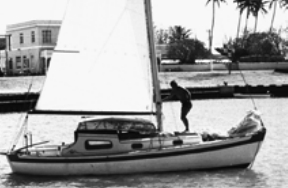
The only way that I know how to find a suitable yacht is to inspect lots of them. Walk up and down the marina docks. Climb in a dinghy and row past the moorings in the summer. Look around the freezing boat sheds during the winter. Try to size up all the yachts that appeal to you. Fat ones, skinny ones, beat-up old woodies, steel streaked with rust. Cast-off aluminum racers. Tired-looking fiberglass boats. The lot. Take a couple of photographs of each one you like. Talk to the owners. Find out where the boats have been.
Some of the yachts will appeal to you aesthetically and grab your heart. Perhaps it’s the canoe stern, a yawl rig, or the angle of a jaunty coachroof. Maybe it’s the way the early sunlight falls across the mast and boom. Perhaps it’s all these things . . . or none of them.
If you’re a serious looker, buy yourself a bound notebook and use two facing pages to keep a record of each yacht you inspect. When you’re comfortably seated aboard the boat, start writing. Begin with the date and location. Then the yacht’s name. Her overall length, waterline length, beam, and draft. (If you need a measurement, you can whip out your tape measure.)
Note the rig. The age of the boat. Hull material. Mast material. Sails (number and type). Radios. Engine (how many hours?). Steering vane or autopilot? Boarding ladder? Dinghy? Is there a place to stow the dinghy on board? Is the price open to negotiation or a trade? How long has the vessel been on the market? Is the owner anxious? Look over the yacht for her general condition, and grade her on a scale of 1 (a wreck) to 10 (too good to believe).
Make lots of notes
Write down your contact. Is there a “For Sale” sign on board? If you’re there because of an advertisement, jot down the owner’s name and telephone number. If you saw the boat with a broker, note his name and number.
Look at the condition of the berth and seat cushions (check underneath for dampness and mildew). Stretch out on the bunks and see whether they’re comfortable and OK for your body size. Try to visualize sailing in the vessel. Does she seem pleasant or is she too far gone? How many anchors does the boat have? What sizes? Is there an anchor windlass? Does it work, or have rust and corrosion sealed it forever? Write down both the good and the bad. Be specific. If you have questions (Capacity of the water tanks? Number of hours on the engine? Extra mainsail?), list them in your notebook. Take a couple of color photographs of the yacht. These don’t have to be artistic wonders, just something to help you recall the yacht. When you get the prints, staple them to the appropriate page.
What often happens is that after a few weeks of looking, you try to recall a certain yacht. But was it in Mattapoisett or Marion? Portland or Bass Harbor? Annapolis or Oxford? When we hear a lot of numbers, we tend to mix up prices, ages, and yacht names. Sometimes after a few days, you want to take a second look. Just where did you see that Cal 40?
After you look at 20 or 30 different boats, you’ll find that you like a certain design. Or maybe two kinds. If you’re unsure about making an offer, try to arrange a sail. I would have no hesitation about offering the owners a nice lunch or the payment of $75 or $100 for them to take me out for a couple of hours, particularly if I do all the string pulling. This little fee may put you next to information (good or bad) that you never thought about. For example: can one person sail the yacht or does the distance from behind the wheel to the sheet winches mean that you need two people in the cockpit? Must you walk up to the mast to adjust the topping lift? The reefing arrangements for the mainsail may seem impossibly complicated. And what about that terrible vibration when the owner put the engine in gear?
Buying brand new
So far we’ve considered ex-racing boats, ex-charter boats, and ordinary used boats. Each category has good and bad points. What about buying a new yacht?
A deluxe new 35-foot yacht designed specially for cruising may cost $200,000 or more. But she’s all new and pristine. No nicks in the gelcoat. No grubby spots or tears on the cushions. A brand-new engine with a warranty. Gloriously white sails. A new mast and rigging. Wow! It’s convenient and tempting to buy various factory options for special equipment, but the costs are high because you pay the full ticket for the item and its custom installation. The blandishments of the dealer may be hard to withstand. Also, some of the goodies (suede fabric for cushions, a two-color deck, a larger engine) may be of doubtful value. In any case, together with taxes, preparation, commissioning, and delivery, the tab can easily climb another 20 percent. With storm sails, a spinnaker, a dinghy, mast steps, extra anchors and warps, and an anchor windlass, a new, high-line 35-foot production yacht can easily cost $237,500 or more.
The gloomy reality is that if you get tangled up with installment payments and finance charges, you may never get away. This means that from a dollar-and-cents point of view, buying a used yacht may allow you to go sailing years earlier.
Summarized prices
To summarize my investigation of yacht prices in the 35-foot range, the figures look like this:
- An ex-racing boat from 1998 (5 years old) will cost $99,000. A 1985 (19- year-old) model will cost $55,000. She will sail particularly well and have many sails but may not be entirely suitable because she is set up for a large crew. Her interior will be rudimentary. If you add joiner-work and cruising equipment (water tanks, anchors, chain, extra sails, etc.) you will increase her displacement and degrade her performance. Vessels of her type tend to lose value faster because of obsolescence. Her price may be open to negotiation. Offer half and see what happens.
- An ex-charter yacht 5 to 6 years old will cost $65,000, perhaps less depending on her condition. Typically she will need $13,500 worth of equipment renewal, painting, and sails. Charter yachts tend to be of average quality. If you’re after a deluxe yacht (Alden or Cherubini), you’ll have to look in the used market.
- A used cruising boat 5 to 6 years old will cost from $99,000 to $185,000, depending on the original price. A 1985 yacht will cost about $59,000. I estimate repairs, equipment, and sails will be $16,500, which will bring the total to $75,500. A Hinckley, Crealock, or Tartan is more expensive than a Catalina, Beneteau, or Jeanneau, mainly because of more deluxe equipment and better finishing details. Are the more costly boats safer? Do they sail better? Not necessarily. Remember, most of the designs are roughly similar. You will probably be replacing the sails, so they become a standard item. Many of the masts and rigging come from the same sources.
Try to satisfy yourself that the hull, deck, rig, rudder, and steering are well built and have worked for others. You don’t need such things as television viewing centers, complex electrical systems, satellite radios, watermakers, fancy metalwork, turbocharged engines, exterior varnished trim, and so on aboard a small cruising sailboat. I’ve found that my life is simpler, more satisfying, and easier without these things.
Thank you to Sailrite Enterprises, Inc., for providing free access to back issues of Good Old Boat through intellectual property rights. Sailrite.com