Corsair Marine’s little three-huller is fast and fun
Issue 38 : Sept/Oct 2004
Lest we find ourselves engaged in one of those downward-spiraling debates about the characteristics that define a good old boat, trust me: I find a traditionally designed Colin Archer sloop or cutter as pleasing to the eye as the next chap. A main saloon with room for a kerosene lantern to swing from the overhead and an enclosed wine locker are just fine with me.
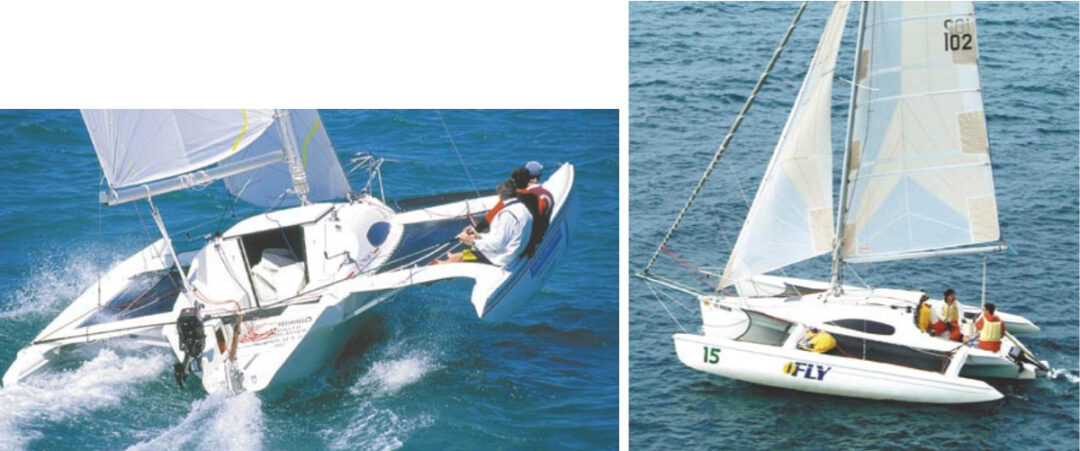
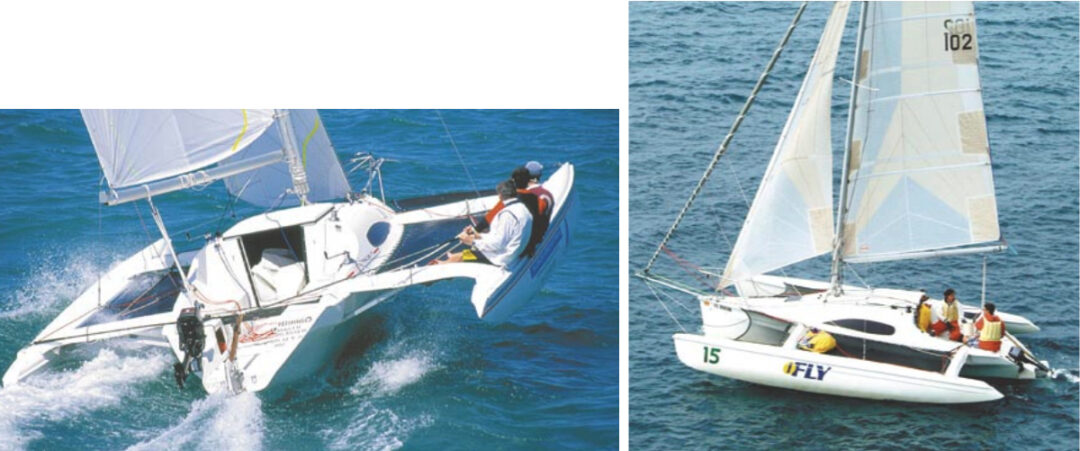
Nonetheless, the fact that a boat may not have teak on the gunwales or cockpit seats and may have a reverse transom need not result in its banishment from the world of good old boats. That it may have more than one hull (heaven forbid!) is not a knockout punch either, especially when it is as foldable and as easily trailerable as the Corsair 24 trimaran.
Think of it this way: with a trailerable boat you can be sailing in Kansas, Dorothy. Add this: if you’re aboard a Corsair 24 in virtually any wind condition, you’ll be going faster than similarly sized monohulls and some of their big sisters. There’s more: if the mood strikes, 30 minutes after loading her onto a trailer you could be motoring toward a sailing destination in North Dakota. Or Nebraska.
Prior to my first Corsair Experience, I suffered from a heavy dose of skepticism, based on old prejudices. After all, multis just don’t look like real sailboats, do they? Plus the conventional wisdom (now there’s an oxymoron for you) held that multihulls do not sail well to weather. They require the rental of two slips, so these craft were exiled to end ties with little protection from waves and wind. In addition, the Corsair was designed to fold up, and I figured that was merely trouble waiting to happen.
Wind and calm
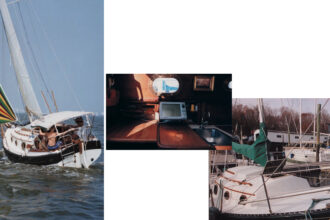
Then I sailed on a 24 for two days during a regatta on Puget Sound in no wind and in lots of wind. Shanghaied by a boatbroker who was demonstrating the boat for a potential buyer (and the client’s bikini-clad companion — bad form in the Northwest), I signed on as a sail trimmer.
What fun! Beating in 10 knots of breeze on the first weather leg, I managed to overtrim the jib and stall the main while trying to point to within 45 degrees of the apparent wind. With boatspeed at a steady 5 knots, that seemed to confirm the multi’s lack of pointing ability.
“Ease the sheet,” the broker said, so I did. He footed off two clicks, and the 24 accelerated as if someone had lit an afterburner. Boat speed immediately increased to 9 knots, and we began passing a monohull fleet that had started ahead of us, though well to leeward. No matter. Just as the book says, we sailed more distance on a lower course and made more tacks than the monohulls but were close enough to the breeze that we reached the weather mark ahead of the pack in the company of several other multis.
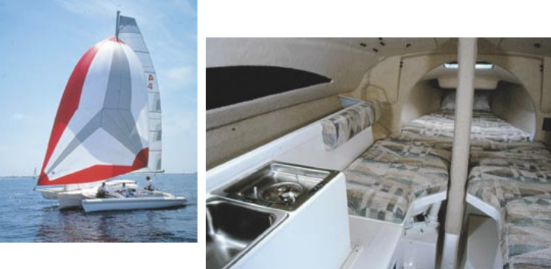
We were faster on the downwind leg too. Rather than sailing 130 to 150 degrees off the apparent wind with a spinnaker — the normal routine on a sloop — we sailed at 120 degrees under an asymmetrical spinnaker tacked at the bowsprit. I became a True Believer when the entire fleet of nine trimarans danced the same dance, with boat speed a steady, comfortable, 12 to 13 knots.
Day Two was a replay of Day One, except the bikini had been replaced by layers of fleece. Plus the designated trimmer made the classic boo-boo. As part of my contribution to the effort, I managed to attach a sheet to the head of the reaching spinnaker, resulting in the sail being hoisted sideways.
“I thought the numbers on the sail were a little hard to read,” the broker said, hoping that his plans to cash a commission check had not been waylaid.
Company history
No longer the new kid on the street, Corsair Marine was founded in 1983 by John Walton of the Wal-Mart family to produce fast, easily trailerable multihulls. To meet that objective, the first compromise required designing accommodations that are, at the least, cramped but functional. Overnighting is akin to camping in a pup tent and cooking on an tiny camp stove. Nonetheless, John Walton and subsequent owner Paul Koch succeeded, despite the complicated, people-intensive construction process necessary to produce foldable boats capable of withstanding loads endured at sea and on the highway. A by-product, however, was pricing that ratcheted the boat into the upper stratosphere and initially produced sticker shock in the marketplace. In retrospect, when high resale value is added to the equation, the long-term cost is lower than that of many other boats.
At the outset, John convinced Ian Farrier, a high-profile multihull designer in New Zealand, to abandon a thriving practice and move to California to execute his vision. (Ian’s story is told in the March 2004 issue). Ian designed the first Corsair, a 27–footer that still enjoys an excellent production run, before he and Corsair had a falling out that led to his departure. Rehired, he designed the F-24 Corsair Sport Cruiser in 1991 before a second disagreement, after which both parties went their separate ways for good. Paul Koch purchased the company in 1994 and continues the manufacturing operation in California. In its first two decades, Corsair has produced 1,260 boats; annual production is typically 72 to 75 boats, Paul says. The original 24- footers, designed by Ian Farrier, were called F-24s; newer models, based on Ian’s design, are called Corsair 24s.
Design
During a morning-long session with Ian Farrier at his Seattle office, I learned that he sees the world only through multihull lenses. While elaborating the many reasons he considers a multihull to be the best alternative, he says, “The proper attitude for a monohull is resting on its bottom on the bottom of the ocean. In comparison, a multihull’s natural orientation is floating on top, in either an upright or inverted attitude. Corsair boats are virtually unsinkable. They have watertight compartments so even if pitchpoled, the crew can crawl inside a capsized hull and have air to breathe and protection from the elements. A monohull’s crew will most likely be adrift in a life raft.”
As with most foldable trimarans, understanding Ian’s design target for the original F-24 requires a lesson in the language of the artist, since designers have different names for components. The main hull, which is typically narrow and shallow to produce speed, may be called a vaka. The floats are called amas by Ian Farrier and outriggers by Tony Smith, another noted multihull designer. The amas are V-shaped to produce maximum lift and minimum drag, and their center of buoyancy is located well forward to reduce any tendency of the bows to bury, especially when they are loaded with spare gear. Akas, which would otherwise be referred to as crossbeams, connect the vaka to the amas.
Five years after its introduction, a new, lighter Corsair 24 Mark II was introduced. The newer version features a fine entry on the center hull, a U-shaped midsection, and a relatively fat and flat stern section. The flat section aft allows the boat to plane downwind and also dampens pitching moment when seas are up and wind speed is down. Most of the stern sits well above the waterline to reduce wetted surface (and friction) and add buoyancy aft.
Modifications
Other important modifications were a rotating mast and single-spreader rig, a transom-hung rudder, and a retractable daggerboard, all of which simplified sailing. Performance was improved by the combination of the weight-loss program, hull shape, and improved hydrodynamic shape of the daggerboard and more aerodynamic shape of the mast. A square-top mainsail added horsepower aloft and created a signature profile.
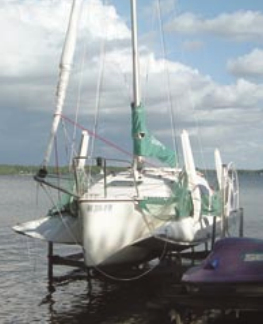
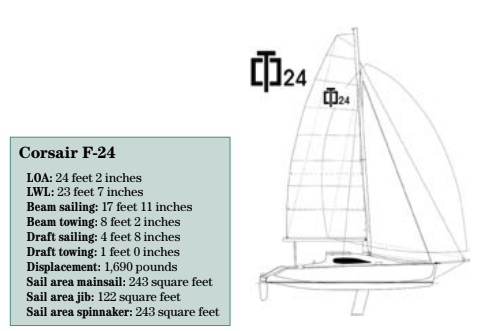
Compared to a folding catamaran, which typically slides together, a Corsair folds inward to produce the appearance of a giant daddy longlegs. The akas (those crossbeams) fold into an upright position, reducing beam to an easily trailerable 8 feet 2 inches. Initial fears concerned the durability of the structure, but the boats have proven themselves to be eminently seaworthy. From an operational standpoint, once he’s familiar with the process, an owner can have the hulls deployed in less than five minutes.
Another plus of the design is that, even when folded, the amas produce adequate stability for the boat to be motored safely at slow speeds.
Deck
Logic dictates that a 24-foot-long, 17-foot-wide boat should have room in the cockpit for a crew of 20, right? So much for logic. With room for the helmsman, tiller, and two sail trimmers, cockpit space is at a premium. However, space for a dozen loungers is on the center hull and netting between the vaka and amas . . . which also provides a ventilated space from which to view the water coursing below.
Under sail, this boat is as easily manageable as a traditional sloop. An optional bowsprit adds horsepower by allowing the use of the asymmetrical spinnaker, which is a kissing cousin to a light-air drifter. However, on this boat the payoff is tremendous. For openers, the sail is easy to handle, eliminating the mental barrier encountered by crewmembers who just don’t want to deal with a spinnaker, spinnaker pole, foreguys, afterguys, and the complications encountered when flying a ’chute. With this sail, it’s just a matter of attaching the tack to the ’sprit, adding two sheets, and holding on while speed doubles. Easy is good; fast is fun.
Belowdecks
Living space is at a premium since the center hull has less than 7 feet of beam. The good news is that there’s little risk that the boat will become the social center when tied up at the dock. Headroom is greatly improved when a pop-top is elevated, which also makes a very positive contribution to ventilation. Otherwise, headroom is about head high for a seated adult, and crew may be rubbing elbows and touching knees when seated on the settees. There’s a paucity of storage space, as well, though additional space is under the cockpit and in the amas. Without shelves, those areas tend to have the appearance of an overstuffed sock drawer. As a consequence, one of the fun challenges for those with an organizational bent is creating storage with the use of small bags and other portable containers that may be attached to the interior of the hull with Velcro. Boat camping implies a portable alcohol stove, sink, and Porta Potti, and the Corsair does not disappoint. A (sort of) private V-berth forward will probably be occupied by the kiddies or vertically challenged adults. Skipper and first mate will usually occupy quarter berths port and starboard.
Construction
The high cost of Corsair’s boats is attributed to several factors, not the least of which is the tooling cost associated with a boat that has more than 50 different molded sections. The 24’s structure includes the vaka, amas, akas, and the dozens of interior components.
From the outset, the company has employed the use of high-tech raw materials, including vinylester resins, carbon fiber, double-bias fabrics reinforced with Kevlar, and a vacuum-bagging process.
The lamination schedule consists of a layer of gelcoat, a skin layer impregnated with vinylester resin to prevent blistering, and multiple layers of uni-and bi-directional fiberglass. Kevlar is laid in high-stress areas on the bottom, the daggerboard trunk, and at bulkheads. The hull-to-deck joints in older boats were bonded with a vinylester fiber-filled putty compound; newer boats are bonded with methacrylate. Historically, boats have not experienced hull-to-deck-joint leaks.
To increase their stiffness, the akas (crossbeams) are constructed of layers of fiberglass, carbon fiber, and foam. Additional strength and buoyancy are produced by watertight bulkheads in the amas.
Pricing
The base price for a new Corsair 24 is $42,695. Expect to add $1,000 to $1,500 for mainsail and jib, depending upon fabric and design. Necessary options include an electrical package with navigation and interior lights ($840). The wish list might include a Schaefer 750 furler ($1,691) and a VHF radio, antenna, and cabling ($785).
A similar-sized monohull can be purchased for 75 percent of this boat’s price. On the upside, well-maintained, newer used boats are selling for 75- to 85-percent of their original price.
The bottom line
First, she’s a good boat, despite having three waterlines. She’ll sail in light and heavy breezes. She’s fast and simple to manage. Since her sailors spend most of their time topside, the deck (netting) space is a real plus. She does suffer a smallish interior when the galley slave is preparing a meal for five and if overnighting in cool climes with more than three adults. In warm weather, I’d sleep under the stars.
Nonetheless, unless accommodations are higher on your priority list than performance and comfort under sail (she sails flatter than a monohull, you know), or you are planning an extended cruise with a family of eight, this boat is worth a second look. Just be sure there’s a big X on the head of the spinnaker before you hoist the sail.
Thank you to Sailrite Enterprises, Inc., for providing free access to back issues of Good Old Boat through intellectual property rights. Sailrite.com