How changes can affect the strength of a rig
Issue 46 : Jan/Feb 2006
In recent weeks I’ve had several inquiries from boatowners asking for advice on mast rigging. Their questions prompted me to write a few words on the subject. One of the queries was the advisability of switching over to the newer, more corrosion-resistant, type 316 alloy stainless-steel wire. Another dealt with the bene fits of increasing the wire diameter from 1⁄4 inch to 5⁄16 inch on a boat that needed new rigging. These questions were easily answered. In both cases, my reply was, “Don’t do it.” The reasons are simple but perhaps not obvious unless you are a professional rigger or have been involved in design. First, a bit of background on yacht rigging.
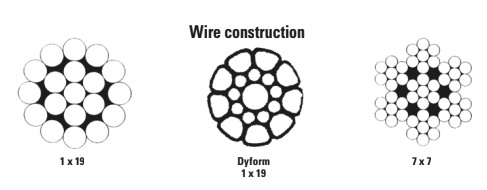
A group of wires concentrically laid about a central wire is termed a “strand.” The usual number of wires in a strand of yacht rigging is 7 or 19. A single strand, or a group of strands, forms a “wire rope,” or “cable.” Wire rope is designated by the number of strands, plus the number of wires forming each strand. The three basic types of wire rope (sometimes just called wire) used for standing rigging are shown above. The most commonly used wire rope in a yacht’s standing rigging is 1 x 19 construction, which means that it is made of one strand, composed of 19 wires in all, twisted around a central core. This produces a rather stiff and strong wire rope.
Traditional yachts often use 7 x 7 wire, composed of seven strands, each of seven wires, as it can be spliced around deadeyes, blocks, or cast thimbles. It can also be swaged. It is much more flexible than the stiff 1 x 19 wire, so it’s often used for running backstays.
Even more flexible than 7 x 7 is 7 x 19 wire, seven strands each of 19 wires, but it is not used for standing rigging. It was long the standard for halyards as its great flexibility allowed it to be run over masthead sheaves. But 7 x 19 tended to develop “meat hooks” (protruding wires) with wear, and these took many a long, painful slice out of a crewman’s hand, including mine. Fortunately, wire rope has been largely replaced for halyards by the development of low-stretch synthetic ropes and, as one of its numerous victims, I do not regret 7 x 19’s passing.
More metal
Dyform wire rope is available in 1 x 7 construction in 3 mm and 4 mm diameter for dinghies and in 1 x 19 construction in larger diameters for yachts. As is evident in the illustration above, the Dyform wire simply packs more metal into a given diameter due to the unusual shape of the individual wires. This makes it both heavier and stronger for any given diameter or, conversely, slimmer and with less wind resistance for a given strength. It is also considerably more expensive. One company prices 6 mm Dyform at more than three times the cost of 1⁄4-inch type 304 wire. Note that Dyform comes only in metric sizes.
Stainless-steel rigging wire for marine applications has been commonly made of type 304 alloy. This alloy contains 18 percent chromium and 8 percent nickel and is often termed 18-8 alloy. Type 304 has a lower carbon content than the similar type 302 alloy and thus has somewhat greater corrosion-resistance. Type 304 wire is relatively inexpensive, strong, and resists corrosion quite well. However, it does develop rust stains over the years.
Indeed, it is particularly prone to failure in swaged fittings in warmer tropical waters, as it suffers from crevice corrosion. The corrosion starts just inside the neck of the swaging, where the water can seep in. It eventually expands to a point where the swaging starts to split and peel like a banana. Complete failure is the inevitable result and often ends in the loss of the mast, unless the rigging assembly is replaced in time.
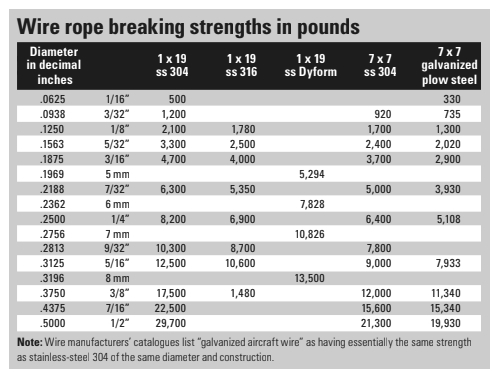
The more corrosion-resistant type 316 stainless steel is made by adding 2 percent molybdenum to the other components of the metal. Unfortunately, type 316 is weaker than type 304, as is shown on the breaking strengths chart on Page 18, and cannot be used size-for-size to replace type 304 wire. It is necessary to increase the size, and this is not always feasible for reasons that will be shown. There is also the matter of cost. For example, 1⁄4-inch type 316 will replace 7⁄32-inch type 304 but costs 80 percent more. The need for larger end fittings and other hardware will add to the cost as well. The question you must ask yourself is, “Will it last 80 percent longer?” I have to doubt it.
Cheaper but weaker
Galvanized wire is the least costly wire rope and can prove durable if properly maintained. Galvanized plow-steel wire is considerably weaker than stainless steel, but I have older catalogs showing galvanized aircraft cable in both 1 x 19 and 7 x 7 construction with strengths comparable to that of type 304 stainless. However, aircraft cable may not be readily available today. Still, many handsome character yachts are happily sailing around our waters with galvanized 7 x 7 plow-steel rigging, properly sized for the loads, of course.
The secret to giving galvanized wire rope a long life is to soak it in a trough containing boiled linseed oil and then letting it dry before it is set up. After that, slush it down annually with a rag soaked in the oil. I have inspected galvanized 7 x 7 rigging close to 15 years old that was still in good condition as a result of this treatment.
The table below shows strengths of wire rope in the various diameters and materials. The difference in strength between type 304 and 316 alloys is quite substantial so it is, obviously, very dangerous to substitute 316 for 304 of equal diameter. The 7 x 7 wire is weaker still, so traditional rigs need to be given an increase in diameter also. This adds windage, of course, but that is rarely a major concern to the skipper who is in love with the gaff rig.
Since Dyform wire comes only in metric sizes, some compensation in diameter may be necessary. Also Navtec does not recommend the use of Dyform wire with hydraulic backstays due to the reverse lay. The wire tends to unwind with tension, and this has shown to result in undue stretch. Hayn makes swageless terminals with specific cones to suit the Dyform wire. If swaged terminals are used, they must be purpose-built for metric wire.
The reader is cautioned that swaging Dyform is a controversial practice, and some riggers will refuse to do it. The concern is that there is not sufficient room for the metal to flow. Also, above 10 mm, the strength of the swaged fitting will be less than the wire because the commonly used milspec limits the wall thickness of the swage fitting for other reasons.
Designed for bronze
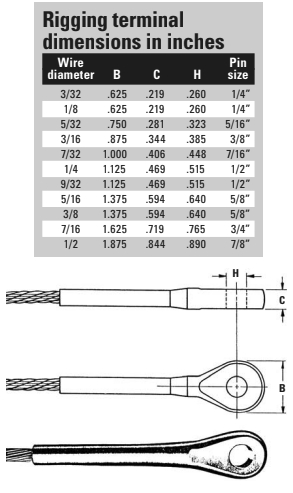
The illustration on Page 61 shows the measurements of marine-eye terminals as used on so many of our boats from the 1960s into the 1980s, and even today. These terminal dimensions were, in all probability, originally designed for the old bronze, hot-zinc socketed terminals (still a great end fitting if you can find them) and continued on unchanged through the era of the stainless-steel swaging. The terminal sizes shown are also similar to those available in swageless terminals.
Just to confuse you, I noticed in a recent catalog that the swaged marine eye for 5⁄16-inch wire is now available to fit a 1⁄2-inch diameter pin as well as the more usual 5⁄8-inch pin. I checked it out on my calculator, and the smaller pin is adequate for 5⁄16-inch diameter 1 x 19 wire, but the yield strength of the pin is too close to the 12,500-pound breaking strength of the wire to suit me. I have to believe the original designers knew what they were doing when they specified the pin sizes, and I do like to see some more meat around parts that are subject to considerable wear and corrosion.
When it comes to turnbuckles, I was surprised to see that one manufacturer makes an open body stainless-steel turnbuckle which, it says, can be used with 3⁄16- to 1⁄4-inch wire. It has a 3⁄8-inch pin, and the manufacturer lists the breaking strength of the turnbuckle at 8,000 pounds, which is below the breaking strength of the 1⁄4-inch wire. Also, some stainless-steel, tubular-body turnbuckles are made with odd pin sizes, such as a turnbuckle for 1⁄4-inch wire also fitted with 3⁄8-inchpins. I certainly would not use them on my boat or recommend them to a client going offshore. It’s definitely a case of “buyer beware.” A close study of the catalogs is necessary.
Pin size problem
Earlier I mentioned a problem in going to a larger-size wire diameter. The problem lies in the pin sizes. For example, the man who wanted to go from 1⁄4-inch wire to 5⁄16-inch did not realize that the terminal pin size would increase from 1⁄2-inch to 5⁄8-inch. That would mean the chainplates and the mast tangs would have to be reamed out to the larger diameter with a commensurate loss of strength. It might be safe or it might not, depending on how generous the designer was in specifying the original chainplate and tang dimensions.
Of course, today you can buy a 5⁄16-inch terminal with a 1⁄2-inch pin, but I would not go that route. Instead, I suggested that my client increase to 9⁄32-inch wire that is 25 percent stronger than the original 1⁄4-inch, yet still uses the same 1⁄2-inch pin. Similarly, in upgrading from type 304 to type 316 wire, you must increase the wire diameter to obtain the same strength and, again, the problem of incompatible pin sizes crops up. You would have to increase to 1⁄4-inch type 316 wire to get strength equivalent to 7⁄32-inch type 304; then the pin size of the terminal jumps from 7⁄16-inch to 1⁄2-inch. It is quite probable that the chainplates can be safely drilled out to suit, but there’s no way to guarantee it without measuring and calculating carefully.
In some situations, custom-made fittings will solve problems caused by changes in the rigging schedule of a yacht. Rigging Only can supply some custom fittings. If you go this route, you may want to buy extras because replacements will be hard to find.
Even more confusion exists when you get into “aircraft” terminals. These terminals are available in both jaw and eye type, but use a smaller pin than marine eyes. A 1⁄4-inch “aircraft” eye uses only a 3⁄8-inch pin, instead of a much more robust 1⁄2-inch. The fork-style terminal is often used with single-plate mast tangs, instead of the more common double-plate tang, and I would avoid these like the plague on any boat much larger than a daysailer.
Not cost-effective
I do not include rod rigging as I have not used it to any extent on my yacht designs, and I do not find it to be cost-effective for the typical cruising sailboat. Rod does have advantages of excellent corrosion-resistance, lighter weight, and smaller diameter for less windage. Its main disadvantage is that it can fail unexpectedly, as the signs of failure are difficult to detect. If you are a serious cruiser/racer you may find it to be affordable and advantageous for your sport. If so, I would suggest that you contact an experienced rigger for advice and an estimate.
I would add one note. It is obvious that shrouds can slat around considerably when they are on the lee side of the yacht. Most sailors realize that toggles must be fitted to prevent damage to the turnbuckle from the banging around. The other alternative is to use toggle-type turnbuckles. However, few sailors think about the ends of the fore and aft rigging and, here, toggles are recommended at both the top and bottom on all headstays in order to allow for the twist of the catenary under a press of sail.
Finally, regular inspection with a very strong magnifying glass is essential to head off rigging problems. Rust is the first sign of a potential failure in stainless steel. The use of a penetrating dye is particularly helpful in detecting minute cracks in swagings, turnbuckles, and toggles. Careful polishing of the rigging can eliminate the small pits that allow corrosion to get a start.
Remember that like a chain, standing rigging will be as strong as the weakest component in the path of tang, fitting, pin, wire, fitting, pin, chainplate. There is nothing gained by upgrading only one of these “links,” and everything is downgraded by making any of these parts weaker.
Thank you to Sailrite Enterprises, Inc., for providing free access to back issues of Good Old Boat through intellectual property rights. Sailrite.com