The way we keep time at sea
Issue 48 : May/Jun 2006
The concept of latitude and longitude have been known since the early days of sail, but without accurate timepieces longitude readings required long and cumbersome mathematical calculations, and the instruments for measuring latitude were very crude at best. Sailors primarily depended on dead reckoning (or ded reckoning, which was a contraction of deduced reckoning) to determine their position. But even dead reckoning required rudimentary timekeeping, since to calculate the distance traveled you had to multiply speed by time: D = S x T.
Clocks existed during the Elizabethan era, but they generally used a pendulum, which was incompatible with a rolling, pitching vessel. Even the best of these clocks had to be corrected frequently by sun sightings. Water clocks and sundials were often much more accurate, but both had serious disadvantages at sea; so the sandglass or hourglass became the early timepiece of choice aboard ship.
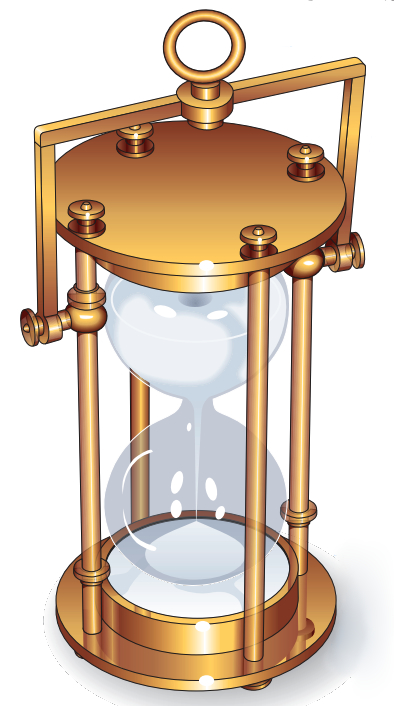
Sandglasses
The most commonly used sandglass was the half-hour sandglass (although four-hour sandglasses were sometimes also used). The ship’s boy or the seaman at the helm tended the half-hour sandglass. As soon as the sand ran out he would turn it over and strike the ship’s bell, adding one bell every half hour until, at the end of the four-hour watch, it was eight bells. These bells were grouped in twos, with each group of two signaling an hour. Thus, at two-and-a-half hours into a watch it would be five bells rung as two bells, pause, two bells, pause, one bell.
At eight bells the four-hour watch was finished, the new watch took over, and the process was repeated.
During the 1700s and 1800s, whaling voyages and voyages of discovery could last two years or more. For voyages of this length, several sandglasses were part of the ship’s inventory. Not because of breakage — always a possibility — but because a sandglass would wear out. Sand was going through the narrow neck of the glass from one chamber to another 24 hours a day, and sand is abrasive. After many months of use the narrow glass opening became larger and soon, instead of a half-hour sandglass, it was a 25-minute sandglass. After months at sea, a new glass would be brought out and compared with the old one. If there was an appreciable difference, the old sandglass would be retired.
Ships’ bells
The announcement of time aboard ship, the ship’s bell, is still often used, but these days on large ocean liners the bell sound is now generated electronically and broadcast on an intercom. Nevertheless, many traditional ship’s clocks, sold to nautically-minded customers, still chime the four-hour watch bells for telling time.
The standard watch system aboard ship was first established by the British Navy, which mandated six watches each day of four hours each. These watches started at 12, 4, and 8; so if you heard five bells you would know that was 2:30 a.m., 6:30 a.m., 10:30 a.m., 2:30 p.m., 6:30 p.m., or 10:30 p.m. To prevent sailors from always being on the same watch and to allow both watches to have supper, the watch between 4 and 8 p.m. (1800 and 2000) was modified into two two-hour watches. The first of these watches, from 4 to 6 p.m. was called the first dog watch, and the second two-hour watch was called the last dog watch. Although the term dog watch has been used since the 1700s, naval historians are not sure how that term originated.
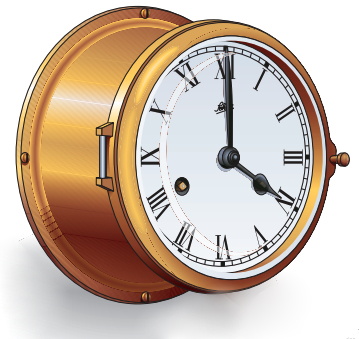
Name that watch
Each watch was given a name. The watch starting at 8 p.m. (2000) was called the first watch; the midnight watch was called the middle watch; the 4 a.m. watch was the morning watch; the 8 a.m. watch was the forenoon watch; then came the afternoon watch; first dog watch; and last dog watch. The two watch crews aboard ship were often given the names of the port watch and the starboard watch.
In the 1700s the search for a reliable method of measuring longitude intensified. Many scientists believed it would never be possible to create a ship’s clock accurate enough for this task because of the large variations in temperature and humidity, coupled with the ship’s wild gyrations. They opted, instead, to find an astronomical solution.
But finally, in 1764, carpenter John Harrison refined his ship’s chronometer to an accuracy that resolved this dilemma. However, these new clocks were rare and expensive and only found aboard government and naval vessels. It wasn’t until well into the 1800s that the average sea captain or packet company could afford a clock that would make determining longitude possible.
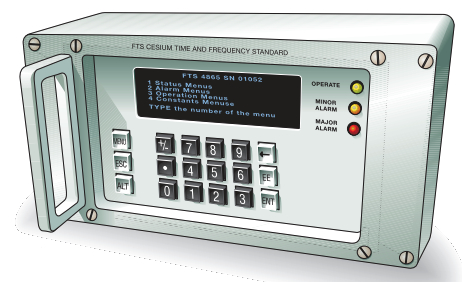
Accurate timepieces
In the mid 1900s quartz clocks and wristwatches, which could be purchased for a few dollars, were able to keep time better than the best mechanical timepieces ever made. These watches made practical use of the piezo-electric effect, which was first discovered in 1880 by scientists Pierre and Jacques Curie. Now we have clocks and wrist-watches that can pick up the time signals broadcast from the atomic clocks in Fort Collins, Colorado, and our GPS receivers show the time from the atomic clocks aboard the GPS satellites, giving us access to time with- in a small fraction of a second.
Although the sandglass has now been relegated to the mantelpiece, it’s still a nostalgic reminder of our nautical past.
Thank you to Sailrite Enterprises, Inc., for providing free access to back issues of Good Old Boat through intellectual property rights. Sailrite.com