This orphaned Pearson 365 will rejoin the fleet of good old boats
Issue 49 : Jul/Aug 2006
Most of the time I am looking at or looking for boats. If there were a self-help group for excessive boat ownership, my wife would have me enrolled. Our fleet numbers over 20. Hey, you have probably said it yourself, “No one boat can do it all.”
Some people collect lost cats. I collect boats, most of them project boats. I regularly do quick Internet searches for sailboats under $20,000, and it’s nice to see what’s out there for a reasonable buck. That’s how I found Maruska. Perhaps she found me. In any case the events that led to her purchase had many fantastic twists and turns.
Maruska initially popped up on one such search. A $20,000 maximum price, a 35-foot-and-up length criterion, and a simple push of the Enter key on my computer brought up several pages of intriguing prospects.
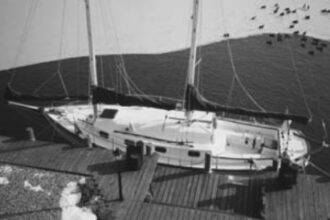
Most often, as I make a quick glance down the list, I see that the offerings are too old, too wooden, or too ferro or else they’re boats you would need swim fins and a mask to see. On this day, however, one listing caught my eye. It was a 1976 Pearson 365 ketch in Havre de Grace, Maryland. We had looked at several of these ketches in the past. All were basically out of our price range, and the timing wasn’t right. But I love to look at boats. The Pearson 365 turned into a “someday boat,” like many, many before it.
When the listing for a Pearson 365 hit the screen for the magic $20,000 number, the wheels in my head began to turn. I saw right away that the listing was cleverly crafted. There was no equipment inventory, no vessel specifics, and no information except for the words “project boat.” It was topped off with a half dozen pictures of what looked like a Pearson 365 afloat, along with several fuzzy pictures of a “modified interior.”
I returned to the listing again and again for the next several weeks. I compared pictures of the boat with pictures of sister ships and tried to determine just what this particular project was really all about. I shot off an email message to the listing broker and then a phone call. Both went unanswered.
Life is hectic. I wanted to know more about the boat while at the same time I didn’t want to know, so I never followed up. One morning I glanced at the ad and my heart sank. Apparently she had been sold because the Pearson 365 for $20,000 no longer showed up. I scanned the listing rows one last time . . . What was this? A price reduction to $15,000!
I quickly called Arvid, the listing broker and owner of Havre de Grace Marina. With startling machine-gun repetitiveness, Arvid insisted that I would have to “look at her.” Her previous owner had modified her interior, and I would have to “look at her.” What she had for gear was onboard, but I would have to “look at her.” She needed a lot, but I would have to “look at her.” Arvid said it was tough to explain over the phone. He repeated for the fifth time to come and “look at her.”
I decided to go.
Long ago, I learned to make out a contract. In the past I’ve lost several boats because of time wasted from indecision, the “we-will-sleep-on-it excuse.” One Fuji 32 in the Florida Keys was in the path of a hurricane, so the scared owner took the first bid — any bid — that came along. The hurricane, by the way, took a sharp left after I heard the news that my lowball offer was too late. I even lost one while driving to look at the boat!
I emailed a contract and faxed a copy of a deposit check for Maruska to Arvid. This turned out to be one of the best decisions of the day; there apparently were plenty of people watching and waiting, and the $15,000 number shook the bushes.
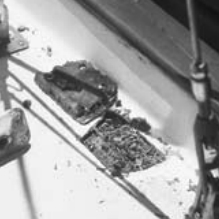
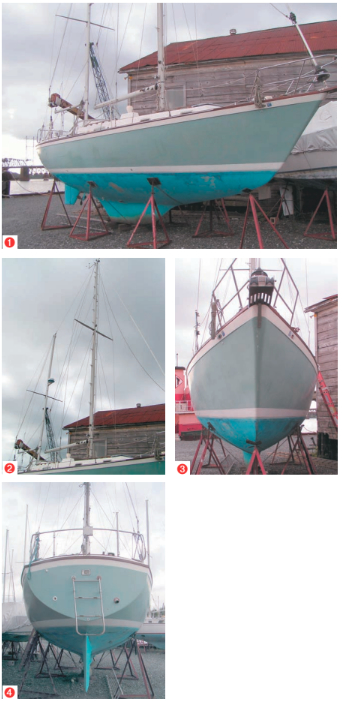
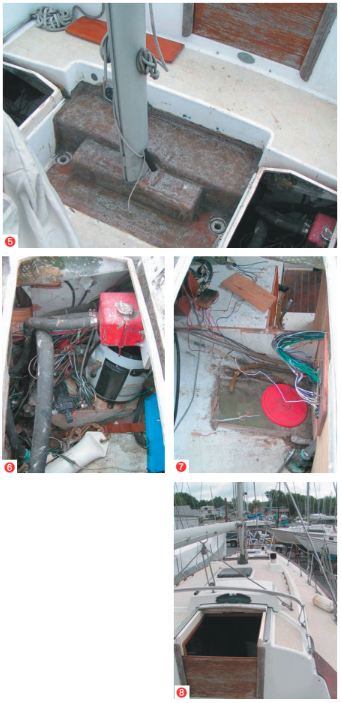
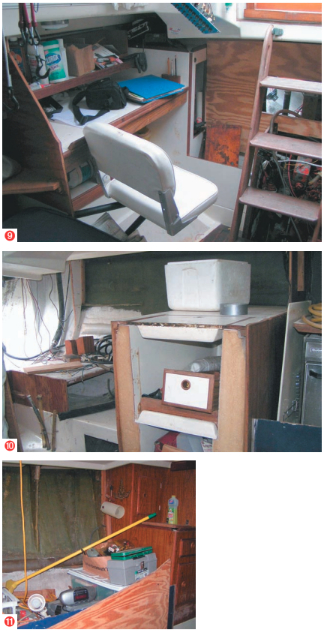
My son, Eric, and I pulled an all-nighter, and 370 miles later I was looking at what appeared to be a reasonable Pearson 365. She needed a good cleaning and some new running rigging, but, all in all, Maruska was in good shape on the outside. Upon sliding open the companionway and de- scending the cabin ladder, however, we entered a whole different world. It was a cabin filled with questions, loose ends, missing pieces, and an awful smell. From the forward bulkhead aft, almost everything had been modified or removed. The U-shaped galley had been literally cut down the center of the icebox. The over- head storage unit had been non-surgically removed via Sawzall.
There was a gaping hole in the sole where beautiful teak cabinetry once stood, cut wiring and plumbing dangled everywhere, a good portion of the hull was exposed, and you could see straight through to the transom on the port side. The port and starboard water tanks had been cut open, the engine enclosure was gone, rank bilge water had been high over the sole. The depressing list went on and on.
My son and I hurried topside for some fresh air. At breakfast, our discussion went from “no way” to “what if?” and we headed back to the Havre de Grace Marina for another look. Unfortunately, nothing had changed; the interior of the boat was still a disaster. The story, as it unfolded, was that the previous owner had retired and purchased the boat. His plan was to make some changes. When he was done, he and his wife would sail away.
Unfortunately, he died six months into the project. Sadly, he took his dreams and aspirations with him, as well as any indication of which direction he was heading on the project. Instead of doing one project at a time and completing it, the owner had begun 20 or more; the result was chaos. The Pearson had languished for a year and a half, literally an orphan. She was taken from the original marina when her slip contract was canceled and towed to Havre de Grace.
A steady procession of would-be buyers and dreamers crossed her decks weekend after weekend. The broker said that Maruska had generated more inquires than any vessel in his 30-year history of selling boats. He got to the point where he refused to answer email inquiries. Just during the time we were aboard that Saturday morning, the broker received three email messages and two phone calls.
I was the only one foolish or visionary enough to sign a contract. The truth was that each item that needed attention required only modest repairs. The grand total, however, of dozens of individual things to fix was massive, even for a project boat veteran. Perhaps my quick emotional attachment to this orphan clouded my senses.
I have to admit that for me, Maruska will be the boat project of my lifetime (so far). I have a chance to make her into what I think a sailboat should be and an opportunity to sail her home to Buffalo, New York.
Thank you to Sailrite Enterprises, Inc., for providing free access to back issues of Good Old Boat through intellectual property rights. Sailrite.com