Try the two-handed method for better results
Issue 50 : Sept/Oct 2006
A dedicated heaving line should be supple and easily handled, weighted at the end by tradition with a monkey’s fist knot. It is used as a messenger to get a heavier cable to another vessel or, aboard a small yacht, may serve also a standalone function, thanks to the high tensile strength of many modern synthetic ropes. The dedicated heaving line should be thrown in the correct fashion, although its weighted end may make it tolerant of error.
Often there is no time to use the messenger; you find yourself needing to throw someone a line and the nearest rope is the only option. Then it may be a matter of life or death that you can heave that line to the hand waiting to grasp it.
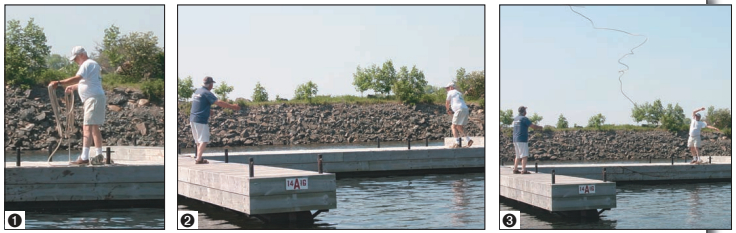
If you find throwing a rope difficult, you might like to try the following method (shown in the photos at the top of facing page). Take a rope of manageable length and weight and form it without kinks into a clean coil. Split the coil into two coils, one held in the left hand, the other in the right (1). For a right-handed person the bitter end of the left hand’s coil should be secured aboard. There should be somewhat less rope in the left-hand coil.
Rotate your body and swing back both coils, one in each hand, then steadily and firmly heave both simultaneously, the right hand releasing its coil fractionally in advance of the left (2). The idea is that the left-hand coil should not act as a drag holding back the right-hand coil.
It is tempting to secure the bitter end by standing on it, we’ve all done it, but when you put your best into the heave, in the style of a Sumo wrestler, that foot may lift off its charge. Worse still, the line thrown to another boat may be secured at once to the bitts on that vessel, while aboard your own ship it’s tangled around your ankle.
To catch a line, stand with arms outstretched to present the maximum target (3). Heaver and catcher, beware! I have seen lines with a lead-ballasted monkey’s fist that could double as a mace in a medieval jousting tournament.
With practice, the two-handed heave is very efficient. Try it with a rope of modest weight and, say, 30 to 50 feet in length, depending on your physique. Once the trick of getting the two hands to work together is mastered, it should be possible to throw the rope dependably to its full length.
Thank you to Sailrite Enterprises, Inc., for providing free access to back issues of Good Old Boat through intellectual property rights. Sailrite.com