What’s a retired Snipe and Catalina 22 champ to do?
Issue 52: Jan/Feb 2007
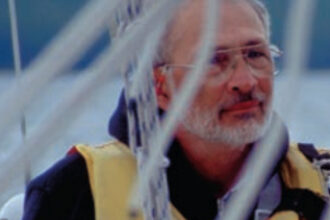
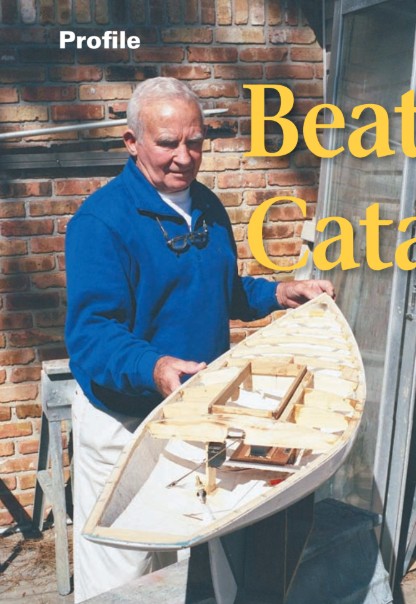
WHEN IT COMES TO SAILING, Beattie Purcell has done it all. He was a major figure in the early days of Catalina Yachts and has a long record as a fearsome competitor on the racecourse on both sides of the Atlantic Ocean. At an age when most ancient mariners are taking in sail and seeking out a quiet anchorage, this remarkable Florida sailor is just getting under way.
Beattie was born in Ireland. Since no point in the Emerald Isle is far from the sea, salt water was a neighbor and a constant presence. He was born in 1925 in Belfast, a great port city and shipbuilding center, and grew up in the Belfast Lough town of Carrickfergus in County Antrim. His grandfather was a mariner and, as a 12-year-old, Beattie watched him almost drown after a capsize at nearby Whitehead on the coast.
Beattie’s father was a yardbird, having worked throughout the British Isles, including the great Harland and Wollf yards in Belfast where the Titanic was built. It was Beattie’s father who built him his first boat, a 9-foot dinghy, and later, his first sailboat, a 16-foot sharpie designed for construction in Masonite, but which was executed in wood.
Growing up on the water, Beattie also built his own boats and became a figure in club racing in Northern Ireland, sailing 505s, Hornets, and Merlin Rockets, and going on to win national sailing championships in GP 14s he had built himself, and several Lipton Cups in Snipes. Later, in the United States, he won championships again with the Super Satellite and the Catalina 22.
Coming of age in the 1940s, Beattie has vivid memories of World War II. The U.S. Army Rangers were founded at Sunnylands Camp, in Carrickfergus, and he remembers a Luftwaffe raid on the Belfast yards, the crash of bombs, and the rattle of anti-aircraft fire from warships in the harbor.
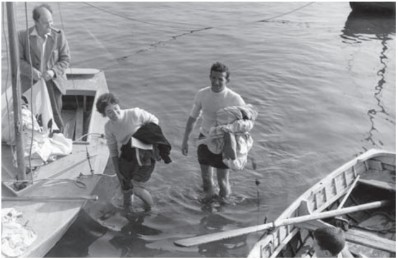
He also recalls fondly sailing his Snipe out to the American invasion fleet, at anchor awaiting D-Day in the Irish Sea, to barter sailboat rides for rationed fruit and chocolate. Beattie expressed the hope that perhaps some of those brave young men who survived that terrible time will read this story today and remember him.
After the war, he continued his sailing and boatbuilding activities and he learned the fundamentals of the up-and-coming technology of fiberglass boat construction.
Move to North America
Beattie had a cousin in California, who came to visit him in Ireland. Beattie took him sailing, which gave his cousin a bad case of the bug. When he returned to the States, Beattie’s cousin purchased a boat from Frank Butler, then owner of Wesco Marine and Wesco Tool and later founder of Catalina Yachts, the largest sailboat builder in North America.
Not long afterward, at the age of 30, Beattie and his wife, Maire, moved to Canada where he worked at a Toronto auto dealership and later as a machinist for Northland Navigation in Vancouver. Meanwhile, the cousin, knowing how much Beattie loved sailing, brought Beattie’s name to Frank Butler’s attention. Frank was a businessman, boatbuilder, and recreational sailor. He needed an accomplished sailor, so he contacted Beattie and offered him a job at Wesco, later to be known as Coronado Yachts, in Burbank, California. It was the start of a lifelong mutually productive and rewarding professional collaboration — as well as a deep personal friendship.
Beattie’s experience at Wesco began in 1962 with small-boat (14- and 21-foot) fiberglass hull construction, a relatively new technology at the time, and then he moved into rigging. He also successfully promoted Wesco’s boats by campaigning vigorously in various regattas. The business grew rapidly and he was deeply involved in every aspect of it, designing company artwork, traveling as far as Hawaii to troubleshoot rigging problems, and even managing an Oxnard, California, marina owned by Frank Butler. In an amazing coincidence while at that marina, he met once again the young nurse who had helped revive his grandfather 27 years earlier at Whitehead.
Full hull liner
In 1964 the fi rm began marketing the Coronado 25, a design that introduced the full-pan hull liner to the U.S. boatbuilding industry, a construction technique Frank had adapted from the aircraft industry.
In 1968 Frank sold Wesco Marine to Whittaker Corporation and soon afterward parted with them altogether. However, he retained the rights to build the smaller boats, the Coronado 15, the Omega, and the Super Satellite. The Purcells briefly moved back to Ireland to start a family. But Frank called Beattie in Ireland to say he was forming Catalina Yachts and wanted him back.
Beattie jumped at the chance, arriving in time to take part in the design, development, and marketing of one of the most popular boat designs of all time, the Catalina 22, a 1995 inductee into the Sailboat Hall of Fame.
The Catalina 22 was one of the first reasonably priced, mass-produced, trailerable, swing-keel weekenders that opened the sailing lifestyle to American working families in the late 1960s and early ’70s. It was by far the most successful of the lot; thousands were built and, unlike most of its contemporaries and imitators, it is still in production.
Catalina Yachts became, and remains to this day, a runaway success. Other models followed, with Beattie always there at their birth. He was the first person to sail both the Catalina 22 and the Catalina 27, and he helped with the development of the Capri 25. In 1973, as demand for the new boats soared, Frank sent him to South Carolina to start up and manage an eastern U.S. production facility built to meet the increasing demand for Catalina sailboats across the country.
In 1977 he was again dispatched, this time to Fort Walton Beach, Florida, to do the same with another plant. After seven years, Beattie moved again, to Largo, Florida, to work in purchasing for Catalina after the fi rm bought out the Morgan Yachts yard there.
Many victories
During this time, Beattie was still sailing, transferring his uncanny skills as a dinghy sailor to skipper Catalinas to victory after victory, culminating in the National Catalina Association Championships in 1979, over a fi eld of 40 other boats. In 1998, at the age of 72, he crewed on his son, Brent’s, Catalina 22 to a sixth place in the National Championships. Today, he is still a formidable competitor, racing frequently and successfully in club races, skippering his Catalina 22, Tango, very effectively in the Fort Walton Beach Yacht Club Catalina Fleet 77 he founded and in which he is still active.
He also was honored with the Catalina 22 Sailing Association’s Racing Family of the Year Award for 2000. (The Purcell boys — Gary, Brent, and Glenn — are accomplished sailors.) Other honors include election in 2000 as vice-commodore of the Catalina 22 National Sailing Association and helping to organize the FWYC hosting of the Catalina 22 National Championship Regatta in 2001.
In 1995 Beattie retired from his long association with Frank Butler and the Catalina organization, though he maintains close contact with his old friend and colleagues.
Now 81, Beattie still lives in Fort Walton Beach, a town and seascape he came to love when he founded and managed the Catalina facility there. He keeps busy sailing and working on boats, organizing cruises, and working part-time at the local West Marine store where he serves as advisor and consultant to the local sailing community. And he remains active in the Fort Walton Yacht Club. He also is a marine artist, working in watercolors and sculpting wooden hull models. And he’s still designing and building racing yachts . . . but of a different nature.
R-boat model racers
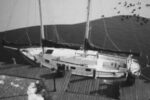
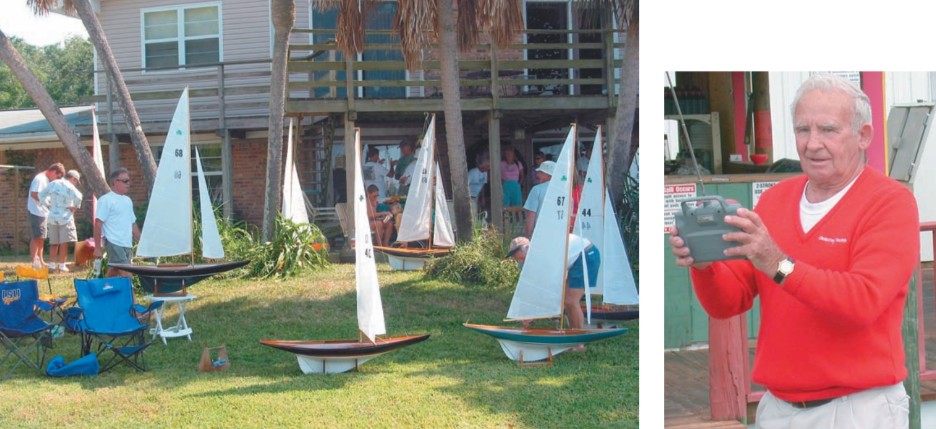
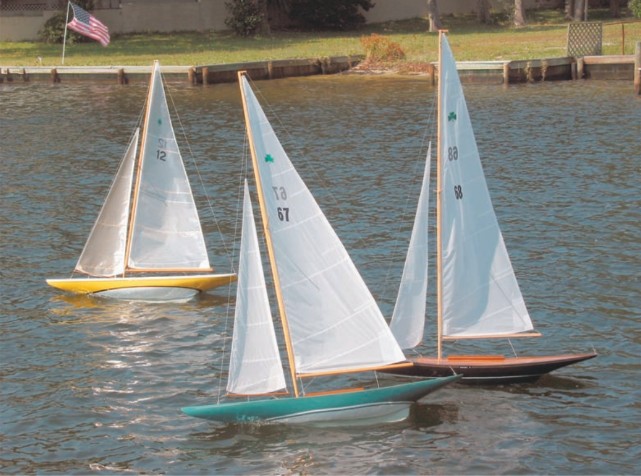
About 20 years ago, one of the craftsmen at Catalina made him a mold of a model sailboat hull, based on the sensuous lines of a 1930’s R-boat. Using the mold, he has been able to make identical hulls about 5 feet long, which he meticulously fits out and finishes to create lovely model yachts equipped with fully functional sloop rigs (sails built by a local sailmaker), and remote-controlled rudder and sheets.
The Shamrock-class model yachts, as he calls them, have become popular; more than 80 have been built and sold across the country, even as far away as Culebra in the Caribbean. They are raced in regattas (which he organizes) by enthusiasts who control the vessels with hand-held transmitters. For more information, contact Beattie: 850-243-2790, BeattiePur@aol.com.
A radio receiver and servos inside the hull operate the controls. Although perfectly operational RC models, these are not mass-produced or home kits; the boats are lovingly crafted, beautifully realized, handmade miniatures with glossy painted hulls, ballasted lead keels and exquisitely varnished wooden decks. Removing a deck hatch reveals the interior mechanism and a signed and dated certificate identifying the owner and shipwright. The Shamrocks may be legitimate racing machines, but they are works of art too. Fully rigged, their classic lines form a striking decoration for many an elegant drawing room. They are made to survive their builder and owners and to be treasured by generations to come.
After a long life on the water, Beattie is a remarkably active man and a terrific resource for Florida Panhandle sailors. He has seen everything, been everywhere, and knows everyone. Meeting Beattie makes it easy to understand the affection and loyalty directed toward him by his friends in Fort Walton Beach.
Even after a lifetime on this side of the pond, he still speaks with a delightful Irish accent that — coupled with a fit physique, good tan, and alert, sparkling eyes — gives one the impression of a much younger man. He is cheerful, yet quiet, hesitant to speak of his own accomplishments, but his authority and experience are unquestioned.
Thank you to Sailrite Enterprises, Inc., for providing free access to back issues of Good Old Boat through intellectual property rights. Sailrite.com