Another idea on how to improve airflow below
Issue 50 : Sept/Oct 2006
In the March 2003 issue of Good Old Boat, Peter Bonsey presented his unique method of increasing belowdecks airflow in a small boat in an article titled “Banish the Damp.” Peter’s idea firmly grabbed my interest.
What interested me more than anything was the fact that it overcomes a huge problem with Dorade-style venting, that of preventing (or at the very least, minimizing) water intrusion below during severe weather. Peter’s vents also greatly reduce the possibility of lines being snagged by the vent itself.
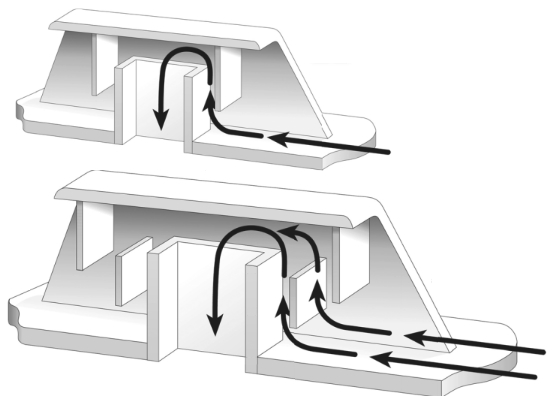
For pure air circulation, a Dorade system is generally adequate unless you happen to be in the tropics, where you will need some airflow assistance (fans, hatch vents, and so on). In severe weather, the system can be overcome by water quantities due to the small drainage area built into the deck boxes. Of course, larger drain areas could be provided, but that immediately reduces the amount of airflow.
With Peter’s system, water that gets past the baffle has the same-sized outlet; the only intrusion below would be from water splashing against the vent pipe. In corresponding with Peter, he reported that he and his wife did not have any water below in any of the heavy weather they encountered on their Atlantic crossing or during their Mediterranean cruising. His wife said that the coolest place on the boat is in the head area immediately under the vent. I was encouraged. When I commenced the revamp project of the Fuji 32 I’m rebuilding, I decided to try Peter’s idea.
Cosmetic change
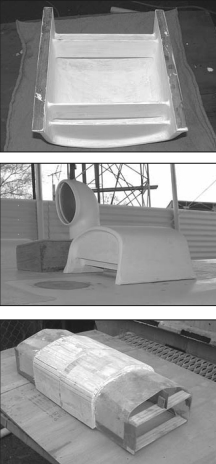
I kept to Peter’s original dimensions as far as possible, but made one cosmetic change. Since I don’t like square, sharp-cornered objects on a boat, I chose to make the vent rounded. This, of course, reduces the air passage a small amount, but I was prepared to accept that inconvenience.
Lightness and strength were of importance, so I molded the vent body using 3⁄8-inch balsa coring sandwiched between layers of 18-ounce Knytex (biaxial with mat) glass.
The outer baffles (a further explanation follows) are 3⁄16-inch plywood, initially cemented in place with epoxy fillets and then fully glassed with 18-ounce Knytex. To provide a ramp effect for any lines bearing against them, the body faces are angled back 20 degrees from vertical. The through-deck vent pipes were also constructed using the same balsa-Knytex construction.
With that completed, I did some airflow tests on the new vent compared with an original Dorade setup but still using the original 2 3⁄4-inch diameter through-deck vent pipes. With air-speed of 5 knots from a household fan directed at the vents, the Dorade gave 1.9 knots at the cabin outlet and the new vent didn’t produce a reading, although I could feel some air movement using the “wet finger” technique. That wasn’t nearly good enough to warrant replacing the Dorades.
I decided that the air needed another baffle to force it upward toward the vent pipe. To minimize the amount of water a second baffle might also direct upward, I made the baffle smaller in height, mounting it 1 inch lower at the bottom with a 2-inch gap at the top and spacing it 1 1⁄2 inches back from the outer baffle.
Encouraging result
With this temporarily in place, I ran the air test once more and found the new vent now gave 1.7 knots at the cabin outlet. Encouraged by this result, I constructed the second baffles as per the outside baffles but, reasoning they would not be subject to the full force of any water, glassed them with 8-ounce cloth instead of the heavier Knytex.
After installing the new, larger, through-deck pipe I ran the test again. This time I had 2.5 knots at the outlet. Now my mind started to run amuck: I reasoned that if I radiused the inner edges of the pipe tops I would get even higher flow. How wrong that was. The airflow dropped to 2 knots, so I immediately squared off the edges and got 2.5 knots again.
To test water intrusion, I filled a 5-gallon bucket with water and, standing 2 feet from the vent face, heaved the water at the vent as forcefully as I could. Not a trace of water went below. Conducting the same test at the Dorade installation I got a noticeable amount of water below.
A rough calculation based on velocities and areas suggests that the Dorade would pass 7.89 cubic feet per minute with a 5-knot breeze over the deck, while the new modified Bonsey design would pass 27.86 cubic feet per minute.
While I don’t actually expect that amount of volume flow — due to friction, turbulence, and so on — I do expect a noticeable improvement over the Dorades. Of course, we may have the situation in higher wind strengths that too much air is coming below. I have thought about this and intend to make up two types of vent plugs. Both will be of 1⁄2-inch plywood with somewhat hard-rubber edging to assure a tight fit inside the vent pipe. One will have a series of through-holes, possibly 1⁄4-inch diameter, to restrict airflow and the other will be solid, to keep water out.
The major advantage I see in the new system is reduced water intrusion. This will allow the vents to remain in use in all but very extreme weather. Needless to say, I consider the new vents a success; they will be permanently installed on the Fuji. Thanks, Peter, for providing the impetus to experiment further.
Thank you to Sailrite Enterprises, Inc., for providing free access to back issues of Good Old Boat through intellectual property rights. Sailrite.com