Space-age braids named after a biblical hero
Issue 52: Jan/Feb 2007
A NYONE WHO EVER BRAIDED HAIR OR made lanyards in craft class knows the intricacy of the braiding process. Consider automating that process. Now consider a factory full of rope-making equipment. Spools of yarns and strands and finished ropes of all colors . . . fast-moving machinery . . . forklifts . . . bustle. Welcome to the Samson Ropes plant in Ferndale, Washington, just north of Bellingham. This is the company headquarters. In addition to this manufacturing plant there are two others: in Lafayette, Louisiana, and in Merida, Mexico. There are 170 employees in all.
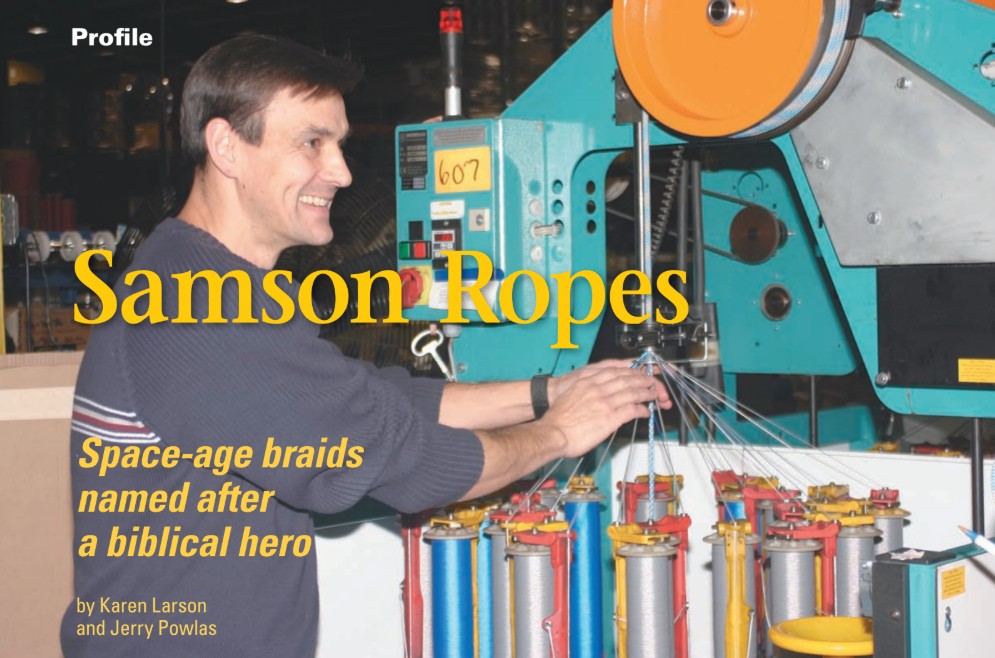
At the Ferndale plant, Samson produces only braided ropes (three-strand and eight-strand are made in Lafayette and general cordage is manufactured in Merida). The machinery is ingenious. Anyone, even a young child, can braid a plait of hair. But the high-speed manufacture of braided rope takes your breath away. It requires extremely sophisticated manufacturing equipment and experienced employees to set it up and run it.
Imagine children rotating in two groups turning in opposite directions around a maypole. They weave in and out with each other as they braid the ribbons down the pole. The right-hand/left-hand passing movements in square dancing also come to mind as two groups, moving in opposite directions, weave past each other.
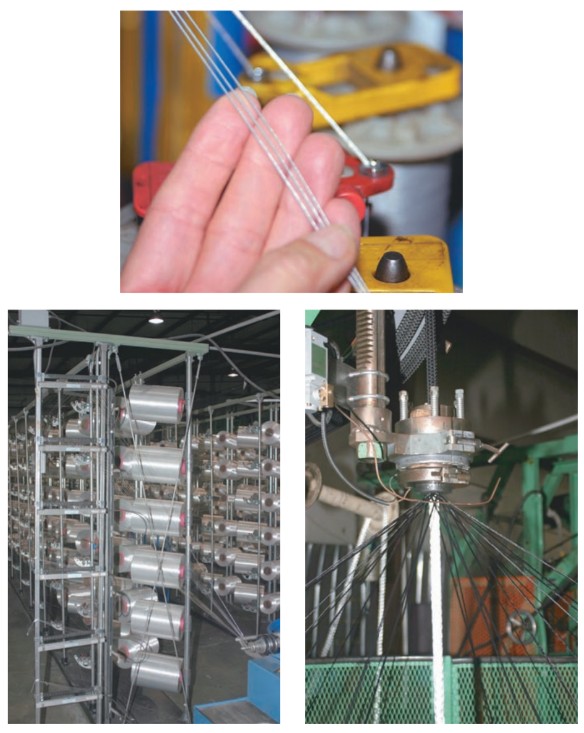
Now imagine bobbins of yarns weaving around each other according to patterns that vary from rope to rope. The machine rotates so quickly that the human eye can’t resolve the pattern of motion. The variations are nearly endless. The yarns are selected for their mechanical properties while their color helps the user identify the finished product.
Complex formula
Braided rope is “designed” for a variety of tasks. The formula for a given rope is a complex thing — so many strands of this, so many strands of that, cores of this, cores of that. The dance around the maypole varies with the design. Characteristics vary according to the buyer, the intended use, and the pocketbook. The engineers at Samson must consider all these characteristics as they create the next product: strength, weight, stretch, elongation, heat-resistance, abrasion-resistance, ability to grip hardware such as winches and rope clutches, cost, ease of splicing, service life, and more.
The building blocks, we were told, are the threads. These are graded using an international system (denier) for numbering of silk and man-made fi lament yarns. Some are solution-dyed, some are natural. The recipe for their use in the creation of a specific rope calls for a specific number of plies, a specific number of turns per inch, a specific number of pics (or strands) per inch.
As the building blocks are created, some threads are twisted in one direction, making what is called an “S-twist” (left-hand). An equal number must be twisted in the opposite direction to result in what is called a “Z-twist” (right-hand). These opposing twists lock together to form a yarn. Large braids may even use a second tier of S- and Z-twisted yarns, but let’s stick to everyday yacht braid.
The machines that do the braiding have large bobbin-like structures called carriers. Depending upon the product to be produced, they may have 12, 16, 20, 24, or 32 of these carriers. Half of these will zigzag in and out in a clockwise pattern while the other half will zigzag in a counter-clockwise pattern faster than you can say, “Turn toward your partner, promenade right and left grand.”
Where did it all begin?
It wasn’t always this way. The way we imagine it, there must have been a time in the misty past, not long after our ancestors crawled out of the sea, that one of them used a strand of human or animal hair or, more likely, a fiber from a tree or plant. Generations passed. Then some revolutionary twisted several strands together and pronounced it “rope.” A mariner nearby immediately corrected him, calling it “line.” And so began one of the first chasms in history. Religious differences could not be far behind.
No doubt, the early ropes were, in concept, much like the early yarns that were created on spinning wheels. Twist strands together for strength. Twist those together with twists of opposite directions so the finished product won’t unlay. The three-stranded rope traces back to those early days, but braided rope is a somewhat newer idea that makes an arguably superior rope to three-strand.
Samson Rope Technologies was originally founded by J. P. Tolman in 1878 as Samson Cordage Works. The company was incorporated in 1888. The most remarkable thing about this long-ago past is that the company’s trademark of Samson slaying the lion is currently the oldest active trademark in the United States.
But there’s another thing worthy of historical note. The braided rope that we consider to be “modern” was developed more than a century ago. As the Samson literature tells it, “It was during the 1800s that Samson developed the unique concept of incorporating reinforcement cores within braids to significantly enhance product performance.” Braids may have been there, but Samson added the true strength of the braided rope: the core.
The company also claims the 1957 development and patent of synthetic double-braid. Double-braids are two ropes in one: a braided core covered by a braided sheath. “Utilizing the new, high-strength nylon, polyester, and polypropylene fibers in this patented construction allowed Samson to manufacture ropes that were far stronger and more durable than the three-stranded twisted ropes that had been the standard since biblical times,” the company history notes. It seems fitting somehow that this modern manufacturer of rope should be named after a biblical hero.
Rope technology today
These days, newer fibers have overshadowed the innovative nylon, polyester, and polypropylene fibers of the 1950s. Today’s developments include fiber technology such as Kevlar, HMPE (high molecular weight polyethylene such as Spectra and Dyneema), Technora, Vectran, and PBO (Zylon).
One of the most amazing parts of a visit to the Ferndale plant is the cordage testing equipment: there’s an abrasion tester, a puller tester, and a drop tester. Speaking of the largest of these machines, Dr. Rafael Chou, vice-president of R&D says, “Not only can this machine test strengths up to 1.1 million pounds, but it also provides a wide range of other relevant data including auto-cyclic loading, automatic elongation measurement, and much more.” This equipment also allows Samson to measure samples up to 50 feet in length.
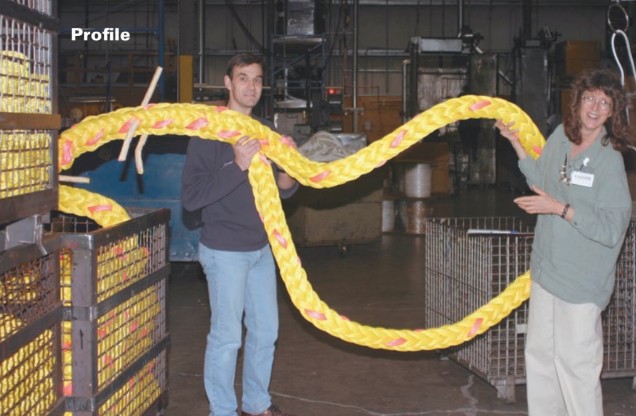
Each of the complex products is “designed” for specific markets and specific uses. Samson produces ropes for recreational and commercial boating, to be sure. But they also create specialty ropes for use by arborists and industrial engineers of all kinds (think of theater sets, NFL camera setups, safety and rescue, utility companies, and the space program). Sailors do not make up the largest segment of the Samson market, but they benefit from proximity to Samson’s larger markets. Just as we all benefited when the high-tech space program developments trickled down to life in the suburbs, so it is that sailors are on the receiving end of the developments in fiber technology. Better, stronger, longer-lasting line is the ultimate outcome.
Lighter weight, lower stretch
In fact, it works both ways according to David Krupka, sales manager for the Recreation Marine Division, who says, “We’re always looking for lighter weight, lower stretch, on the recreational side and some breakthroughs apply to the commercial side as well.”
Today’s ropes come in a wide array of colors, but David points out that this isn’t about fashion. The colors help indicate what the rope is made of and, therefore, what its intended purpose is. “We’re not trying to be like an apparel company, in which we come up with something new every year,” he says. Instead, the company is focused much more on customer education. The Samson website www.samsonrope.com and product brochures (available for download on the website) are loaded with information about line selection, care of line, types of rope, the building blocks of rope, splicing, rigging, glossary terms, when to retire rope, standards for strength and usage, and so on. “Our mission,” David says, “is not just building rope but, instead, providing high-performance cordage solutions to critical customer problems.”
Thank you to Sailrite Enterprises, Inc., for providing free access to back issues of Good Old Boat through intellectual property rights. Sailrite.com