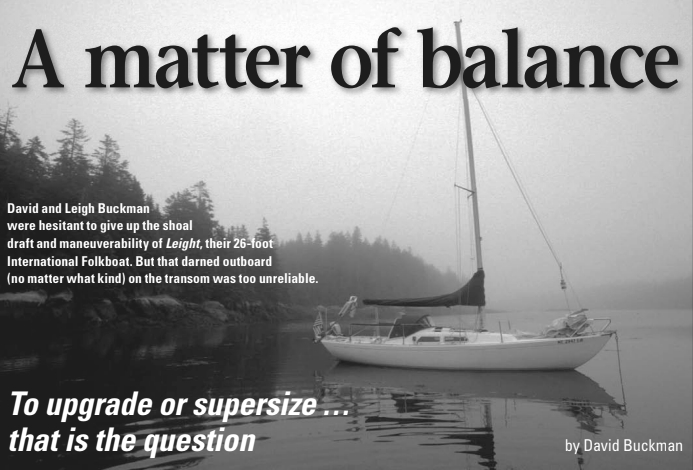
To upgrade or supersize . . . that is the question
Issue 50 : Sept/Oct 2006
There comes a day in many sailors’ lives when the prospects of either upgrading their vessel or acquiring a new boat sends their thoughts ranging far and wide on seas of speculation. There they are buffeted by the winds of desire and tossed about by powerful undercurrents of prudence and practicality.
Such were the circumstances for my wife, Leigh, and me as we grappled at the conclusion of our 20th summer of cruising aboard the Leight, a 26-foot International Folkboat built in Sweden. As sweet of line as they come, this full-keel fiberglass sloop is capable of crossing oceans, sailing into the slimmest of possibilities, and being easily singlehanded. Adventuring along the East Coast from the Chesapeake to Nova Scotia, she’d not once let us down in seas smooth and surly or winds sweet and snotty.
Yet as decades of experience aboard any boat will prove, she had her issues. Irritants generally had to do with the lack of dependability of her powering systems, rather than any shortfall of sailing integrity. We loved her close-windedness and that her 4 feet of draft allowed access to wild and remote places rarely trod by the cruising crowd. We reveled in the fact that she was so handy she could be sailed into little eel ruts of anchorages, so sturdily built that she could sail away from an occasional grounding. And there was a pleasing efficiency to the fact that a pair of solar panels met her modest electrical demands.
Despite that impressive array of admirable qualities, we grew tired of messing about with motors and started studying the used boat ads, focusing on the listings for 32- to 35-foot sloops. Maybe it was time to broaden our horizons beyond the idea of improving the Leight and buy something a little larger. Wherever we wandered, we almost always had the smallest cruiser. Perhaps supersizing was the way to go.
New boat idea compelling
The idea of a new boat, possessed of none of the well-worn familiarity of our current craft, was compelling, and for a time the Leight took a back seat in our speculations. It wasn’t that we didn’t like her anymore, but one of the things we were particularly troubled by was that her various outboard engines let us down regularly and often in the worst of places. Caught in roiling tide rips off Point Lepreau in the Bay of Fundy one fogbound afternoon, the engine “crapped out” on no less than eight occasions.
Even the most modern of four-stroke outboards that graced the Leight’s stern over the years couldn’t be trusted; we employed them only in the most desperate of windless circumstances. Our quiet quests, not without merit, produced many memorable sailing moments. Still, there was a certain tension in the air when we did go off motoring since every little engine stutter or bout of irregularity left doubts floating in the air like clouds of concern.
What about a diesel?
Leigh, the ever sensible and centering force in my life, counseled against rash moves and suggested that we explore the idea of installing a diesel, which every sailor knows hardly will ever break down. We consulted with Bruce Cunningham and Dave Martin at Padebco Custom Boats in Round Pond, Maine, where the Leight was berthed. Dave, who had circumnavigated the world in a Cal 25 with an old Johnson outboard bolted to the stern, surprised me when he counseled against the diesel on the basis of simplicity (see article on Page 20). I argued that 200 pounds of engine, fuel tank, and other gear placed low in the middle of the boat was a far better balance than 77 pounds hanging off the stern. Dave argued against the expense of it, and I against the expense of not doing it, since our cruises were but a month or two long and the chronic breakdowns and repair time cut deeply into our ambitions and sometimes our sense of safety too.
Dave bemoaned the complexity of systems required while I reasoned that the best quality gear for a little diesel would likely be no unfathomable expense. Dave said we’d lose storage space. I countered that we kept a pair of 6-gallon gas tanks in what would become the engine room. He said we wouldn’t get our money back when it came time to sell. I replied that I didn’t give a damn because I wanted the sloop given away when at last I sailed over the bar.
Dave railed against the high cost of yachting in general and I denied that the Leight was a yacht. So Dave played the simplicity card again, even though he has a diesel in his 33-foot steel sloop, Driver, in which he, Jaja, and their three kids had recently sailed to Iceland, Norway, and the Arctic. Dave enjoyed pushing and I enjoyed pushing back. The engine I had in mind was a Yanmar 1GM10, a single-cylinder, 9.1-hp model that weighed 167 pounds. Through it all, Bruce wisely kept his own counsel and went to work estimating.
In the meantime, we scoured the brokerage ads and visited boatyards. We found the pickings slimmer than we’d expected. One of the baselines of the search was our insistence on a boat possessing classic good looks. Among the vessels we considered were 32- to 35-foot Allied yawls, Bristols, Albergs, and Contests of 1960s to early 1970s vintage. More than a few of these were as much as 18 years older than the Leight, which was built in 1978. These were priced in the $25,000 to $45,000 range, unless they were in particularly desperate condition. By the time we added $10,000 to $25,000 to the purchase price for various essential upgrades — ranging from new engines and sails to rigging, interior makeovers, and other systems — we were looking at investing $40,000 to $60,000. Worse yet, a number of the boats that really piqued our interest, like the Morris 30 and the Victoria 32, were priced over $100,000. Then there were other costs to consider. The labor necessary to bring a larger, older boat up to the state of finish and seaworthiness we find acceptable would add up to hundreds and hundreds of hours. Given my general abhorrence of coarse labors when I might otherwise be sailing, this was a major concern.
But isn’t bigger better?
On the other hand, the idea of being able to take friends along for a weekend or a cruise was appealing, as was the ability to shower in a dedicated space and to have an actual head that could be closed off with more than a curtain. A dedicated, non-folding galley sounded good. So did a diesel engine, chart table, oven, and expanded interior volume. The issue of standing headroom was one of the most frequently mentioned advantages by brokers and fellow sailors. The ability to stand up in the cabin seemed to be the defining element of what a lot of folks thought of as “real boats.”
When I tallied up our usual patterns of sitting, lying down, and standing at home, the results were surprising. On the upstanding side of the ledger, I recorded 2 hours standing time a day. I spent a total of 16 hours off my feet, sitting and reclining. When you add the usual away-from-home activities like working and driving, sitting time can grow to more than 90 percent of a typical day. Sitting down on a boat is certainly more stable, though none of this is to suggest standing headroom isn’t a good thing. If you think you need to be able to stand up in your cabin, then you probably do. The Leight was not totally bereft of standing space. We can stand in the aft end of the cabin, under the dodger . . . a compromise to be sure, but in 20 years of cruising we’d not found any of it to be taxing of our comfort.
Another consideration was the cost of supersizing in terms of financial stress. We were ready to do the deal if that’s where our thoughts led us, but we took no little satisfaction from the fact that the Leight was all ours. Hanging on to our sloop meant that we wouldn’t have to commit ourselves financially for a decade, sign dozens of pages of promissory, insurance, and regulatory documents, or pay thousands of dollars of interest. There was a comfort in that, for it put us firmly in control of our destiny and there seemed an inherent rightness to carrying a light load of fiscal obligations.
Scoring another point for the Leight was her kindly motion in large seas and the fact that her modest freeboard put her crew closer to the waterline where the swinging arc is more modest, thereby reducing the effects of motion sickness. The reality of it is, of course, that boats of any dimension, even large ships, can be uncomfortable in big seas. A big boat’s motion might be less quick, but it can get slammed about harder and suffer more damage because of its greater weight and volume. Dave and I thoroughly hashed out these thoughts. His experience was that a well-found smaller craft was more forgiving and buoyant in large seas.
Another consideration as we worked through the possibilities of moving up to a larger craft was what it would add or take away from the cruising dimension. While the wild beauty, expansive mood, and thrill of discovery would be unchanged, a larger craft’s greater draft would reduce our gunkholing ability and access to some of the most secure and scenic anchorages, well off the beaten path. Where we now sail into the narrowest of channels, we would likely have to motor. As to the comfort of sloops’ berths, I can’t imagine sleeping better than we did aboard the Leight and, though the ability to bunk with your mate would be pleasant, none of the bigger boats we considered offered double accommodations other than the usual V-berth arrangement, which we’d found considerably compromised in terms of comfort.
When we added up our impressions, one of the things that stood out was the beauty of the Leight’s efficiency. She could ghost easily along before the lightest of zephyrs and stand up to a howling cat of a wind. Her economy was admirable too. A gallon of bottom paint lasted two seasons; her simple systems allowed us to outfit her with the most robust of gear at modest expense; and keeping her shipshape was well within our capabilities in terms of time, energy, and cost. This ease of manageability allowed us to concentrate on critical tasks, make a workmanlike job of them, launch early, and haul late. She could go anywhere the big boats did and farther than most we ran into.
An article on resistance to capsize published in Practical Sailor a few years ago ranked the International Folkboat alongside an Alden 44 on stability. Leight was well mannered, and in more than two decades of summer cruises aboard her, we’d become finely tuned to her moods. We posted a few 140-mile days offshore, we could count on 100-mile runs in the usual mix of summer weather, and we could coast along comfortably at 5 to 6 knots in ordinary summer breezes. While this was hardly blazing speed, the larger craft we considered offered only slightly increased cruising velocities on the order of a half knot or so. This was not without merit, but the burning question was: at what expense did such a move come in the quality of the cruising experience, added capabilities, efficiency, complexity, and fiscal prudence?
Though speed is the holy grail of our consumer culture and a worthy quality in sailing craft, we looked at the issue through the lens of how much better, really, is 5.5 knots than 5 knots. It was difficult to assign the slightly greater velocity any measurable advantage unless you were racing. In a lifetime of sailing at the modest velocities that the Leight was capable of, we never had a day that it made the difference between arriving safe and sound or getting in trouble. And in the meantime we logged more sailing time . . . which is the point of it, after all.
What about singlehanding?
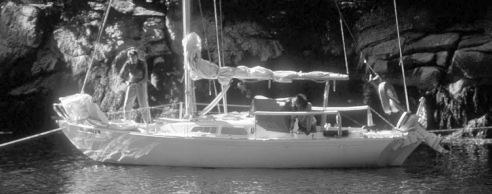
Where sails and gear on a bigger boat are heavier and more problematic for singlehanding, the Leight’s systems were manageable. While the additional space of a larger cabin would allow us to spread out more, over the years we had already learned to retreat into our own spaces if we needed to. Our closeness aboard our sloop had never grown uncomfortable, perhaps in part because of the expanse of sea, with islands and shore close abeam. Having confidence in the boat’s ground tackle was a comfort too. We never dragged anchor and could set and haul by hand the 25-pound CQR with 10 fathoms of chain and a couple of hundred feet of 9⁄16-inch nylon rode. To be honest, it was Leigh who set and hauled the hook by hand, a division of labor that might seem uncharitable but illustrates the sloop’s handiness. Larger boats are not only harder on their ground tackle, but their crews’ backs too.
Less quantifiable perhaps, but as important to us, was the sense of balance and centering of the sailing life that would make the acquisition of a new craft a comfortable fit in which we could invest as deeply of ourselves as we had with the Leight. We took pride in the fact that, despite her modest stature, we kept our sloop sailing when others were heading for harbor. Part of the pleasure was wrapped up in the very fact that locals seemed to find a certain comfort in her approachability.
Looking through the classic literature of small craft cruising, the books by the Pardeys aboard the 24-foot Seraffyn, John Guzzwell on the 20-foot Trekka (see article on Page 26), or any of Maurice Griffiths’ captivating accounts, all made adventuresome passages that were as rich in drama, beauty, enlightenment, and satisfaction as was ever known. In fact they seemed possessed of particular élan for the very fact that their craft were modest, their dreams big, their seamanship superb, and their deeds admirable on all accounts.
It made sense
The installation of a diesel in the Leight seemed to make more and more sense. A lot of it had to do with the functional advantages of an inboard. All of the outboards we used on the Leight were attached to a swinging mount that I fabricated and attached to the transom. This placed their weight well outboard, which is undesirable in terms of balance, performance, and exposure to seas. The two-stroke outboards were the most dependable, but noisy and inefficient, and they left a fog of unburned hydrocarbons in our wake.
The Leight’s latest engine, a 5-hp, four-stroke Honda, was by far the most efficient but also the most undependable. The often dirty and watery fuel available in the hinterlands Downeast and in the Canadian Maritimes regularly plugged up the carburetor’s fine jets, even though it was equipped with a fuel filter. This caused motor failure on four of our last five cruises, the last thing we wanted to experience when we were bucking the Bay of Fundy’s 29-foot tides or rounding Nova Scotia’s Cape Sable Island, the Cape Horn of Canada. We learned to remove the carburetor and clean out the needle valve in the float chamber. This would often get us going again but didn’t address the clogged jets, which required nothing less than disassembly of the unit, a nearly impossible task in close quarters and rough seas.
When the estimate for the installation of the Yanmar came in at around $13,000, we swallowed hard for a few minutes and told them to go for it, knowing that in-progress upgrades, like a feathering Max-Prop, stainless hatches in the cockpit, and a custom fuel tank would push the final figure higher. It came to $16,000 when all was said and done. This was no trifling amount when we looked at it in terms of an investment in dependability, convenience, and peace of mind for a decade or more.
As we shaped our course for the wilds of Newfoundland or the familiar Downeast Coast, it seemed money well spent. Weighed against the $30,000 to $60,000 required to purchase a used 35-foot sloop, the project wasn’t a burden and would allow us to continue to devote resources to other important aspects of living well — such as good wine and food, travel, books, the arts, hiking, skiing, kayaking, and helping our children. The whole process was about striking a balance in which we could craft a nurturing equilibrium and invest deeply of ourselves.
I am not suggesting this approach as a universal panacea for all such issues or that we expect the diesel to be fault free. Nonetheless, it illustrates one way of addressing these issues and shows that there is something important to be said for embracing simplicity, efficiency, and economy.
Thank you to Sailrite Enterprises, Inc., for providing free access to back issues of Good Old Boat through intellectual property rights. Sailrite.com