Avoiding engine failures in rough seas
Issue 52: Jan/Feb 2007
IT USUALLY TAKES A COMBINATION OF failures, poor decisions, and bad luck to narrow down your options. We had been learning that our new cruising area was a very crowded place in the peak of summer season. It was hard to find an anchorage that was not jam-packed with boats when we got there. As we turned away from the second overcrowded anchorage of the day, continuing our pursuit of shelter for the evening, I said to Karen, “We are going to have to be aggressive about the next one or try to get to a marina for the night.” That was Poor Decision Number One.
At the third anchorage we picked our way through an opening with unmarked submerged rocks and found a part of the otherwise crowded anchorage that nobody seemed to want. That was not simple good luck. After four attempts, we got the smaller hook to seem like it was set. I put the storm anchor down too. Then the expected blow arrived. Our little piece of mucky paradise was pretty exposed. We noticed a large deadhead protruding from the water’s surface a bit out of reach of our swing. That was OK for the time being. We slept like that, but the smaller anchor slowly dragged, so that by morning the protruding end was a lot closer. We were out of options. Although it was still blowing strongly, with winds now coming right into the rocky inlet, it was time to go.
I tried to time it so we could haul the anchors in a lull, but the weather was building and I timed it wrong. It was blowing too hard to hold the bow upwind. The truth of our situation was beginning to sink in: we were going to have to do just about everything right for the next half-hour.
We did do everything right and to paraphrase my father, “I learned about sailing from that.” A key element in our departure from that anchorage was that the engine had to keep running and had to produce full power for prolonged periods without overheating. Once out in the lake, it had to continue to buck large storm waves that piled up in the shallows near shore and it had to run at or near full power while the boat rolled her guts out just off a lee shore. How rough was it? The prop came out of the water several times, so the cooling water intake probably did too. But the rudder did not come all the way out, so we never lost steering.
The engine kept running, but it is not uncommon in our experience and the experience of others for marine auxiliary engines on sailboats to quit running, especially in heavy weather, and particularly at the crucial moments when they are most needed. That is not bad karma; there are reasons why the beast in the bilge goes on strike in heavy weather.
Bad fuel
Over the years we’ve had most engine shutdowns as a result of plugged fuel filters. This problem starts with water in the fuel. It can condense out of the air pocket above the fuel as the tank cools in the evening. It can come in through the tank vent as rain or spray, or it can leak through the deck-fill plug for the fuel tank. I have never seen a deck fuel-fill design that I thought was all that good. Most rely on the sealing of an O-ring against rain and spray that collects in a groove just above it. The O-ring gets old and leaks some water into the tank with every rain shower. Being an oil, diesel fuel floats on top of this water. There are microorganisms (bacteria, fungi, and yeast) that can live at the interface of the water and oil. They eat the fuel and live in the water. As they grow and multiply, they produce a slimy film or “mat” made up of their cells. There can be a lot of that in the bottom of a fuel tank. This won’t interfere with the fuel flow until the weather gets rough. Then the motion of the boat will mix the mat into the fuel, which then plugs the fuel filter and eventually shuts down the engine.
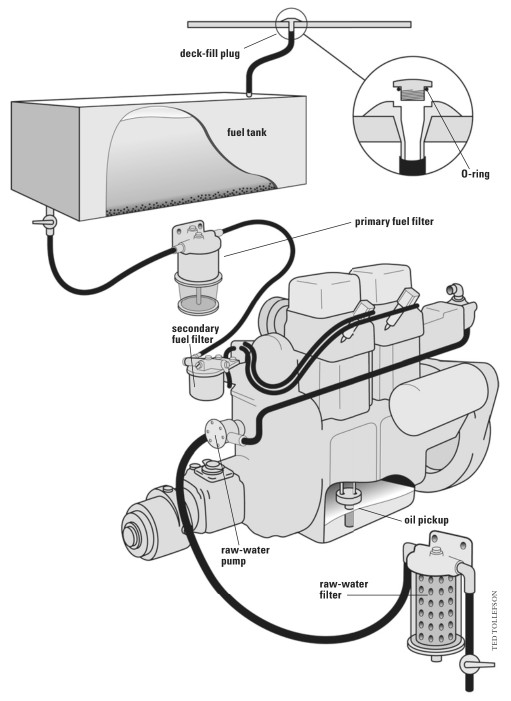
Complete prevention is probably not possible, but here some things you can do to minimize this problem. Every boat should have two fuel filters: one on the engine (secondary, or second in the line of flow) and one that feeds the one on the engine (primary, or first in the line of flow). Most engine manufacturers will supply the engine with a 2-micron filter as the secondary filter, but you may have to add a 10-micron for the primary. A slick system is to have two primary filters so you can valve one to supply the engine while the other is being changed. But many smaller boats don’t have room for that. If you have only one primary filter, inspect and change it often. Carry many spares for the primary and even several for the secondary filter.
In addition, there are fuel additives that are compounded to kill the microorganisms. They have boron compounds that dissolve in fuel and seek out the water interface. There they turn into boric acid, which is a biocide. If you use these, follow the directions carefully. These kill the bugs, but they don’t remove the crud or water (for another opinion on this, read the sidebar by Gordon Torresen below).
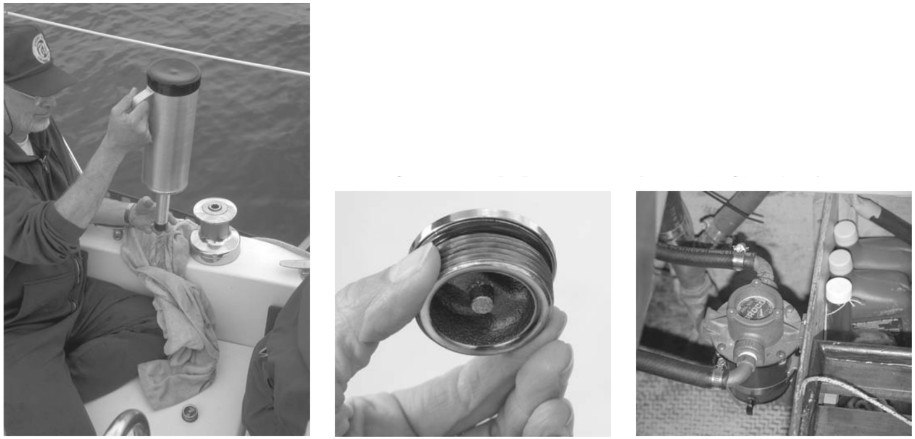
Every boat with a diesel engine should have a Baja fuel-filter funnel or something similar with a tight mesh that allows fuel to pass through while stopping water. When I had a pretty bad load of water in my tank I pushed an outboard motor fuel line to the bottom of the tank and pumped the fuel through the Baja filter and back into the tank with the primer bulb. I pumped until the fuel came back looking really good. My wrists were sore, but my fuel was clean. If you’re considering doing this, don’t use an electric pump that makes sparks.
Once the water and crud are removed, put in a fuel additive and check again in a few days. Clean the fuel again if you have to. You can buy O-rings from McMaster Carr that will probably stop much of the water entry. Keep your tank full anytime the boat is laid up, in order to reduce the air space in the tank. In the spring, following a winter layup for example, take the boat out in some serious waves under sail and pound around to mix up the fuel. Then run the engine to get the crud in the filter, and then change it. There is no permanent fi x for this. It will be a running fight for as long as you own a diesel engine. If you are not vigilant the crud will plug your filter and stop your engine when you need it most.
Lack of water intake
Next in line behind plugged fuel filters, the raw-water pump has caused the most serious engine shutdowns on our boat. Nigel Calder calls this type of pump a variable volume flexible impeller pump. I’ve called the one on our previous engine a lot of other things. Every liquid-cooled marine engine has one. It sucks sea water from outside the hull and pushes it through the engine or through the antifreeze-to-raw-water heat exchanger. After it leaves the block or heat exchanger, the raw water is injected into the exhaust elbow to cool the exhaust. Taken in total, there is no other system on a marine engine so fraught with the potential for failures.
The intake can plug with everything from bread wrappers to fish. The pump has several failure modes by itself. The water injection elbow can corrode to failure and, if the pump leaks, it can siphon water into the engine, fill, and lock it. With just a little more bad luck, it can sink the boat. Following another fault path, the pump can stop pumping, which will overheat the engine and exhaust system, potentially damaging both and filling your bilge with smoke. This is a system to understand, respect, and coddle.
Failures while motoring in extremely heavy weather can occur when the boat pitches violently enough for the intake to get clear of the water so the pump sucks air. The odd gulp of air may be tolerated; regular repeated gulps may not. The pump needs water flowing through to lubricate it. Without water, the rubber impeller will overheat from friction and fail.
The failure mode in calmer operating conditions also involves the impeller. This part has a very limited life span under the best of conditions. Eventually, the impeller will crack and break up. It is not uncommon to find several missing lobes when the pump cover is removed. Where did they go? Into the heat exchanger where they are blocking the flow. Poetic. The impeller does not have to break up to fail. It can simply take a set so that when it is removed it still looks like it is scrunched into the pump. In this situation it will look right until you remove it, but the impeller will not have the elasticity to pump enough water. The rubber vanes can even lose their bond to the bronze driving ring and slip, instead of pumping. That problem is difficult to diagnose.
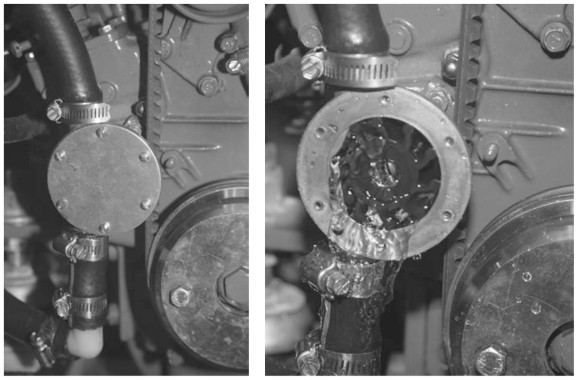
There are a number of things you can do to improve your odds with this system until some saint comes up with a better one. The kind of bronze intake screen that bulges out from the hull and adds drag will tend to keep the bread wrappers and fish out of the intake. I dislike things that add drag, but I believe this one is worth it. Add a raw-water filter before the pump. Clean it often. Regularly check the impeller by completely removing it. If your boat gets an annual lay-up, remove the impeller for that period. Some people simply toss the impeller after a year. I inspect mine, looking for cracks where the lobes join the center. I also look at the outer surfaces of the lobes for wear.
When your boat is recommissioned in spring, coat the pump housing with Vaseline before you install the impeller. The raw-water pump is self-priming, or should be self-priming if it is in good condition, but the Vaseline will give it some lubrication until the water reaches it. Inspect the pump body and side plate for wear and scoring. They may call it a water pump, but it also pumps its fair share of mud, which is very abrasive. Worst case, if the casing is badly worn you may have to replace the pump. They are normally easy to remove if you can get at them, but writing the check may choke you up a little.
If you find yourself trying to motor in extremely heavy seas and you think the raw-water intake may be pitching clear of the sea regularly, consider changing course or speed or whatever else you can do to keep the boat from pitching or rolling that badly.
Some engine builders put the raw-water pump where it is difficult to reach. Some boatbuilders finished the job by making the thing impossible to reach. If you are thinking, “I’ve never seen the pump and can’t imagine how I’d fiddle with the impeller and all that to keep it from failing” this line of reasoning will not save you. If you neglect the raw-water pump, it will surely fail. Evaluate your problem and then cut access holes where you need them so you can reach that pump with both hands on a rainy night in high seas and be able to change the impeller. Naturally, you should carry a spare impeller and water-pump gasket. The impeller and other spares made of rubber, such as O-rings and belts, should be kept in freezer bags with the air sucked out to minimize ozone damage, which will cause premature aging.
Siphoning
Before leaving this seriously failure-prone engine system, it is worth noting that if the entry point of the sea water into the exhaust elbow is below the waterline (which is normally the case in most boats), you need a vented loop with some sort of vacuum breaker at the top. Otherwise, when the impeller starts to leak in the pump casing, water will siphon into the exhaust elbow. Given time, it will fill the exhaust system and back up into the engine. Nothing good comes after that.
When boats sail in large following seas for long periods, it is possible for the seas to slam into the exhaust port and eventually pound their way into the exhaust system. After enough of this, the engine gets water in it and will lock up when you try to start it. The specific design of the exhaust system and muffler have a lot to do with the tendency of a boat to do this. A goose-neck loop near the exhaust exit point tends to prevent this, as do other exhaust system designs, such as the North Sea exhaust or an exhaust-riser loop at the engine. (See article in Good Old Boat, September 1998. Available on CD only). If you find yourself in extremely heavy following seas and you don’t know if your boat has a tendency take water up the exhaust, a temporary precaution would be to start the engine and clear the exhaust at regular intervals. Another trick I’ve seen is to clamp a short piece of hose or inner tube to the exhaust port on the outside of a boat so a following sea will push it aside without entering.
Lack of oil pressure
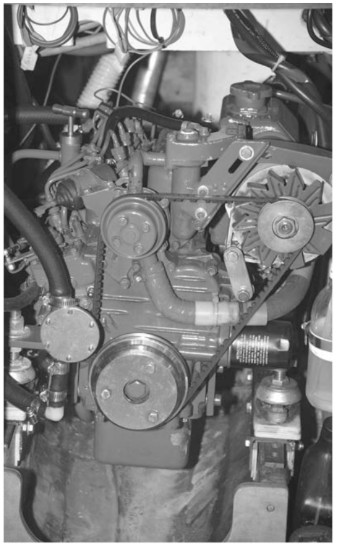
When you are motoring in conditions were the boat is pitching or, even more importantly, rolling violently, it is possible for the oil-pump pickup to come clear of the oil sump. When this happens, the oil pump pushes air into the engine bearings. The crankshaft main bearings, rod bearings, wrist pins, and sometimes other parts, are designed to be fed oil under considerable pressure. This pressure keeps the parts from touching each other and prevents wear. It has been understood for a long time that engines that run continuously will run many more hours than engines that stop and start up many times. The starts are done without oil pressure. It is hard to say exactly how much of this kind of abuse a given engine will take. Under light loads, such as startup, engines do take this abuse without catastrophic failures. It shortens their life, but they don’t fly apart.
Loss of oil pressure when an engine is running at high speed under a nearly full load will be more serious. Some racing automobile engines have baffled sumps because they can pull about 1 g in a corner, which is enough to sling the oil away from the pump pickup. Combat fighter aircraft with piston engines had dry sumps with scavenger pumps so they could pull high g-loads and even fly upside down.
Unfortunately, marine engines don’t have either of these features. What you can do is make sure your engine is not low on oil. (Don’t overfill it, though.) And if you are motoring in very violent conditions where there is a lot of pitch or roll, consider slowing down and changing course. Often, if you tack upwind or downwind, you can ease the motion of the boat. Try to stay out of shallow water where waves build up. Have a care when motorsailing as well. The heel angle may exceed what the engine can tolerate.
Other factors
Finally, some boats can motor effectively under calm-water cruising conditions, but their engines will overheat when they are motoring in heavy weather. Certainly the engine must work harder to move a boat in large seas, so it will be more likely to overheat. There are several things you can do to keep your engine ready for the heavy loading that accompanies large seas. If you have had an impeller failure, you need to find all the parts of the impeller that may be causing partial blockage of your cooling system. Many heat exchangers are not too bad to take apart. You can clean them out, change the zincs, and look for chunks of impeller. If the chunks are in the block, as would be the case with a raw-water-cooled engine, they will be harder to find. Raw-water-cooled engines and some parts of fresh-water-cooled engines can cake up with mineral deposits. These can be flushed away with special cleaners. Make sure the chemicals and processes you use are known to be safe for your engine.
Don’t assume that the diameter of the water and exhaust tubing on your engine is optimal. Back pressure makes an engine run hotter, as will a slightly smaller-than-ideal raw-water intake through-hull, seacock, and hose. When I changed engines in our boat I replaced a 20-hp raw-water-cooled engine with a 20-hp fresh-water-cooled engine. Both were metric engines. The old one was served by water and exhaust tubing made to Imperial measure.
The conversion was not exact from millimeters to inches in the new engine’s manual, but I reasoned that if the old engine had the same horsepower as the new one, the existing tubing would be satisfactory. This was not the case. In fact, a fresh-water-cooled engine needs more seawater flow and a larger-diameter supply line than a raw-water-cooled engine of the same horsepower. The reason for this is fairly arcane, but I should have known better. When I later increased the diameter of the raw-water supply through-hull, seacock, and tubing, the engine ran cooler. The higher the exhaust back pressure, the less water the raw-water pump will deliver, since it ultimately has to discharge into that back pressure. I’m going to kick the exhaust tubing up one size too. I wish I’d done that to begin with.
Final chapter
Still, when we really needed it, the little red beast in the bilge put her heart into it. I held the boat’s stern into the wind while Karen pulled up two anchors. Then we spun in a full-throttle, full-rudder turn and punched through that entrance with the hidden rocks. Karen ran from the foredeck to the navigation station below and guided us out and along the lee shore of the island. It must have been like navigating in a Maytag toploader down there. Large waves rose even larger in the shallow water as we ran the length of the island. All I could do was take them on the beam. The filters didn’t plug, and the engine somehow got enough oil. We ran at full throttle for nearly half an hour before we could round the island and get in its lee.
It is good to have an engine that will keep running in heavy weather when it absolutely must keep running, but it is much better not to let matters come to that very often.
Impellers and winterizing — Jerry Powlas
Engine manufacturers and aftermarket parts suppliers both offer impellers. I found Jabsco and Globe Rubber Works Inc. to be prominent manufacturers of these parts. Most impellers are made of neoprene, which is black. Globe offers impellers made from what they call an elastomer, with the combined properties of rubber, nitrile, and neoprene. These impellers are blue. Globe claims their impellers will run dry for 15 minutes. My experience is limited to the black neoprene impellers, but these have been such short-lived parts I am tempted to try the alternative made by Globe.
A common way to winterize a marine engine is to pull engine anti freeze in through the raw-water pickup and let it be pumped through the engine and exhaust system. I use ethylene glycol anti-freeze for this, not the pink propylene glycol antifreeze intended for winterizing potable water systems. Normally, I remove the impeller after I pump the antifreeze through the engine, but on two occasions I did not do this immediately. On one occasion the impeller was left in the pump over the winter, and in the other it was left in for only a couple of weeks.
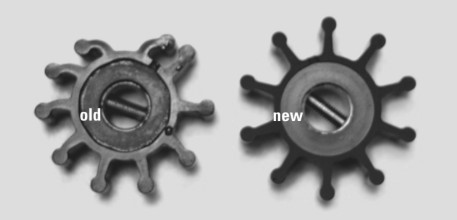
When the impeller is left in the pump it is forced into the shape of the pump cavity and immersed in the antifreeze. In both cases, the impellers took a set, and I deemed them unusable when I checked them in the spring. I saved one such “bad impeller” for photos and, over the course of about a year, it recovered its shape completely. I poured boiling water over the other one a few hours after I removed it and, as I watched, it also recovered its shape completely. I don’t know how good either impeller would be if put back in service, but if I were caught in a situation where I did not have a new impeller available, I would certainly try the boiling water trick to put the engine back on line until I could get a more trustworthy part.
I have not been able to find any confirmation suggesting that there is an incompatibility between neoprene and ethylene glycol, but I no longer leave my raw-water pump impellers soaking in antifreeze.
Another opinion — Gordon Torresen
If the fuel in the tank is clean and water-free, the filters won’t plug. I emphasize water removal and constant checks on that pesky O-ring at the fill cap. If any water is detected in a fuel filter, there is water in the tank. The water will be at the bottom of the tank and the related crud will be in the water. It is very important to pump from the lowest point in the tank. I recommend heeling the boat to assure a lowest point in the tank. Choose a calm day, take your main halyard over a few slips, and put the boat on its ear. Then, with a rigid tube so you can feel the absolute lowest point in the tank, go into the tank through a clean-out port or a fuel-gauge hole. The water will move quickly to that point. The sludge will move more slowly. The longer the heel, the more successful the cleaning.
I personally frown on additives of any sort. If you get a spec sheet from your fuel vendor, you will see that the necessary additives are already in the fuel. When you pour in an additive, you cannot be sure if whatever is in your bottle is compatible with what is already there. If you read the additive labels (or spec sheets) you will see that the benefits are vague and each brand is the best. Biocides kill the live stuff in the water but what happens to all those little corpses? Even dead, they are waiting for a rough-weather ride. I don’t know what it will do, but I don’t think I would want boric acid in my tank.
Getting a “pretty bad load of water” should never be allowed to happen. Failure of the O-ring on the fuel fill is the most common way to get contaminated fuel. The O-ring needs frequent inspections. We top off well over 100 tanks each fall (at Torresen Marine in Muskegon, Mich.) before putting boats up for the winter. Every O-ring is removed and inspected for cracking. I would guess that about 20 percent fail the visual inspection. For a buck, we’ll install a new one. How long a new O-ring will last is anybody’s guess. We once had a new batch develop cracks while sitting on the shelf.
Tanks that have a lot of air space above the fuel will accumulate water during periods of large temperature swings. If you add your fuel from a can, the condensation is forming while that can sits empty. A water-stopping funnel is an absolute requirement. Fuel docks in this country all have such a filter right at the outlet of the pump.
Thank you to Sailrite Enterprises, Inc., for providing free access to back issues of Good Old Boat through intellectual property rights. Sailrite.com