Salvage those little bits of horribly expensive wood
Issue 61: July/Aug 2008
After fitting out a boat or just making moderate changes to its interior, few of us escape the scrap dilemma. This occurs when you find yourself surrounded by frustratingly small, apparently useless scraps of richly grained, incredibly expensive timber. It’s one thing to throw away scraps of cheap pine, quite another to drop red cedar, teak, and mahogany into the trash.
The answer is to resist dumping scraps until their potential is fully considered. By thinking small, creative ideas for a range of wooden fittings may surface, making the hoarding of “useless scraps” a smart and useful idea. The following examples describe a number of uses for quality timber scraps on a good old boat. The trick is to take advantage of their inherent quality by turning them into simple, practical, and attractive fittings that not only enhance the vessel but also satisfy the desire to recycle beautiful timber. This is not rocket science, nor does it demand detailed plans, merely a desire to turn trash into treasure.
Coat hook
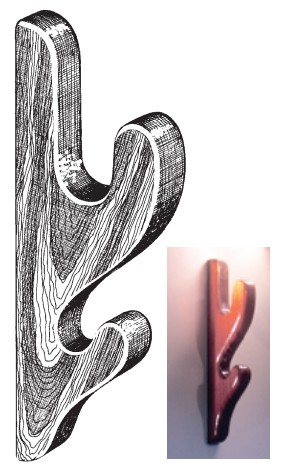
The coat hook is an easy fitting to make. After sanding and varnishing, it can be screwed or glued (or both) to a suitable vertical surface. In some cases a wooden hook can be secret-screwed from the other side of a bulkhead. A particularly useful site is close to the main companionway, where a hook is valuable as a place to hang not-quite-dry foul weather gear. Metal hooks in this busy area, as many of us know only too well, can be dangerous, especially if situated at eye level.
The illustration shows a double hook in its raw state. But whether making a double or single hook, cut out the shape with a jigsaw (in the absence of a band saw) and round the edges with a router. Then varnish it half a dozen times or more. Leave the base raw if the hook will be glued to the ship.
Glass holder
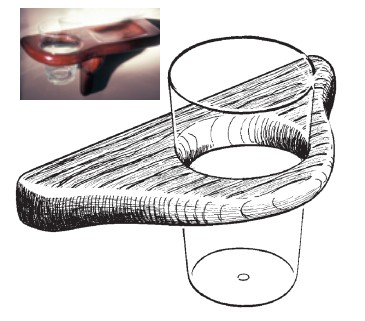
For that favorite drinking glass that is rarely properly stowed — owing to its constant demand, no matter whether it is kept in the head or in the galley — this holder can be screwed or glued to a bulkhead close to the washbasin.
The aperture is best cut with a good-quality hole saw. Enhance the overall appearance of the fitting by tapering its bottom surface toward the outer edge. Then round the edges with a router, including the aperture for the glass.
If you’re rich in scrap lumber and have some larger pieces about, you might consider making a rack that will hold several glasses, a cup rack, a combination cup-and-soap holder, or a cup rack that also includes several toothbrush holders. Any of these items can be made in much the same way.
Solar panel supports
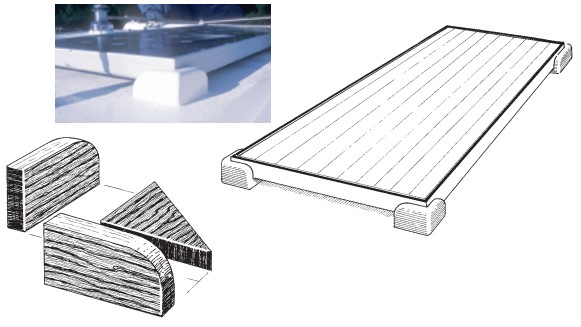
Where a solar panel is placed on a horizontal surface, it is important to elevate it above that surface by about 1 inch to allow a cooling airflow beneath it. Very small timber scraps can be employed to fabricate corner supports that elevate and hold the panel in position. To prevent the panel from blowing off in a gale, drive self-tappers (not shown) through one side of each corner piece into the panel’s side. Attach the supports to the cabintop with polyurethane adhesive/sealant whose squeeze-out is coved into the base with a wet finger and/or mechanically secured with self-tap-pers or threads. As suggested by the illustration, construction can be very basic without any fancy joinery because of the intrinsic strength of a unit this size and the fact that it is best painted over for less maintenance.
Nightlight
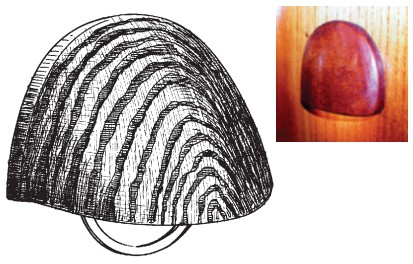
By definition, any light is a nightlight. But in the lexicon of the sailor, we know it as a low-powered light that gives illumination without destroying night vision. The light described here blends into the furniture while illuminating such tricky areas as alleyways and companionway steps during long night watches. Scallop the hood to whatever exterior shape takes your fancy and place it over a very-low-powered globe-holder. It is not — repeat not — intended as a strong light, which would defeat the objective of protecting night vision, plus the excessive heat would turn the hood into charcoal. The globe should remain as cool as possible and be of minimal amps. Better still, use a low-amp 24-volt globe working on 12 volts to produce a cool soft yellow glow.
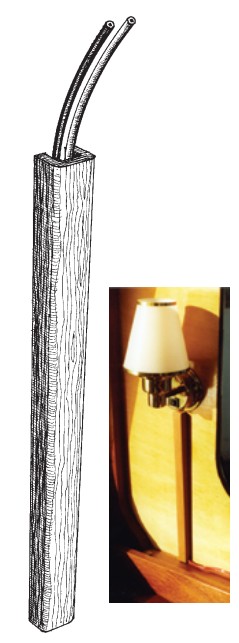
Cable cover
Wherever short runs of electrical cabling cannot be hidden behind a bulkhead, a cable cover can be made by routing a gutter in one side of a length of timber and rounding the outside. Attach the finished cable cover to the bulkhead with panel pins or with an adhesive/sealant using very small scattered dabs that squeeze inward when held in place to cure. Ordinary masking tape holds the cover in position during the curing process.
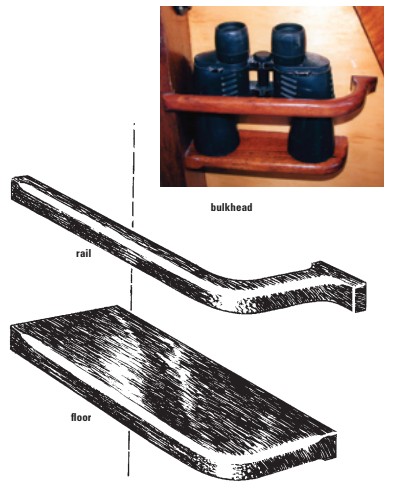
Binocular rack
Reminding us that more than one scrap can be combined to produce a single unit is this binocular rack composed of a small floor and rail. Because a timber rail of this size is easily knocked and broken, it is best placed away from serious traffic and care is needed in its use. Although it is not as robust as a proper binocular bin, this type of solution does an excellent job and is much easier to clean than a bin.
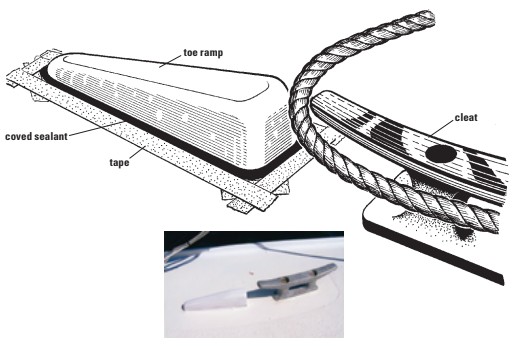
Toe ramp
If you’ve never stubbed bare toes on deck, you are either an extraordinarily diligent person who wears shoes at all times or someone who has never been aboard a boat. The rest of us need toe ramps to deflect toes up and over offending fittings. They don’t actually prevent accidents, but they sure take the pain out of the collision between flesh and metal.
A toe ramp may be needed at the end of deck cleats (far enough away not to obstruct lines being made fast), at the end of sheet tracks, against certain types of stanchion bases, and so on. In all cases, a small scrap of timber shaped like a wedge and rounded on top is attached to the deck against or close to the object. Attachment is simplicity itself: use a good sealant/adhesive whose squeeze-out is coved into the deck with a wet finger.
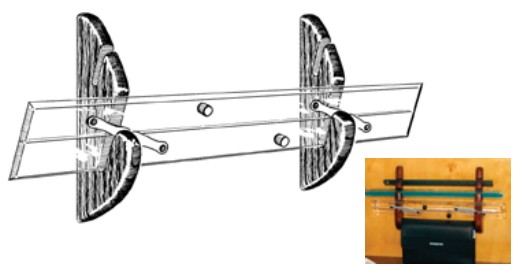
Ruler rack
When parallel rules are not in use, they get in the way of the navigator unless they are provided with exclusive instant-access stowage. This is easily achieved with a couple of tiny, slotted timber scraps that form a bulkhead rack for one or more rulers. Such a rack is easily made, and the principle readily extends to a tool rack for the engine room or a bosun’s locker.
Compass base
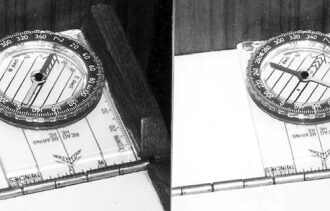
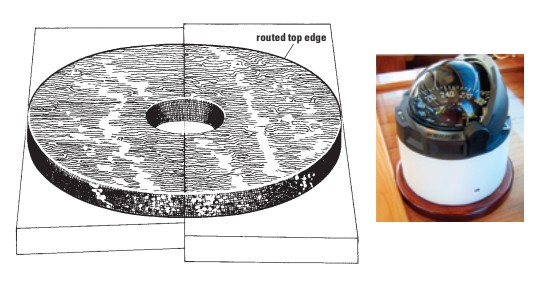
Using a single scrap, or two or three scraps butt-glued together, a compass base can be easily fabricated. It enhances the marriage of compass and control surface but, more importantly, is a means of mounting the compass on a curved or sloping surface. Tailor the bottom of the base to the shape of the surface to ensure the compass sits horizontally.
And more, much more
There is no definitive end to this subject because it is limited only by the human imagination. And should you become hooked on this satisfying way of recycling yet feel bereft of new ideas, there is always the call of traditional blocks, cleats, locker latches — you name it — to keep you busy. The trick is to hang on to those scraps.
Alan Lucas has been cruising nonstop since 1960, using his training in commercial art to support himself by illustrating how-to articles and books. Of his 28 books, he is best known for two cruising guides to Australia’s east coast: Cruising the Coral Coast and Cruising the NSW Coast.
Thank you to Sailrite Enterprises, Inc., for providing free access to back issues of Good Old Boat through intellectual property rights. Sailrite.com