Delicious fresh bread on a Cape Dory 36
Issue 55 : Jul/Aug 2007
The sailor in me accepted long ago that certain foods remain on the hard. When we back out of our slip, we leave behind ice cream, French fries, lemon meringue pies — any food too chancy to keep, too messy to cook, or too delicate to withstand a beam reach.
That’s fine. It’s good to leave the land behind.
But there’s one food I’ve never stopped missing: fresh-baked bread. I bake a lot of bread at home. I even built a brick oven in our backyard to make better bread. So it was a drag to leave both the task and the taste behind, especially on extended sails. Last summer, I decided to tackle the issue.
Issues, actually. Chief among the many questions was whether our alcohol oven was up to the task. Was there a way to boost the heat? Would conditions on the water affect how the bread rises? How much extra gear and ingredients would be required? Could I make dough and not cause the Coast Guard to wonder about the nature of this fine white dust that covered everything?
I’m happy to report that baking fresh bread aboard is possible (and irresistible). All that was required were a few adjustments to my procedure, my oven, and my expectations.
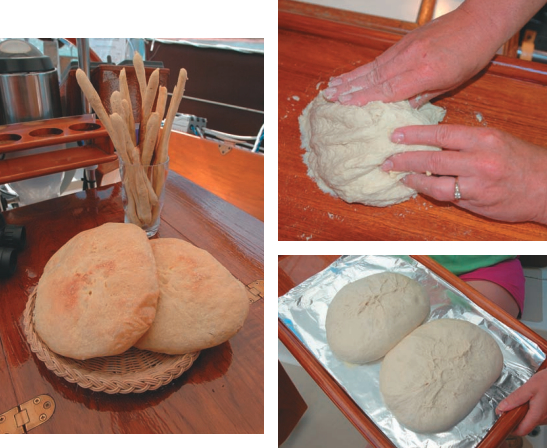
For starters, I put aside thoughts of a traditional loaf. A loaf pan would be yet another item to store, and the baking time was too long. I shifted my vision to smaller, meal-sized versions of flatbreads, plump little rounds just right for one supper, and breadsticks that I could vary from soft batons to long, pencil-thin grissini.
No messiness
I also developed a streamlined mixing method that sidestepped messiness, a means of kneading that minimized the usual grand slapping about, and a way to make the most of the less-than-fiery heat created by our boat oven.
As with most things marine, the key is to plan ahead, or in this case, measure ahead. I choose my recipes while still at home, then measure out the dry ingredients — flour, salt, and yeast — in Ziploc bags. That saves me from bringing a bag of flour and a jar of yeast. I also use instant yeast, often called rapid-rising or bread-machine yeast, because it doesn’t need to be dissolved in water. Once on board, I mix the dry ingredients with water in my largest bowl. That way, I can do much of the kneading inside the bowl before resorting to a floured board. Then I employ a baker’s secret weapon: autolyse.
Autolyse is the practice of letting the dough rest for about 10 minutes. Turn the still somewhat sticky blob of dough onto a floured surface — I use our cutting board — and cover it with the upside-down bowl. This resting period lets the flour fully absorb all the water and helps the dough relax and become easier to handle.
While the dough is resting, you’ll notice your doughy hands. Resist the urge to wash them and send the floury bits down the drain, Instead, go on deck and briskly rub your hands together over the leeward rail. Most of the dough will rub off, leaving only a quick rinse to make you presentable.
Quicker kneading
Ten minutes later, the dough will be firmer and less sticky, so the remaining kneading won’t take long. Put the dough in a clean bowl coated with a thin sheen of oil, cover with plastic wrap, and set it in a warm place. Keep it out of direct sun and wind — my favorite spot is under the dodger — until it doubles, in about an hour or so.
Now it’s time to talk about heat. Our alcohol stove never seems to get as hot as the stove at home, no matter
what the temperature gauge says. So I give the heat a boost by placing a small pizza stone on the bottom rack. This helps retain the heat, but more important, it lets me place the dough directly on a hot surface, making the most of every degree. You can also lay clay tiles to fit on the bottom rack. The key thing is to give the stone plenty of time to preheat — at least 30 minutes before you want to bake and longer if you can.
Warming the cabin is one advantage of baking on a cool day, of course, but hot days work too. On one of the days I baked last summer, it was an unusual 90 degrees in the Apostle Islands, so the cabin could hardly feel any warmer, oven or no. It was good to sit on deck while the bread was baking, the better to answer those who glided by and won- dered about the wonderful aroma.
Flatbreads work the best because they’re small and bake relatively quickly, as do soft chubby breadsticks. If you’re really ambitious, you can make another half-batch of dough, add some dried herbs, and roll skinny grissini — pencil-thin breadsticks — to put in the oven after you remove your loaves. They benefit from a long session in low temps, so you can turn off the oven and let them bake in the waning heat until they’re crisp.
The accompanying recipe will provide fresh bread for an evening meal, and the leftovers will make a tasty French toast the next morning. Still have some left? Toast or grill slices for the afternoon’s hors d’oeuvres of bruschetta.
Thank you to Sailrite Enterprises, Inc., for providing free access to back issues of Good Old Boat through intellectual property rights. Sailrite.com