Making a convincing case for a hard dinghy
Issue 55 : Jul/Aug 2007
My first cruising sailboat was an 18-foot William Atkin-designed sloop. I built her and cruised her without a tender of any kind. Since she drew less than 18 inches, I could easily take the beach to dig clams or work her up into the mouths of tidal rivers to dry out and spend the night.
One summer a friend loaned me an inflatable. Not much more than a swimming pool toy, the little bauble was the start of a life-long affair with dinghies. It taught me to enjoy early morning hours paddling through the fog with my dog. I also loved to watch her poppling along behind, trying to leap over her frothy track and take to the air, which she did once or twice.
I’ve had a Yugoslavian inflatable for about 20 years, and she was a veteran when I got her. Undeniably, inflatables are hearty and the most stable of tenders, extremely forgiving of awkward movements. These dinghies are a good choice for those unacquainted with or anxious around deep water. With an outboard clamped to the transom, they’re speedy workhorses and can be a lot of fun, especially for electronically deprived, impatient, and easily bored teenagers.
I always carried my 2-hp engine mounted on the pushpit, but getting it off and onto the dinghy became increasingly tiresome. So was filling the tank on a shaky platform. So was finding a place to store cans of gasoline. So were hard starting and the noise and fumes.
One summer we left the engine home and rowed everywhere. We were hooked. It was an easy way to get a little exercise and to further enjoy the delights of gunkholing. We didn’t miss the engine, but I began to realize how badly the little airboat rowed.
Pathetic holdovers
Oars on inflatables have become vestigial appendages, pathetic holdovers from a time before outboard motors. Whatever her advantages — and there are many — an airboat is not a rowboat. Rowing puts us in touch with the water in ways that are increasingly hard to achieve in our industrialized society. Rowing a boat easily and quietly in fresh air, dipping and skimming the oars just feet away from the head of a seal, can provide some of the happiest of times afloat. A boat that rows well is more in keeping with the idea of a sailing boat than one propelled by a motor. We enjoy rowing and sailing in similar ways and for similar reasons.
Like the good old boats that tow them, hard dinghies are found in various states of disrepair and can be acquired cheaply. When hauled into the garage for a few weeks during the winter, an 8-foot rowboat in need of tender loving care can provide the same satisfaction that upgrading the mother ship offers.
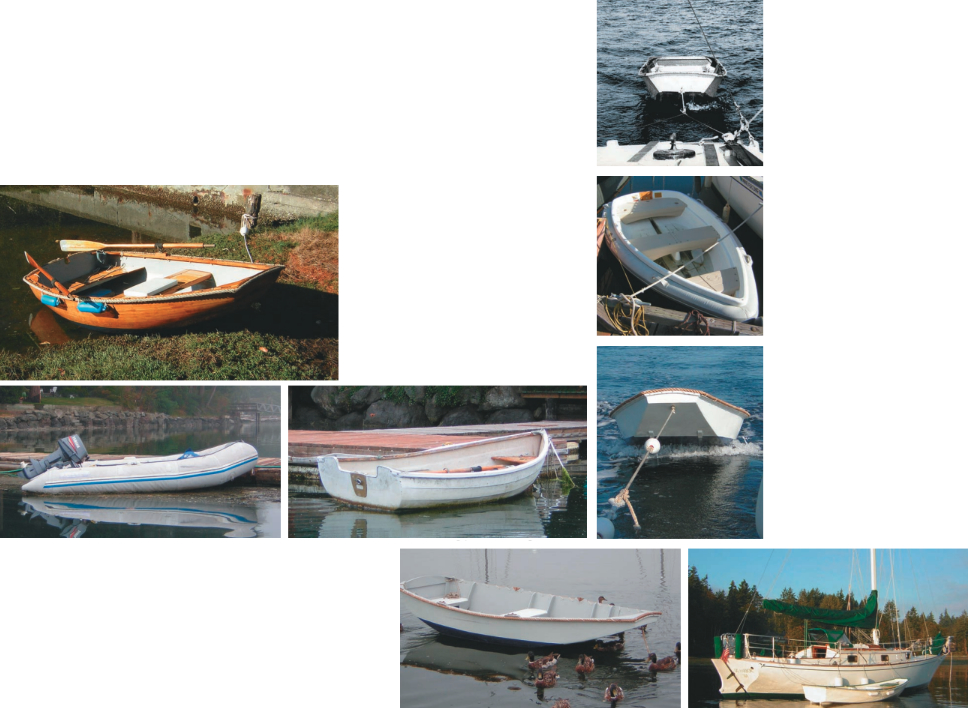
Give or take a few horsepower, inflatables tend to perform similarly and look alike. Conversely, there is great variety to be found in hard dinghies. There are pointy-bowed hulls and prams. There are dories; V-, flat-, and round-bottomed boats; and folding and nesting dinghies. There are carvel-planked, lapstrake, and strip-built skiffs. And there are fiberglass replicas of fine wooden boats. Differences in form and function characterize each type, and we can modify them still further to get the best match with our individual preferences in use and appearance.
For sale in boatyards
Hard dinghies are ubiquitous and often can’t be sold for enough to make it worthwhile advertising them. They can be found for sale in boatyards and by word of mouth. We stumble upon them in garage sales or spot them in backyards or alongside the road.
A battered 6-foot fiberglass boat washed up on our beach one morning after a stormy night. The hull was badly abraded and the oarlocks were gone, but I got her home and dried her out. A quart of epoxy and some fiberglass cloth later, and she was ready for sea. But even with a properly struck waterline and a new pair of oars, she lacked whatever it is that smacks of a good old boat. She was old, to be sure, but even with lashings of TLC she wasn’t very good. Beauty is not entirely in the eye of the beholder. The dead-straight sheer, her stubbiness, and a wavy deck flange didn’t help. She got us to shore and back but wanted an engine badly. She made a better planting box than ship’s tender.
For those lucky souls who have yet to build their own boat, I can think of no better end to a couple or three sheets of plywood. With a good set of plans, common tools, and sufficient desire, your cruising adventures can be fortified with a dinghy of your own making.
A flat-bottomed pram is a good choice for amateur boatbuilding. There are many plans available in traditional and epoxy-based building systems and drawn by some of the world’s finest small boat designers. Before choosing your $30 plans, consider the little boat’s carrying capacity, her width and length, flare and rocker, the rake of her transom, and shape of her stem. These and many other features should be considered in relation to the intended use and overall appearance. In the process, you’ll learn quite a lot about boats, how they move through the water and what pleases the eye.
Fine tenders
Over the years, I’ve built two William Atkin-designed dinghies, one the 6-foot Tiny Ripple and the other a 7-foot Rinky Dink. Both were fine tenders, light and very well-behaved while being towed in the short and choppy waters of our inland sea. They handled the wakes of large and fast-moving powerboats and ferries with confidence, and their small size meant that I could get them aboard the big boat during rough weather or before long passages.
The great British yachtsman, Claude Worth, in his classic book, Yacht Cruising (now out of print), described the French Auray fisherman’s punt. I thought she would make a good tender. I liked the decidedly pugnacious nature of this little boat, with her long bow overhang that I could imagine would allow me to step, dry-footed, on a sandy beach.
More recently the prominent American small boat designer, Philip Bolger, drew a replica Auray punt in modern taped-seam form. I ordered a set of plans from Dynamite Payson and spent several pleasurable weeks putting her together.
We towed her for several weeks last summer and, except for the fact that she is too big for us to haul aboard easily, she makes an excellent and highly personal tender. The punt’s added length and two oarlock positions allow her to balance quite handily even with two large adults and a dog. In fact, with the narrow bow, old Scout has less latitude to move about and upset the trim.
Good flare
Like the Atkin prams, the 9-foot 9-inch Auray punt has good flare and, with her long bow overhang, she seems to slide about among the waves taking to heavy wakes and tide rips like a duck. The absence of a skeg may prevent her from tripping over waves, and her waddling about seems to settle her in just the right way. This same feature, however, requires some acquired skill to keep her to a straight course under oars.
I once towed an 8-foot plastic boat with simulated lapstrake sides that came with a Thunderbird sloop. I reinforced the oarlock mounts and fitted a rope fender. Being very light, she panted a little but held together as long as I had her. I would fault her only in that her appearance clashed with the clean and purposeful lines of a Thunderbird.
Friends of ours built a Danny Greene Chameleon nesting dinghy to serve as tender to their Mason 33, now cruising in Ecuador. The Chameleon design is a little over 10 feet long, but when broken in two and nested, she takes up just a little over 5 feet of deck space. They reduced the overall length to 8 feet, however, keeping the same beam and freeboard, so she would fit comfortably abaft the mast. By doing this, the weight was also reduced from the original 100 to about 60 pounds.
Our friends report that she is “light, rugged, extremely serviceable . . . and easily repaired while cruising.” They’ve mounted a 3.3-hp outboard on the transom but also find the Chameleon rows and tows very well.
Another friend, with whom I sail in tandem every summer, owns a full-sized nesting Chameleon, but he happily tows her almost exclusively. She carries two large adults, bags of groceries, and a large dog.
Strip-planked pram
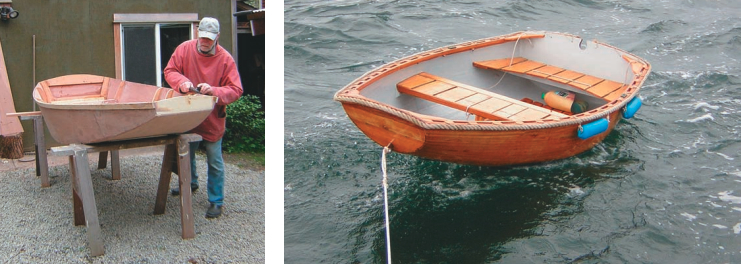
In recent years, I’ve cruised with one of my all-time favorite dinghies. She’s a round-bottomed, strip-planked pram that I built of 1⁄4-inch Western red cedar planks encapsulated between layers of fiberglass cloth and resin. She’s based on the lines of an 8-foot Plat Montfort Black Fly fabric-covered boat that I couldn’t quite resolve with our gravel and barnacled beaches. She’s a little lighter than a plywood boat of similar size and a lot lighter than fiberglass. I can get her up on deck by dropping the lower lifeline up at the bow and pulling her up and over the gunwale. I turn her upside down and wriggle her around into transom chocks.
The little round-bottom pram is, quite simply, a joy to look at — not just by me but by many who like her looks and say so. I think this is because she is well-designed but also because she’s unique and built by hand, features appreciated by many in an increasingly off-the-shelf world.
In any event, these good looks make the dinghy’s small size, somewhat cranky nature, and ample foam pillow under tow quite acceptable. I keep fiddling with the seats and oar-lock height and move the towing ring up and down to tweak performance. All this also gives me an excuse to mess about with her. I like this dinghy a lot.
Dinghies are not entirely about performance and cost. A terrific deal doesn’t always make for the best boat on the water. The appearance of a good tender complements the mother ship as much as a carefully drawn sheer line or fine paint and varnish. In fact, the way our tender looks says as much about our seamanship as the way we reduce sail in a blow or how we anchor.
Besides all that, there is something seductive about a handsome dinghy tugging on her painter behind a small boat. Something about her small size and practical nature reminds us of simpler times and, perhaps, the essence of cruising.
Thank you to Sailrite Enterprises, Inc., for providing free access to back issues of Good Old Boat through intellectual property rights. Sailrite.com