An innocent book changes their lives
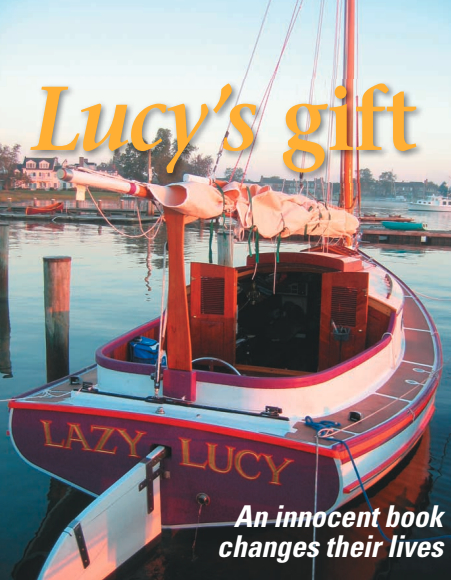
Issue 56 : Sept/Oct 2007
Christmas 1990. One gift, Innocuous enough in size and position in the pile of carefully chosen wrapped packages might well have been shimmering, glowing, and vibrating with the untold power it held within: How to Build a Wooden Boat, (WoodenBoat Publications, 1987.) My husband, Scott, smiled, eased open the cover and inhaled deeply. Just like that, our lives changed.
I should have seen it coming. The man likes to build stuff. Out of wood. Violins, violas, cellos . . . our house. And he likes boats, all kinds of boats. But sailboats, sailboats — that other-worldly fusion of fine, sweeping lines and efficiency at its most elegant — well, there is no other vessel so worthy of Scott Hershey’s passion. According to him.
I should have been prepared when the lumber started to arrive. A lot of lumber. Stacks and stacks of white oak and Spanish cedar and more mahogany than you’d find in Bruce Wayne’s study.
His first project, a Herreshoff 12 1⁄2, the Haven, by designer Joel White, took up our entire garage and a four-year chunk of our lives. But she captured Best of Show at the 1995 Mid-Atlantic Small Craft Festival in St. Michaels, Maryland, and she was beautiful. The Deborah Lynn now sails in San Diego harbor, having been sold, in true shoemaker-and-elves fashion, to afford more wood for more boats.
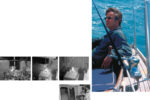
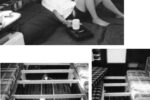
All of this is well documented. We have more photographs of every single stage of every single boat project than we have of our children. No kidding. In one of the pictures that stands out in my mind, there is a freshly-delivered stack of prize lumber in our driveway, right next to the Deborah Lynn and a perky little shellback dinghy aptly named Nice Boat, that happened, somehow, between the larger projects.
Double irony
The irony in all this is twofold. First, you’d have to see where we live — surrounded by deep woods in the mountains of Pennsylvania. There’s not a sea, bay, river, lake, or even a pond in sight. Second, while the finished boats in the photo have been varnished and polished and otherwise lovingly attended to, they haven’t been, well, sailed much. My imagination, maybe, but they look a little dejected.
Our lives, in the midst of all this mad-scientist-style boatbuilding, were busy. Aside from being a partner and creative director of a successful ad agency, Scott makes and repairs violins in his shop at our home and has done so for 25 years. And at the time when his plans to build a 24-foot Cape Cod catboat were announced, we had two teenaged daughters at home. Often I was the sole parent representative at our girls’ many school activities. “Where’s Scott?” our friends would ask.
“It’s epoxy-drying weather,” I offered in explanation. It cracked them up and they remind us of it still.
So Scott, to assuage the chorus of groans at his announcement, promised, in his best campaign voice, that our oldest could host her high-school graduation party aboard the Lazy Lucy. (The name of the boat was diplomatically chosen as well, Lucy being my childhood nickname after the Peanuts character with a propensity to gripe. As for lazy . . . Scott waxed poetic about the tubby, comfortable lines, the wine-and-cheese, slow jazz, and dazzling sunset mood of the catboat . . . a vessel on which laziness is acceptable, even encouraged.)
Boating buddy
His first encounter with a real wooden Cape Cod catboat happened when Russ, a boating buddy of Scott’s, piloted his 18-foot Fenwick Williams cat, Southshore, singlehandedly from Havre de Grace to St. Michaels, Maryland, for the Mid-Atlantic Small Craft Festival in October 1995. Even if Scott hadn’t already been seduced by her voluptuous figure and generous gaff-rigged mainsail, he was a goner the moment he stepped aboard. Her steadiness and composure, her downright graciousness in accepting the burden of two, three, four . . . eight more passengers without so much as a backward glance, that’s what did it. That’s what sent Scott back to Pennsylvania and the wood chips flying.
I admit the charm of this vintage vessel is undeniable. Everyone loves a hard worker and the cat’s roll-up-your-sleeves ’tude is evident in the sepia-toned photos of the New England fishing industry taken at the turn of the century. Her wide beam and shoal draft, that expanse of sail and enormous barn-door rudder gave her confidence and agility that few rigs could rival. The allure of the catboat only intensified when the swankier set got hold of her with racing and pleasure sailing in mind. And throughout the subsequent tweaks and modifications, modern catboats have managed to keep their character and dignity intact . . . a good thing.
It took some detective work before Scott tracked down Bill Peterson, the naval architect who was in possession of the original Fenwick Williams plans. He asked a lot of questions and finally decided on the 18-foot model, circa 1952, modified to 24 feet because, he said, it sounded like the right size. Scott stayed true to the Fenwick Williams plans with one notable exception. After much research and deliberation, he decided against the traditional carvel planking in favor of a double-planked hull reinforced with Kevlar roving and epoxy, reducing the number of ribs required and thereby increasing the interior space. There was also the prospect of less future maintenance with the double-hulled treatment, definitely a plus.
Much in common
People are fascinated by the violin-making/boatbuilding connection. Scott will tell you the two processes — like the finished products — have a lot in common. He loves to cite similarities such as the “nicely curved bottom” (his words) of each, how the bowsprit can be likened to the neck of a fiddle, how the tops of boats and stringed instruments are arched similarly, and how the symmetry and the finish are crucial to both. He incorporates only the finest woods and fittings in his violins and refuses to compromise when it comes to boatbuilding. The latter has required some sacrifice, though. I’m remembering the beloved, if dusty, Harley-Davidson custom Softail advertised for sale just before the Harken blocks, Thurston sails, and Yanmar diesel were ordered. He cries a little when he talks about it.
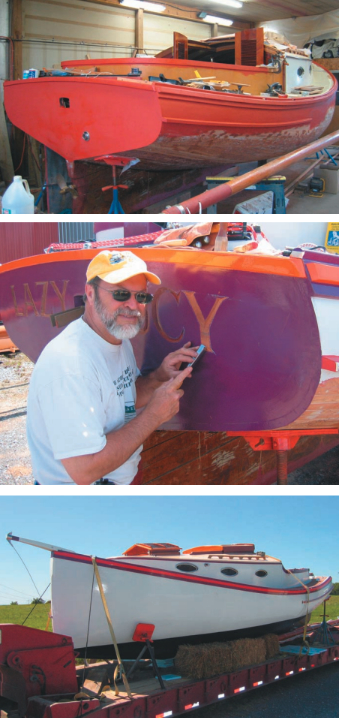
Fast forward to Lazy Lucy’s launch day, August 2006. The aforementioned daughter, the one who was promised Lucy as a venue for her graduation celebration, was present. So were her husband and two children. A recent recipient of a master’s degree in education, high-school graduation was a faded blip on her GPS. Lazy Lucy had been 10 years in the making.
Ten years. Granted, there were lapses — work interrupted by not only the usual demands of life, but other things as well — a foray into puppet-making (yes, puppets — marionettes — complicated, hand-carved wooden ones with strings and controllers) and a heart attack which, happily, took less time to recover from than puppet-making.
And he had help: just about every young man our daughter dated had a hand in Lucy’s development. Sincere interest in boatbuilding or a desire to make points? We’ll probably never know.
Moved inside
Along the way Scott’s closest friend, Gerry, convinced him that it was always epoxy-drying weather inside the gigantic garage used to house excavating equipment for his family-run business. So they (and a small army) loaded Lucy onto Gerry’s flatbed trailer and muscled her inside the garage, where she spent the next five years. Believe me, commandeering, oh, half an acre of someone’s garage for five years will put even the strongest bonds of friendship to the test.
There was Brad who showed up every Tuesday night (“boat night”), and Fred and Garth on the occasional
weekend. They are all there, captured in various acts of construction on the pages of Lucy’s photo albums . . . all the way to her sea trials.
Flipping through those photos is a lot like the picture decks we thumbed through as kids. The stacks of lumber shrink and the boat grows. At the same time, the people in the pictures change: waistlines, hairstyles, children grow into adults, and the adults turn into, um, mature adults. One per- son, Scott’s dear father Harry, whom I hold personally responsible for his son’s building addiction, was there in the photos of Lucy’s molds-and-ribs skeletal stage but is poignantly absent in the pages that follow. Then again, the latest pictures feature our five-year-old grandson, Cole, beside his Poppi at Lucy’s helm on her maiden voyage. Cole wasn’t even in the blue- prints when Lazy Lucy’s life began.
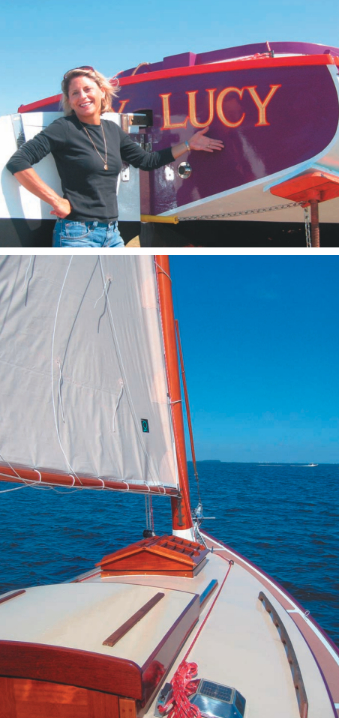
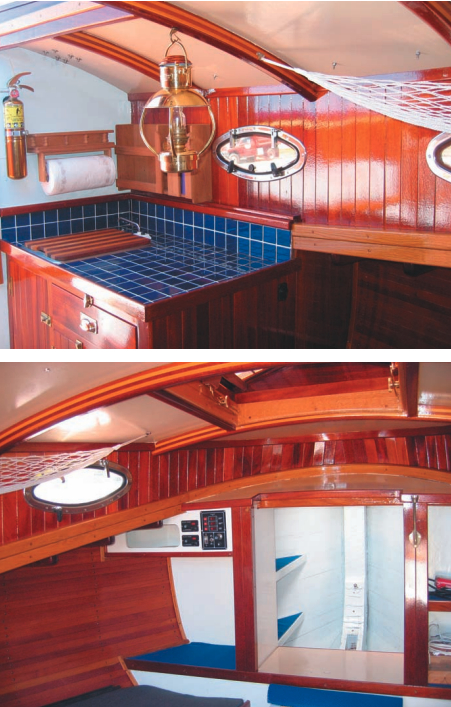
A lot of people have asked what Scott’s next boat will be, and I answer (only half-jokingly) that they will have to ask his next wife. For now, we are looking forward to spending time aboard Lazy Lucy, which, for all intents and purposes, is every bit the vessel she was promised to be. Her gleaming cabin boasts 10 Christmases’-worth of gifts — brass lanterns, a teak spice rack, a 12-volt blender (thinking margaritas).
Next Christmas? I’ve got my eye on some cruising books. And perhaps some new photo albums, ones we can fill with pictures of open water instead of raw lumber. But this is serious business, a responsibility I no longer take lightly. Oh, the power of gifts. Never . . . never underestimate the power of gifts.
Deborah Hershey is a freelance writer and artist/illustrator who has endured almost 20 years of her husband’s boatbuilding addiction. His latest endeavor, Lazy Lucy, a 24-foot Cape Cod catboat, is moored in Middle River, Maryland, a “short commute” from their Pennsylvania home.
Thank you to Sailrite Enterprises, Inc., for providing free access to back issues of Good Old Boat through intellectual property rights. Sailrite.com