It’s helpful — but there’s no absolute certainty
Issue 56 : Sept/Oct 2007
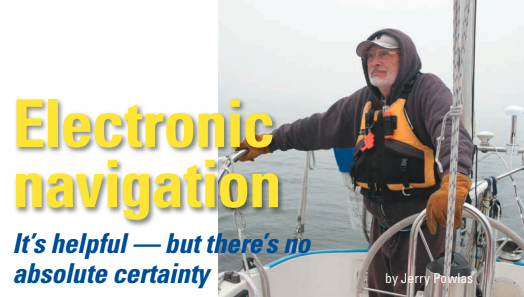
We were following the channel behind the breakwater from Prince Arthur’s Landing Marina, heading toward the entrance to Thunder Bay, Ontario, on Lake Superior’s northwest shore. Visibility in the fog allowed me to see as far as the bow, but that was the limit. Below, Karen was directing our progress using an electronics suite that was far better than the equipment we had on the heavy cruiser I served on in the late 1960s. A GPS receiver fed information to a chartplotter on a laptop computer that told us where we were and where the next channel marker was, and the radar told us we were alone in the channel.
I thought about the time when I told a friend what the butcher’s bill was going to be after Mystic had been hit by lightning and we lost almost every piece of electronic equipment aboard. His reply was, “That’s what you get for having that much electronic equipment on your boat.” He was not given to offering more sympathy than was needed, and he was inclined to keep his boat free of such complexity.
Undeterred, I replaced all the fried electronic gear and am glad I did. There are a lot of ways to equip a boat and, essentially, none is wrong. At the simple end of the scale you might get by with a depthsounder and VHF radio. Beyond simple, you might have no electrical system at all and manage with oil lamps and a lead line. This is not wrong-headed, just very simple and limited, to some degree, because in some situations vessels so equipped would be well advised to get to, or stay in, harbor and ring the bell until the visibility improves.
At the complex end of the scale, a vessel with GPS and radar can move about in limited visibility. Having this gear is not wrong and an argument can be made that such a vessel is somewhat safer. I would not push the safety aspect too far, however, because, given improved capabilities, a crew is likely to operate in a manner that requires the additional capabilities to be safe. Still, consider that fog may come to you while you are between safe anchorages and darkness comes each day.
If you elect to use modern electronics, you will be comforted by the admonition that “a skilled navigator uses more than one method to fix his position.” You should not be comforted, however, by the thought that a lightning strike or other massive electrical failure will leave you without the use of this equipment. To prepare yourself for that possibility, you will still need to become skilled in the practice of non-electronic navigation. This is not a bad thing anyway because the traditional navigation skills are interesting, and knowing them and using them will give you a greater appreciation of how the sailors of only a few decades ago piloted their craft.
The choices you are required to make when equipping your boat for navigation are a part of what makes our hobby interesting. There is no single right way. Still, all skilled and experienced navigators have one thing in common regardless of their methods. They never really trust anything completely. Absolute certainty has no place in the art of navigation.
Thank you to Sailrite Enterprises, Inc., for providing free access to back issues of Good Old Boat through intellectual property rights. Sailrite.com