Design considerations
Issue 57 : Nov/Dec 2007
This excerpt from Beth Leonard’s new book, The Voyager’s Handbook, second edition, is the last of a three-part series with a focus on selecting the right sailboat for extensive passage-making. The first parts focused on the available designs, choosing the right-sized boat for your purposes, and stability and durability issues.
Once you narrow the field to specific boats, you will want to do your own inspection of the boat to see how it matches up to your expectations. There are critical differences between a successful offshore voyager and a coastal cruiser. These details make for a safe, workable, comfortable cruising home; most apply to any monohull or multihull from less than 30 feet to more than 60 feet long.
The survey that follows will not help you assess the construction quality of a boat or allow you to identify potential defects. That needs to be left to a qualified surveyor performing a professional structural and mechanical survey after you’ve decided to make an offer. But it will help you evaluate how the boat will meet the demands of offshore voyaging and liveaboard cruising.
Whenever you look at a boat, ask for the owner’s manual, all maintenance records, and the most recent survey available. The existence of an owner’s manual and maintenance records suggests that the owner cares about the boat. The condition of the maintenance records and their content will give you a good feel for how well the boat has been cared for over the course of its life. If nothing else, it should tell you how many hours are on the engine and how well it has been serviced, at least by the current owner.
Although you cannot implicitly trust a survey that a buyer has in hand, its age and the comments in it can give you some useful information. If the survey is more than five years old, you should probably discount it completely except to see if the surveyor’s recommendations, if any, were carried out by the owner. Any survey for offshore insurance purposes that is less than two years old will provide useful information.
Given a seaworthy, structurally sound hull capable of accommodating you and your proposed crew, almost everything else can be upgraded, changed, or fixed. But if the boat lacks most of the items in the bluewater survey that follows, the cost to make it offshore capable may prove prohibitive.
Sea-safe deck layout
The boat’s decks become your entire world at sea. They must offer a safe, comfortable environment even when chaos reigns. Each area needs to be well designed to meet its function: the cockpit must keep crewmembers secure and comfortable, the sidedecks must allow free movement forward and aft, and the bow platform must facilitate anchoring.
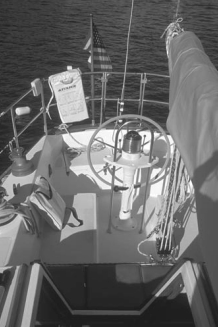
Secure cockpit. The cockpit gets used constantly at sea and in port. In port you might like to have a comfortable cockpit that holds a small crowd. But at sea, you must have a small cockpit that drains quickly. With a boat between 35 and 40 feet, a properly sized cockpit seats up to seven people comfortably without using the coamings or coachroof as auxiliary seating.
A good offshore cockpit on a monohull, as shown in the photo below, has a bridge deck or high sill to prevent a boarding wave from going below. The first or second hatchboard should come level with the top of the coamings to prevent downflooding into the interior, and you should be able to enter the cabin without removing those boards.
Cockpit drainage matters on every boat, but it matters most on smaller monohulls with poorly protected cockpits. Larger boats have enough buoyancy to support the weight of water their cockpits can hold, but smaller boats lose responsiveness and buoyancy if their cockpits are filled with water and may end up being rolled or flooded by a subsequent wave. Cockpit drains need to be large enough to empty the cockpit in 2 minutes or less after it has been filled to the level of the coamings by a large wave.
If there’s a wheel, there should be at least 18 inches of standing room behind it and a way to brace your feet when the boat is heeled. On a catamaran, the helm should be positioned so the helmsman can see the bows and side of the boat for ease of docking. There should be a seat for the helmsman as well as comfortable watch positions under the dodger. On a monohull, the cockpit seats should be long enough to allow an adult to lie down on them and close enough together to brace your feet against one when sitting on the other. That means the seats should be about 6 feet long and a bit over 2 feet apart.
On most boats, the single biggest openings through the deck are for the cockpit lockers. Locker hatches should be watertight, reasonably sized, well secured, and fully protected by the coamings. Ideally, the lockers should not communicate directly with spaces below and should drain overboard. Otherwise, a lost locker hatch could lead to a sinking in heavy weather.
On a daytime watch in the tropics, your primary concern will be shade. Many voyagers’ second offshore boats include a well-ventilated hard dodger or pilothouse. Short of a permanent structure, the cockpit must include some provision for rigging a canvas shade that can be securely stowed in storm conditions.
Safe decks. A safe deck is one that keeps crew from going overboard in any ordinary circumstances at sea. The single most important element in helping crew stay on deck is not lifelines, stanchions, handholds, or footholds — since none of these will help a crewmember who loses his or her footing — but non-skid. A good non-skid pattern molded into the deck of the boat is ideal.
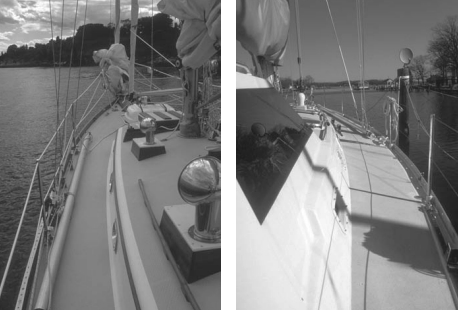
After good non-skid, deck safety depends upon a design that will keep crew aboard at sea, as shown in the photos below. Both of these sidedecks include all of the following:
- Wide, unobstructed deck from bow to stern. A good offshore side deck measures at least 18 inches wide and is unobstructed from bow to stern. Boats with high coachroofs and steep cabin sides will need even wider decks to allow a person to pass along them when the boat is heeled. To test the sidedecks, try walking the length of the lee sidedeck with the boat heeled 20 to 30 degrees.
- Strong handholds always within reach. A person should be able to reach a handhold strong enough to take his or her entire weight from any position on the deck. Acceptable handholds include dedicated handgrips along the coachroof, stays, stainless-steel bars near the mast, or stainless-steel cages over Dorade vents (which also keep sheets from fouling the cowl). Lifelines should never be used as handholds because of the chance of their breaking. Walk around the boat and consider the common problem areas: stepping onto the sidedeck over the coaming, between the coachroof and the staysail stay, and at the mast.
- High toerail or bulwark that does not trap water. When a monohull is heeled, footholds become as necessary as handholds. That means a toerail or bulwark at least 4 inches high and strong enough to support several hundred pounds of weight. To keep the toerail from trapping water and increasing the likelihood of leaks aboard, an open toerail with holes every few inches (as on Hawk) works best. If the toerail or bulwark is solid, as on Silk, the sidedeck should have several scuppers to drain water off the deck.
- High lifelines with strong stanchions. Lifelines provide the last defense against going overboard, not the first. When the full weight of a person hits wires and stanchions, they all too often fail. However, they can serve to help you regain your balance if you still have one good handhold or foothold to support most of your weight. To be of any use, lifelines should be at least 28 inches high, well above knee level. Otherwise, they’re more likely to assist a fall overboard than to pre- vent it. Stanchions should be strong enough that they won’t bend if hit by the full weight of a person.
All too often, designers seem to treat mid-deck springline cleats as an after-thought. On many boats, they prove too small to be of any use with no way to make a line lead fair to them without chafing on the toerail. Or they get left off entirely. Given that, when in use, spring cleats hold two lines while other cleats hold one, they should be just as big as, if not bigger than, the bow and stern cleats — a minimum of 8 inches long. Twelve inches is not excessive on a 45-foot boat (all Hawk’s cleats are 16 inches). Chocks or hawseholes in the bulwarks need to be oriented to allow lines to reach spring cleats from almost any angle, as shown in the photo above at left.
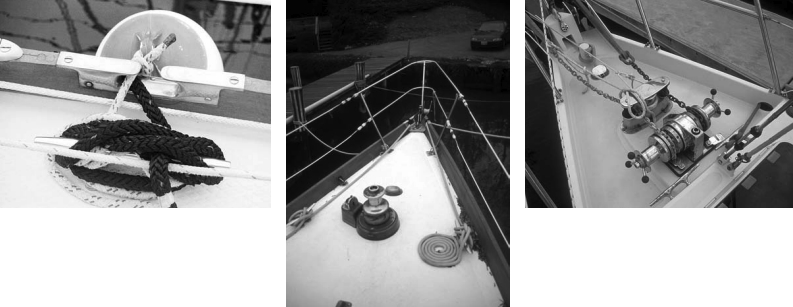
Well-designed anchoring platform. One of the easiest ways to distinguish a real cruising boat from its coastal counterpart is to look at the anchoring arrangements, as shown in the photos above center and right. Coastal and racing boats spend most of their time tied up in marinas, and their crews rarely, if ever, actually set an anchor. Cruising boats spend most of their time at anchor, and their crews deploy and retrieve heavy anchors and hundreds of feet of chain on a daily basis. A properly constructed, well-thought-out anchoring platform makes handling that equip- ment straightforward.
To be fully functional an anchoring platform must be set up to allow two large anchors to be deployed or retrieved and should include all of the following:
- Two large, properly designed anchor mounts. On monohulls, the anchor mounts should be far enough forward of the stem of the boat so that anchors cannot swing into the topsides. A boat with a plumb bow will require a bowsprit. Bow rollers should be at least 3 inches wide, turn easily under pressure, fit snugly in the anchor mount without binding, and be strong enough not to compress or deform under large loads. The cheeks on either side of the roller should be well rounded and flared outward to prevent chafe when the rode is at an angle to the boat. Welded pipe makes excellent, chafe-free cheek plates. To keep the rode from jumping out of the mount, the cheeks need to be at least 2 inches higher than the top of the bow roller, and there must be provision to secure the rode or anchor in the mount.
- Two or more big, stout cleats with proper fairleads. Cleats should be large enough to hold at least two docklines cleated in proper figure eights. A line or rode passing over the bow rollers should lead fair to the bow cleats. A chock through the toerail or a hawsehole through the bulwark, as shown above, should be designed to create a chafe-free lead to each cleat for docklines. Cleats should be strong enough to hold up to two-thirds the displacement of the boat, as they may be called upon to do just that if the boat ever lies to a parachute in a storm.
- Large windlass with both rope and chain gypsies. Boats more than 35 feet long should be equipped with a windlass, which should have rope and chain gypsies so it can be used to retrieve a mixed rode as well as to take someone up the mast. Powered windlasses must be equipped with a manual override system that generates sufficient power to retrieve the boat’s normal ground tackle.
- Solid bow pulpit. The bow pulpit is used as a platform for trying to read coral waters and as a ladder to reach the jib. It should be strong enough to take the weight of a large adult without flexing.
In comparison, on the coastal boat, as shown in the photo above center, the stemhead fitting contains a single anchor mount for a 45-pound anchor with a small bow roller and no cheek plates. The cleats are small and not adequately secured to the deck, and the toerail lacks chocks for docklines. The decades-old windlass does not have a manual override and lacks the power to lift a big anchor and all-chain rode.
On many modern production boats, the windlass is installed in a recessed deck locker and the chain falls into a small, self-draining chain locker below. This creates far more problems than it solves. Such lockers are too small to hold adequate chain for an offshore boat. They are situated high in the front of the boat, the worst possible place to store heavy chain. But worse, when a bow wave rises up around the bow, the waterline rises as well, submerging the drain on many of these boats and causing water to flow into the locker to the level of the waterline when underway. This additional weight in the bow — along with the weight of the chain itself — will make the boat pitch much more than it should, slowing progress to windward.
In addition, a recessed windlass placement makes it virtually impossible to use for the second anchor, for taking someone up the mast, or for winching the boat into a dock using a bowline. The location of the cleats almost always means that the snubber runs across the locker, blocking the doors, and the small drain holes in the locker often get clogged with seaweed or mud, leaving the windlass submerged. Try to avoid buying a boat with this arrangement or look for ways to reconfigure the bow platform to overcome some of these deficiencies.
Seaworthy interior
All interiors that are safe and comfortable offshore share certain attributes. These include a well-laid-out seagoing galley, enough seaworthy bunks, and adequate handholds and footholds. We also prefer a light, bright interior to keep things from getting gloomy when sitting out a gale.
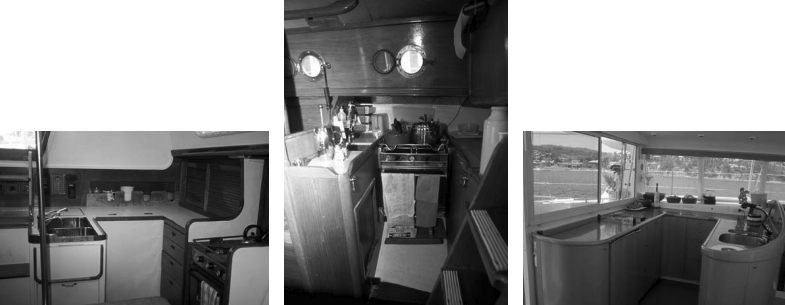
Seagoing galley. The photos at the bottom of this page show three galleys on boats ranging from 34 to 52 feet long. All three possess the essential attributes to make them usable and safe at sea. Unless you are planning to remodel the galley entirely, make sure you buy a boat with a layout that meets these basic parameters. Galley design is much less critical on a multihull, so most of what follows will not apply.
- U -, G- or aisleway galley layout. Almost every task in the galley requires two hands, which means the combination of body bracing and footholds must be enough to hold the cook in position even when the boat is heeled to 30 degrees or rolling hard from side to side. A U- or G-shaped galley layout gives the cook plenty of options for wedging in securely while doing normal galley tasks. Such a galley can be fitted even on very small boats, though there will only be one position for the cook to work in. On larger boats, a galley that lies along either side of the passage leading to the aft cabin creates much more workspace, allowing more than one person to work in the galley at a time.
- Gimbaled propane stove that can be locked in place. A proper liveaboard stove should have three or four burners, should have an oven large enough to roast a holiday turkey, and should run on propane. A proper seagoing stove on a monohull should be gimbaled and able to swing freely to a 30-degree angle in either direction. It should also be fitted with a stout lock to secure it in rolly conditions in port or at sea. A crash bar should be mounted across the front of the stove to provide a strong point for the cook to lean against when working over the stovetop and to help prevent anyone from being thrown into an open flame.
- Deep double sinks as close to the centerline as possible. For offshore work on a monohull, the sinks need to be a minimum of 8 inches deep so you can keep enough water in them to wash dishes when heeled over. They should be located as close to the centerline as possible to ensure that they will drain and not backfill at any angle of heel. The sinks will provide one of your few secure places to put dishes, bowls, and ingredients when cooking at sea. Two are much better than one, though on a boat under 35 feet it may be difficult to find the room without sacrificing all counter space.
- Adequate footholds and bracing. When working in the galley, there’s no way to adhere to the old adage, “One hand for the boat, one hand for yourself.” Picture yourself getting something out of the hot oven while it swings in a rolly sea. You’ll be crouched in front of the stove, making a safety belt useless, with both hands poised to catch whatever delicacy you’ve managed to create. To remain in position, you’ll need solid footholds or something to brace your back against. The cabin sole needs to have a good non-skid surface — olive oil spilled on a varnished sole can turn a galley into a skating rink.
- Accessible lockers with high fiddles. From the safety-belted position in front of the stove, the cook should be able to reach the back of every galley locker and the far corners of the icebox. Lockers located behind the gimbaled stove should not jeopardize important parts of the cook’s anatomy, especially when the burners are lit. Lockers need high fiddles to prevent everything from falling out when opened. Sliding doors are preferable to hinged ones, as they will allow you to retrieve frequently used items without spilling the lot. Positive latches on all doors will keep them secure during gales.
Seaworthy bunks. No boat can become a permanent home without good, comfortable sleeping areas for use in port and on passage. To sleep well, you need to be able to stretch out completely. All berths should be at least 6 feet long and, ideally, 4 inches longer than the tallest person. Single berths for use in port should be a minimum of 24 inches wide; sea berths should be narrower to prevent the sleeper from being thrown around in rolly conditions — a minimum of 20 inches to a maximum of 24 inches. To comfortably sleep two, double berths need to be at least 4 1⁄2 to 5 feet wide at the shoulders and 2 1⁄2 feet wide at the foot.
Boat manufacturers tout how many people their boats can sleep, but they’re only talking about sleeping when the boat is at rest. All too often, they overlook the need for berths that are usable when a boat is running downwind in a trade-wind sea or close-reaching in heavy weather. Many large, modern boats with designer interiors — curved settees and separate seating nooks in the saloon and a walkaround double bed in the forward or aft cabin — have no workable sea berths at all. Sea berths are vital equipment: they determine how well you sleep at sea, which influences your level of alertness and ultimately your safety.
While “hot bunking” — sharing a berth with another crewmember on a different watch — works fine on racing boats for short periods of time, it leaves crewmembers without any personal space and is not a viable solution for longer passages. Further, when becalmed, hove to waiting to enter a remote port, or in the most severe weather, all crewmembers are likely to be below and in sea berths at least part of the time. Therefore, each regular crewmember needs a good sea berth, and if you ever intend to take on extra crew, you will need enough sea berths to accommodate them as well.
The forepeak berth cannot be considered a usable sea berth on most monohulls. Trying to sleep forward of the mast on any boat under 60 feet or so in trade-wind conditions will mean spending half your time in the air — not an arrangement you’ll want to live with for the long term.
To minimize motion at sea, good sea berths are parallel with the boat’s centerline and as close to amidships as possible. On many boats, the settee seating doubles as sea berths with the addition of a leecloth. Curved settee seats do not work as sea berths; the settees need to be straight and long enough to accommodate a tall crewmember. Although the settee location may be the most comfortable, this puts the off-watch right in the middle of any on-watch activity and limits the usefulness of the saloon for other crewmembers.
On monohulls, pilot berths — berths located above and outboard of settee seating, against the hull sides — provide a private space out of the main traffic flow. They allow the main saloon to be used for its primary purpose, rather than becoming a tent camp during a passage, and they make excellent sea berths on any boat that’s large enough not to require that space for stowage.
Larger boats will generally have an aft cabin with a single or double berth, and many smaller boats will have a small quarter berth. While the motion aft is a bit more pronounced than in the middle of the boat, the aft cabin or quarter berth solution gives the off-watch real privacy and takes up less prime stowage area than pilot berths.
Adequate handholds and footholds. Non-skid, handholds, and footholds are just as critical to safety below as they are on deck. The cabin sole needs to be made from a good non-skid material like teak and holly or cork, or it needs to be finished with a non-skid coating. You should be able to reach a good handhold from any point in the interior even when the boat is heeled over. A good handgrip provides a full-fisted grip, not a finger hold. Short crewmembers may have difficulty reaching handgrips mounted overhead when the boat is heeled over. Vertical posts at counter or table corners make much better all-weather grips. Handholds and footholds are inexpensive and easy to install.
Many catamarans lack handholds completely, and this is a mistake. Although you won’t use them while coastal cruising or in calm offshore conditions, when things start to get boisterous they become just as essential as on a monohull.
Many traditional, all-wood interiors are so dark they can be claustrophobic. A white roof liner of molded plastic, or white paint on the cabin trunk, can change the entire feel of a boat. Beyond that, every area needs good lights for reading and working.
Design and construction
A boat can get the layout above and below right and still be wrong for offshore voyaging. To make sure a boat will prove to be a comfortable and practical long-distance voyager, you need to look also at design and construction details hidden inside lockers and behind ceilings. These include adequate stowage, accessible spaces, a high-quality engine installation, weatherproof ventilation, and watertight design and construction.
Adequate stowage. Most offshore boats carry an average of 2,000 pounds of personal belongings, food, fuel, water, and other things per crewmember. For that reason, an offshore boat needs much more of its interior volume devoted to stowage than a coastal cruiser of similar size.
To be most useful, that stowage should be divided into small compartments. Locker doors and drawers must all lock securely so they don’t spill their contents at sea. Drawers should be notched on the bottom of the front edge so they must be lifted up before they will open. They should have a small block on the bottom of the back edge that will stop the drawer from pulling out entirely. When comparing boats, take a good look at the amount, location, and accessibility of stowage.
Accessible spaces. To fix anything, you first have to be able to get to it. Down below, that means complete access to the engine, every part of the bilge, every tank, every deck fitting, and every piece of equipment.
Good engine access means you can easily reach the oil dipstick; fuel and oil filters; air filter; water, fuel, and oil pumps; injectors; starter motor; and gear box. Good plumbing access means you can reach every tank, through-hull, and seacock. Good electrical access means you can find and inspect every bus bar, terminal, and switch. At some point you will also need to reach the steering system, autopilot ram, and windlass motor. Good access to mechanical equipment is near the top of the list for experienced voyagers buying second boats.
Bilge access is almost as critical. Can you access the entire bilge from bow to stern? Pull up floorboards and open the chain locker and the area under the forepeak bunk and uncover as much of the bilge as possible. You should be able to access every area of the bilge along the centerline of the boat — if not with your hand, then with a short length of wire rod. You should be able to reach all seacocks within a minute.
In addition to being accessible, a well-constructed bilge channels water to a deep sump and keeps it there until it is pumped overboard. Many flatter-bottom modern designs have small sumps, and water tends to overflow into the rest of the bilge and onto the cabin sole.
Limber holes should be drilled in all structural members that might otherwise trap water, and you need to be able to inspect those limber holes and clear them of trapped silt and sand. If the head has its own shower pan and a separate drain overboard, you still need to be able to access the bilge underneath. If not, you will have to find another way to clear the limber holes under the head pan liner.
The bilge needs to drain from bow to stern without trapping water anywhere along the way. Take several buckets or a hose and pour water down the hawsepipe. Start from the chain locker and work back to the sump, tracing the path the water takes and noting where it pools and sits. Mold and mildew will grow in any area that traps water, eventually resulting in rot and unpleasant odors.
Bilge drainage has to work when the boat is at an angle, not just when it is flat. When you take a boat sailing, turn the bilge pump off and fill the sump. While beating on either tack, go below and figure out where the water has gone. It won’t be in the sump! On most boats, water will pool amidships under settee berths or aft under the galley stove or nav station. Don’t worry if a small amount of water is involved and returns to the sump quickly when you come back upright. But if more than a few gallons finds its way out of the sump and doesn’t return when the boat comes upright, you will have to locate and drain the area that is retaining the water as part of your refit.
Dirty tanks are an occupational hazard of offshore voyaging. Often, you cannot be certain of the quality of water and fuel. Some minerals cause scaling and, on older boats, the tanks will probably need to be cleaned as part of a refit. Removable hatches allow tank access for inspection and cleaning; these hatches should be accessible without dismantling the interior.
Deck fittings should be easily accessible from below so that they can be rebedded. If fittings are not accessible, you may have to add access panels through bulkheads, ceiling liners, or locker trim pieces. Boats with no interior trim or moldings will be simpler to work on, but they may not be as aesthetically appealing. You will need to find a balance between appearance and convenience that works for you.
High-quality engine installation. Proper engine installation and diesel tank construction will save untold heartaches down the line. To keep oil and diesel out of the bilge, the engine should be mounted over a solid fiberglass or metal engine pan. It should be bolted to mounts, which are bolted and glassed to structural frames. In the event of a capsize, there must be no chance of the engine breaking loose.
Contaminated fuel causes most engine problems. The diesel tank needs to have a sump — an indentation in the bottom of the tank where the dirt and water that settle out of the fuel can pool. The outflow from the diesel tank should be located above this level. This sump must be drainable, even at sea.
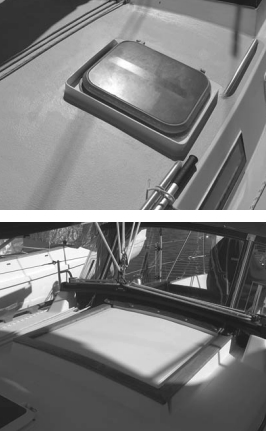
Weatherproof ventilation. Many production boats lack sufficient ventilation for the heat and humidity of the tropics. Poor ventilation contributes to the growth of mold and mildew and makes for damp, uncomfortable berths at sea. In high latitudes, it leads to condensation. Offshore boats need large opening hatches, ideally one for each major living space aboard (see the table at the bottom of Page 24). High-quality opening ports should be located through-out the boat, but at a minimum in the head and galley. Catamarans with large saloon windows should have louvers or mesh screens fitted to keep the area from becoming a sauna in the tropics.
Ports and hatches cannot be used for ventilation on monohulls in boisterous conditions at sea. On most boats, Dorade vents are the only source of ventilation in heavy weather. Four large Dorades should be considered the minimum on a 35-foot boat. All ventilation, including Dorades, must be water-tight in extreme conditions. Crews on boats with all the ventilation options shown in the table will never have difficulty keeping cool whether hove to in a gale at sea or tied up in a windless marina. Most production boats will need to have their ventilation upgraded to be comfortable in the tropics.
Watertight construction. A water-tight boat starts with a strong, rigid, well-built hull that isn’t prone to flexing and working. Older teak decks can be a major source of leaks, and replacing or removing them will involve a significant investment. On many newer boats, teak decks are vacuum-bagged in place without mechanical fastenings, making them much less prone to leaks. However, teak is heavy, hot in the tropics, expensive, environmentally unfriendly, increasingly difficult to obtain, and works no better as non-skid than various types of paint. Unless your taste runs to classic boats, you’ll be better off avoiding teak decks altogether if you have the choice.
Beyond that, the following construction details all contribute to a dry boat:
- Strong, commercial, ocean-rated hatches with structural crosspieces supporting the Lexan or acrylic and either set on plinths above deck level or protected by wavebreaks (see photo at the top of Page 25).
- Ocean-rated opening portlights installed so they drain onto sidedecks instead of pooling water at the bottom of the port.
- A properly constructed companionway, which on monohulls includes a watertight sea hood surrounded by drainage channels (see photo on Page 25).
- A fully weatherproof door or strong, easy-to-use hatchboards that can be fixed in place at sea.
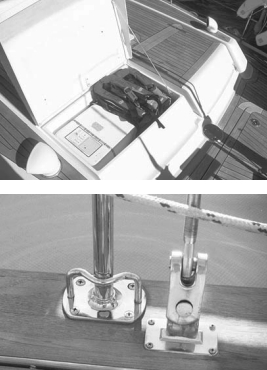
- Strong, positively locking hatches for all deck and cockpit lockers with channels around them to drain sea water, as shown above in the top photo.
- A hull-to-deck joint built with overlapping flanges or completely glassed over with several layers of fiberglass.
- Stanchion bases mounted on a solid toerail or on solid fiberglass pads raised above deck level to keep them out of water pooling on the deck, as shown in the second photo above.
- Solid stainless-steel backing plates installed wherever bolts go through the deck.
- A watertight way to seal the hawsehole at sea.
- Ultra-high-molecular-weight polyethylene (UHMWPE) rudder bearings.
- Dripless stuffing box.
- High-quality bronze (Marelon for metal boats) seacocks.
- Double stainless-steel hose clamps on all drainage, engine, and plumbing hoses.
Finally, make sure that diesel tank and water tank breathers are protected from flooding to prevent siphoning salt water into your tanks. The diesel tank breather on Silk was located in the cockpit, below the level of the cockpit seats. On one occasion, a breaking wave filled the cockpit, and salt water siphoned through the breather into the diesel tank. It took us half a day in rolly seas to pump out the diesel tank sump and bleed the engine.
Very few boats will have all of these construction details, and some boats that have successfully completed long voyages haven’t had most of them. But the more of these items you can check off for the boat you eventually buy, the drier and safer it will be.
Smell offers the very best proof of a dry boat. Any hint of mildew or dampness in the air when you first open the boat up should make you dig deeper. But if it smells fresh and sweet after being shut up for several days or weeks, you can be almost sure that it will be watertight.
Satisfying aesthetics
No matter what this material suggests, acquiring a boat is not a linear process. You bring to it all sorts of preconceptions, experiences, prejudices, and knowledge. It often begins before the idea of going cruising has even been voiced aloud. At some point while walking along a dock in some marina, a boat caught your eye, and for an instant you could picture yourself at her helm approaching a distant landfall with her sails bellied out by trade-wind breezes. That moment will come back to mind when you make the decision to go cruising and begin actively searching for the right boat. Whatever boat you eventually decide upon should touch you in just that way.
Feeling good about your boat and finding it pleasing to the eye do matter. When asked about choosing a boat for offshore cruising, many experienced voyagers put aesthetics at the top of the list. That’s because loving your boat will help you overlook her faults, and every boat has faults. If you get a thrill motoring up to your boat in the dinghy and think she’s the best-looking yacht in a crowded tropical anchorage, you’ll resent it less when the head clogs or the generator breaks down.
Some old salt likened finding the right boat to finding the right spouse: no matter how rational you try to be about it, at some point you may just fall head over heels in love. I hope it will be with a sturdy, seaworthy, well-built boat, and that the rest of your crew will feel the same way.
Beth Leonard and Evans Starzinger circumnavigated from 1992 to 1995. They spent three years ashore rebuilding their cruising kitty and building a boat capable of sailing in higher latitudes. In May 1998 they left aboard Hawk. Their itinerary consists simply of a list of places they’d like to visit.
Thank you to Sailrite Enterprises, Inc., for providing free access to back issues of Good Old Boat through intellectual property rights. Sailrite.com