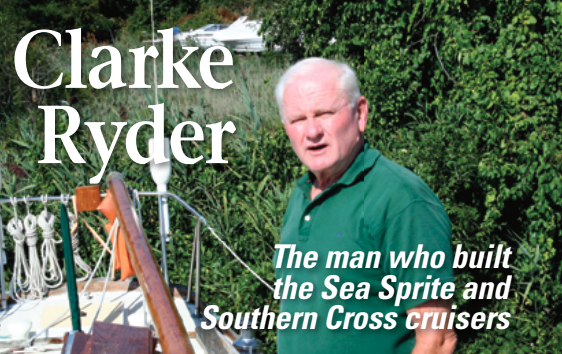
The man who built the Sea Sprite and Southern Cross cruisers
Issue 60 : May/Jun 2008
Anyone who sPends time looking at old sailboats soon figures out that boats with Clarke Ryder’s name on them are held in high esteem. His company, the C. E. Ryder Corporation, employed as many as 100 people during its relatively brief life in Bristol, Rhode Island. The most memorable of the boats were the Southern Cross and Sea Sprite model lines, although he was subcontracted to build many others, such as the Eastward Ho and Sonar. The designers Clarke Ryder hired were a veritable who’s who of American naval architects that included Thomas Gillmer, Bill Luders, and Carl Alberg.
John Vigor’s wonderful book, Twenty Small Sailboats To Take You Anywhere, features the Southern Cross 31. And Ferenc Máté cannot say enough about the Southern Crosses in his book, Best Boats To Build or Buy.
Entering the boat business
Clarke Ryder attended Brown University in Providence, Rhode Island, on an NROTC (Naval Reserve Officers’ Training Corps) scholarship. Recently graduated and freshly married, Ensign Ryder found himself visiting Cuba on the aircraft carrier USS Saratoga to participate in the Cuban missile crisis. Later, while finishing his service in Philadelphia, he wrote to Drake Sparkman, the brokerage side of the prestigious New York design firm Sparkman & Stephens, expressing his interest in boatbuilding. Drake wrote a nice letter back telling Clarke that he had two sons — one a priest and one in the liquor business — and both were doing better than he was. Undaunted, Clarke ran an ad in Yachting magazine expressing his desire to enter the boat-building industry. He was promptly hired as production foreman at Bristol Yachts, founded by Clint Pearson after he left Pearson Yachts in 1964.
The Bristol years were good ones for Clarke Ryder. Clint was serious about building with the new material called fiberglass and did mountains of testing. The boats were laid up in two molds. Then the hulls and decks were bolted together and the seams tabbed. Early on, there was a serious leaking problem with some 23-foot Sea Sprites. Beyond tracking down and fixing the problem, Clint jack-hammered the factory floor and installed a tank to test the boats for leaks before they left the factory.
In 1969 Clint asked Clarke to partner with him in a company that would be a spinoff of Bristol Yachts, concentrating on industrial fiberglass parts. It was called the C. E. Ryder Corporation. Their first customer was Bristol Yachts. At one point, however, they weren’t making money and Clarke had a huge receivable with Bristol. Clint suggested that Clarke buy a boat from Bristol as a method of helping Bristol finance the Ryder payroll. Instead, Clarke purchased Clint’s half of the enterprise for $7,200.
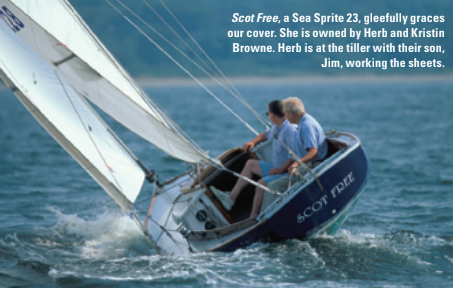
By 1974 the company had wandered back into building boats. Early projects included building the Eldredge- McInnis-designed Eastward Ho 24 and 31 for the Portsmouth Yacht Company, headed by Jack Bagley. These were great boats: salty and well received by the boating community. At the same time Clarke was molding hulls and other fiberglass parts for the Sea Sprite 23, which was being finished by the Wickford Shipyard. In 1975 Clarke bought the Sea Sprite business from Wickford and formed a new division, mostly a marketing entity.
Carl Alberg had designed the Sea Sprite. Clarke called him and asked what he would take for the design rights. Carl, unaccustomed to builders being concerned about royalties, asked for and was paid $1,000. The Sea Sprite 23 became a success for the young company, and it didn’t hurt that one was sailed across the Atlantic Ocean singlehanded by a young man named Robert Gainer, who figured in Ryder’s advertising.
Three hundred 23s were built during its production run. This success inspired Clarke to develop bigger Sea Sprites. Carl Alberg had retired, so Clarke looked around and commissioned Bill Luders to design the Sea Sprite 27, 28, 30, and 34.
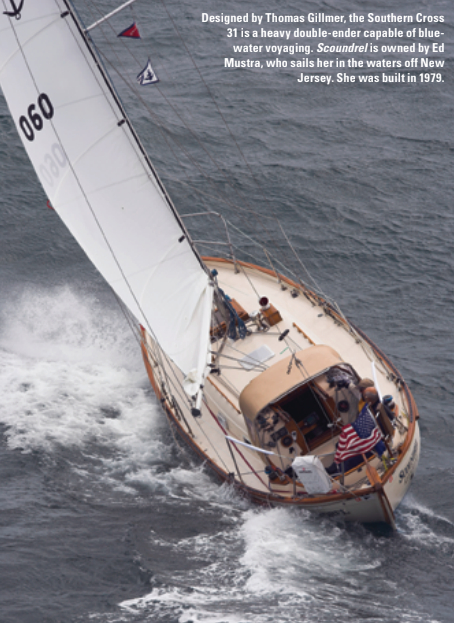
The Southern Cross 31
The Southern Cross series was born as a marketing scheme to compete with the Westsail 32, an even heavier cruiser that was selling like hotcakes. A national magazine had run a feature on the Westsail and, as a result, it was taking the factory 18 months to fill orders. The Westsails were also being sold as bare hulls for owner completion. During the hippie, counter-culture days of the 1970s, the yen to “get away from it all” helped sell these solid seaworthy boats. Another popular bluewater cruiser at the time was the Seawind ketch, designed by Tom Gillmer for the Allied Boat Company in Catskill, New York. The Seawind was introduced in 1969 and had a 12-year production run of 150 boats.
Looking for something similar, Clarke commissioned Tom Gillmer to design the Southern Cross 31. These days a Southern Cross 31 on the used sailboat market costs three or four times as much as the typical 30-foot sailboat. The reason is pedigree. (A profile of Tom Gillmer appears in the July 2002 issue of Good Old Boat.) The Southern Crosses were inspired by Northern European workboats. The double-ended hull, full keel, outboard rudder, and cutter rig give it a “take-me-anywhere” look. The 31 weighs in at 13,600 pounds. A respectable Bristol 30 weighs 8,000 pounds. The 31 sports eight opening bronze portlights and two opening hatches. There is also a nifty vertical anchor locker built into the deck.
The Southern Crosses were built with Airex-cored hulls in which two layers of fiberglass sandwich a layer of foam. This made for a lighter hull and a boat that was less prone to condensation problems in the cabin. The foam also served as sound-deadening insulation between the waves and the cabin. The method was not used on the decks because of concern about the foam reacting to heat on deck and a lack of stiffness.
About half the Southern Cross 31s went out of the Bristol, Rhode Island, plant on what was called the owner-completion program in which buyers purchased a hull with all the exterior fittings, but finished out the interior themselves. Some of these were done beautifully and some were not.
Tom Gillmer then designed the Southern Cross 28, a boat that was tender and required additional ballast to sail well. One 28 recently completed a solo circumnavigation, skippered by grandmother Donna Lange. Eventually, the model line included the Southern Cross 35, 39, and 41. Of these, the 31 was the only boat with a full keel.
Other projects
Clarke’s reputation for quality and his collegial nature brought in lots of interesting prototype work for boats that became famous. Garry Hoyt brought the Halsey Herreshoff-designed Freedom 40 to Clarke before he made his name as a marketer and innovator. Clarke built the molds and the first hull. Bruce Kirby of Laser fame had Clarke build his 23-foot Sonar, and former employee Gary Lanigan brought the Ted Brewer-designed Quickstep 24.
The sailboat industry tanked in the 1980s. The entire industry turned out only 4,000 units a year. Clarke says the auxiliary sailboat market has never been a very big market and pretty soon everyone who wanted one had one. The product never wore out. There were plenty of cheaper boats on the used market. And there was a limit to the number of available moorings and affordable slips. Four thousand new boats a year was a lot for the no-growth mooring business.
The C. E. Ryder Corporation lasted a few years longer than Pearson Yachts, Cal, O’Day, and Columbia Yachts, all of which went out of business in the mid- to late 1980s. Making Black Watch powerboats and doing molding work for Boston Whaler helped. Ultimately though, the boatbuilding enterprise was too capital-intensive to survive. Clarke closed up shop in 1990.
Today, Clarke is a successful yacht broker, specializing in boats he built. Last summer he singlehanded a Sea Sprite from Maine to Rhode Island. It is safe to say he has a couple trips to Bermuda left in him. In reflecting on the boatbuilding industry, he says the owner of a Hinckley would never consider owning an O’Day, but he and the other builders saw the brand differences as being much smaller and had more respect for products of lesser status than the public did. That is a pretty generous statement for a guy who worked at or near the top of the game.
Joe van Benten has operated a shop in Chestnut Hill, Massachusetts, building handmade furniture for the past 29 years http://www.vanbenten.com. Last year he purchased a 1977 Bristol 30, which he sails with his wife, Sarah, out of Pocasset on Buzzard’s Bay.
Thank you to Sailrite Enterprises, Inc., for providing free access to back issues of Good Old Boat through intellectual property rights. Sailrite.com