New alerts help prevent loss of life
Issue 60 : May/Jun 2008
Every year the electronics aBoard the offshore sailboat become more exotic. Among the latest trends in marine safety are man-overboard (MOB) or crew-overboard (COB) electronic alerts. Many manufacturers are now marketing these systems with their own proprietary hardware and software. They are affordable and reliable, and their lifesaving capabilities need no justification. For millennia, sailors have been lost overboard but now these new MOB electronic devices can alert other members of the crew or the government’s search-and-rescue responders and help prevent loss of life.
We’ve come a long way since the only man-overboard devices were a lanyard on the wrist of a small-boat operator (to activate the kill-switch on the motor) and a knotted line towed behind the boat. Although the line towed behind the boat has been touted for years, if the boat is traveling through the water at more than a knot or two, it is nearly impossible for a person in the water to get back to the boat. Even if that feat is accomplished, it is unlikely that he or she will be able to climb aboard.
A modern version of the safety lanyard used to kill the engine is an inexpensive device that automatically shuts off the engine when the person wearing the small transmitter goes overboard. The transmitter and the on-board shut-off system operate on AAA batteries.
Solo sailors
For the singlehander, a Personal Locator Beacon (PLB) is still the best insurance (see “EPIRBs, PLBs, and SARTs 101” in the January 2008 issue). Most sailboats will round up into the wind when the helm is released. But if the boat is being steered by a windvane or autopilot; if the tiller or wheel is locked into position; or if the boat is under power, it will just continue on its merry way and the solo sailor who has been left behind must rely on the PLB to alert the government’s search-and-rescue system.
Boats with crews
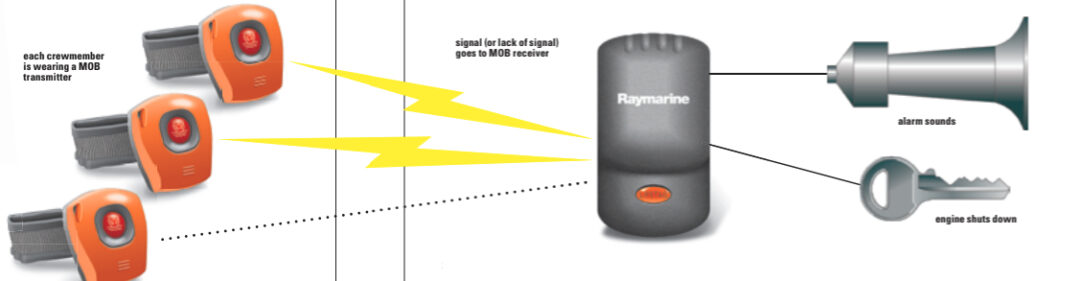
For boats with more than one person aboard — particularly on boats used for offshore passages — an electronic MOB alert system is a good investment. Through an onboard base station, either the water-activated signal of the MOB unit worn by a crew member or the interruption of that signal can sound an alarm to alert others who may be sleeping or unaware for any reason.
Some MOB devices can shut down the engine (if engine shutdown is accomplished with an ignition switch). This alert procedure is accomplished either when the transmitter worn by a crewmember is submerged and the signal to the base unit is interrupted or, in other systems, when submersion in the water activates the transmitter. Some MOB onboard displays feature a “track-back screen” that immediately appears on the MOB base unit to guide the boat back to MOB site.
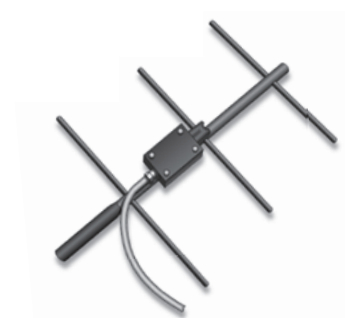
Some systems use an automatic electronic or a manual direction finder to pinpoint the location of the MOB, who is wearing a small locator beacon, by using the international emergency frequency, 121.5 MHz. This signal can help pinpoint an MOB and can also be used by sailors on other vessels that join in the search.
Most GPS units and chart plotters have an MOB button which, when pressed, stores the position of the boat at the time the button is pressed and makes it possible to return to that spot.
This, of course, can only be done if the boat has a crew of more than one and if someone sees a person fall overboard and presses the button. But there are MOB units available in which the base station aboard the boat will show the MOB position on a compatible GPS or chart plotter through an NMEA connection, while also sounding an alarm and/or shutting down the engine. Many manufacturers provide MOB systems that can be fully integrated into multi-function displays, giving a readout of who went overboard, where, and when.
Prevent falling overboard
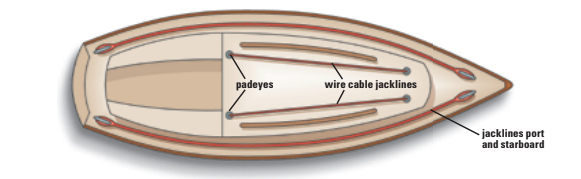
Reducing the possibility of having to use an MOB device is an inexpensive requirement. It goes without saying that it is important to wear a safety harness, especially in the case of a singlehander. Many safety harnesses are built into life vests and foul weather gear, but the boat must have suitable fore-and-aft jacklines that can be clipped onto when deckwork must be done.
At night, crewmembers who go on deck should wear a strobe light to facilitate their rescue if they go overboard. Even in the daytime, a strobe light can be helpful, especially in marginal conditions.
Don Launer , a Good Old Boat contributing editor, has held a USCG captain’s license for more than 20 years. He built his two-masted schooner, Delphinus, from a bare hull and sails her on Barnegat Bay in New Jersey.
Thank you to Sailrite Enterprises, Inc., for providing free access to back issues of Good Old Boat through intellectual property rights. Sailrite.com