No regrets with this lifestyle alternative
Issue 63 : Nov/Dec 2008
At some point in everyone’s life, it becomes necessary to stop and think. Consider for a moment: are you doing what you are doing today because it is what you want to do or because it is what you did yesterday?
The lifestyle Dave and I have chosen is not always easy. Our 34-foot sailboat is our home, our ticket to see the world, and the sum of all of our assets. So when the boat seems too small, the ocean too big and scary, or life in general just too hard, we ask ourselves, “Why do we do this?” The answer varies but always revolves around a simpler, slower, and easier way of life for us and our three sons.
Any system you have on a boat will break, creating stress. Since we are trying to eliminate stress from our lives, it is no surprise that when something quits working on Eurisko we do not run to the nearest chandlery to replace it. Instead, we consider if we really need it at all. For the last seven years, except when it concerned rigging, the answer has often been “no.” Once we remove the broken piece of equipment, the boat is lighter and faster, we have more room aboard, and our lives are simpler.
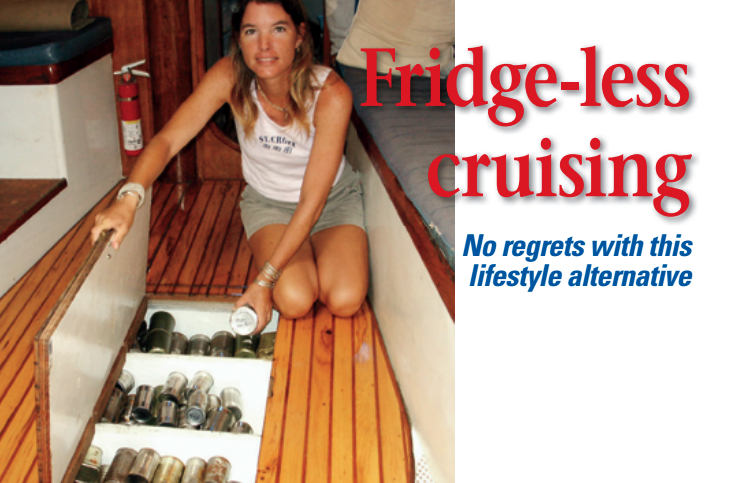
We applied this philosophy to our refrigerator years ago when it died of old age. There was no need for a family meeting or discussion; Dave simply removed the entire system and gained another tool locker in the process. Cooling our perishables with ice was the logical solution until we realized that we now had to find civilization at least once a week. We tolerated the icebox alternative for a few months until it became an expensive hassle. In Georgetown, Bahamas, in 2004, an 8-pound bag of cubes cost $6.
This outrage led to the familiar question: “Why buy ice?” The answer was: “So our food does not spoil.” Which led to another question: “But do we have to keep food cool . . . or are we doing it only because we always have done it this way?”
Like most boaters, we had heard — but did not quite believe — that chilled food is a luxury, not a necessity. We decided to try it for ourselves, and the results were better than we had hoped. We can keep most “refrigerate-after-opening foods” at room temperature for as long as it takes us to use them, even when the room is rarely cooler than 80 degrees. (I just checked the inside boat temperature: 95 degrees in October in Trinidad.) There are a few tricks to keeping perishables from perishing, though, so we have had to alter how we handle food. When compared with the bother and expense of refrigeration and ice, these changes seem minor.
Many cruisers have written about storing eggs for a maximum length of time. Lin Pardey, in The Care and Feeding of Sailing Crew, mentions coating the eggs with Vaseline or sodium silicate. She has kept eggs for as long as three months by turning them three times a week. “If they sit for a week without turning, they’ll start to deteriorate after 25 days or so,” she writes.
A different technique
Unlike Lin, I have never been on a passage longer than 14 days. I am rather forgetful and admittedly a bit lazy, so my technique is different. I buy the eggs, put them in the warm box that out of habit we still call “the fridge,” and use them when I am ready. In other words, I do nothing special except that I crack them into a separate bowl, rather than into a pan or a bowl containing other ingredients, to check for freshness. Using this do-nothing method, I have kept eggs for as long as three weeks and have lost fewer than a dozen in four years — less than the price of even one bag of ice.
In Care and Feeding, Lin also writes that you do not have to keep mayonnaise cold if you never put a dirty utensil back into the jar. From experience, I know that kids are forgetful and unlikely to make such a subtle distinction. For them, we needed a consistent rule: never put any utensil in the jar. Instead, we shake mayo into a cup and use it from there. Not only does our mayo last up to a month after opening, we have even eaten leftover potato salad the following day for lunch.

We buy plastic jars of mayonnaise when possible to make this easier, since you can squeeze the jar. Shaking mayo out does work with a glass jar, albeit more slowly. Since mayonnaise and jelly are now sold in squeeze containers, this is the best option when they’re available. We have also bought single-use packages from a restaurant-supply store. When neither of these choices is available, we buy jelly in small jars. Since it is nearly impossible to shake jelly out of a jar, we use a spoon to remove it but a knife to spread it, thus making the dirty utensil easy to identify. Before we instituted this jelly rule, what remained in a jelly jar would mold within a week. With our new rule, we have learned that jelly will keep for at least three weeks. (These days the jar is empty before the jelly spoils.)
Keeping dairy products
Mustard, ketchup, hot sauces, pickles, relish, hot peppers, and salad dressing have rarely spoiled in our “warm box.” Butter and margarine, however, must be handled carefully. Sticks of margarine do not melt and will keep for up to a month. We store each pound in a clean plastic food-storage container, date it, and rotate our stock. We found that margarine in a tub generally melts at a lower temperature and the containers do not seal well enough to prevent disastrous accidents. Butter melts more easily than stick margarine too, but since I enjoy baking, we always have a pound or more that I use before it turns rancid. As an emergency backup, we store a pound of canned butter, something we have found only in the Bahamas and Dutch islands. Canned margarine is really just yellow shortening, and you can only use it as such without being disappointed.
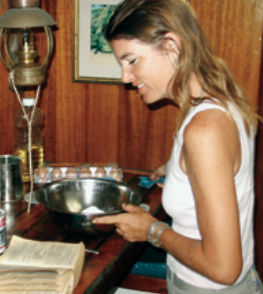
Other dairy products, such as cheese and milk, required us to change our behavior when living without a cooler. We now buy cheese in small portions, store each one in a separate airtight container, and try to use it all within a few days once we open a package. Unopened, it does not mold for weeks, though it does get sharper. Hard cheeses, such as Parmesan and Romano, stay fresh much longer.
We used to buy UHT milk (Parmalat, for example) until a few of the unopened boxes spoiled. After opening, they lasted less than a day without refrigeration. Now we carry canned cream, evaporated milk, and condensed milk for cooking and baking. For everyday milk we use Nido or other brands of powdered whole milk and mix only what we need. We use this in cereal, coffee, and for cooking, and it tastes . . . like warm milk.
The problem with meat
Meat presents its own set of problems when you have no means of keeping it cool. In port, we often buy fresh meat only a few hours before we plan to cook it. We wrap frozen meat in layers of towels and are able to store it in an insulated cold/hot bag for up to 24 hours before cooking. On passages, in secluded anchorages, or on wet and windy days when we do not want to leave the boat, we choose from our other options.
Canned meat is the first solution most boaters consider, and we do eat a considerable amount of it. We store Spam, corned beef, canned hot dogs (found in Dutch islands and Trinidad), ham, tuna, salmon, meatballs, turkey, chicken, and roast beef. A special treat we discovered in Trinidad is canned tuna with potato salad, Mexican salad, or pasta salad — a complete meal in one can. In some places, certain canned meats are unavailable, and we try to stock up on these when we can. We have also ordered canned chicken, turkey, and beef from Werling and Sons.
Chorizo and ham tidbits are sold warm in the States, and we have kept them for several weeks before using. Once opened, we treat them like fresh meat and cook them immediately. We buy cured hams when we find them and have taken up to a month to finish one. After opening it the first time, we wipe the ham down with vinegar. Anytime we use some, we wipe the newly exposed area with vinegar, as well. On French islands, we have found a hard, waxed sausage that we store at room temperature for weeks before opening and then use within 24 hours.
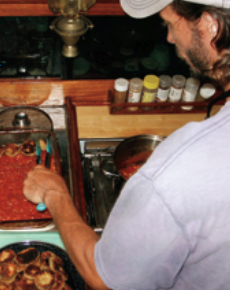
Since these meats are often expensive and high in sodium, we have found several alternatives. Soya chunks (textured vegetable protein) are available in a variety of sizes for different dishes. The smaller pieces are an acceptable replacement for meat in shepherd’s pie, for example.
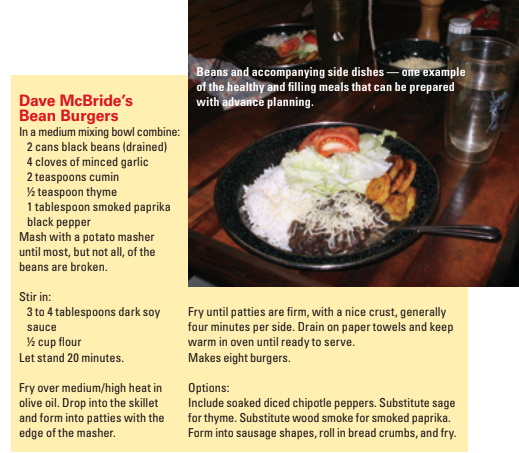
By far, our favorite meat alternatives are beans. We carry dry lentils, split peas, garbanzo beans, red beans, pink beans, and black beans. For those occasions when even a pressure cooker is not going to be quick enough, we also have cans of garbanzo beans, pigeon peas, and black beans. Dave is becoming quite proficient at making tortillas and pita bread. We use the tortillas for bean and rice burritos and for chimichangas, and the pitas for hummus and dhal (lentils). Meatless chili, three-bean salad, curried chickpeas and vegetables, and lentil soup are some of our bean meals, but the family favorite is bean burgers. When the boys have friends over for dinner we generally do not even tell them the burgers are not real and they rarely ask. In color, texture, and flavor, bean burgers are nearly identical to ground beef burgers. The five of us actually prefer them, even when ground beef is readily available. Much of Dave’s bean-cooking knowledge, and a few recipes, came from Janet Horsley’s Bean Cuisine. He also uses The Joy of Cooking as a reference.
Fresh produce challenges
Keeping produce fresh without refrigeration is a challenge. We remove any plastic wrap or bags immediately and keep produce separated. Over the years as I have learned new techniques for storing produce, I have jotted them down. Reviewing my notes, I see that onions are best stored in the light and definitely not with potatoes, which should be stored in the dark, preferably with apples. Apples, on the other hand, should never be stored with citrus fruits. Unfortunately, we can never seem to remember any of that, so we store all of our produce in separate hanging baskets. Since so much of our food is canned, Dave cooks with a lot of garlic and onions to liven meals up a bit.
Our lifestyle requires that we stop traveling for a few months each year to earn money, so we occasionally get to put down roots. Literally. Our middle son enjoys gardening, and we enjoy the results. When we are stopped, he grows tomatoes, peppers, and herbs in small pots on deck. We are still eating dried jalapenos and cayenne peppers from his last garden six months ago.
Little is wasted
In the four years we have been without a fridge, we have thrown away a surprisingly small amount of food. One exception is leftovers. Until last year, there were few leftovers; we had three teenage boys. With two boys away at college now, things have changed. If we have enough food left for lunch the following day, we put it in a clean airtight container. We simply store one-pot meals, such as soups and casseroles, covered in the pot. The next day, if whatever is in the pot still smells fine, we reheat the food for a minimum of 10 minutes before eating.
The sense of smell is a well-used tool when living without refrigeration. We give everything a test sniff before eating it: eggs, mayo, jelly, leftovers, and even canned food. We know some foods will mold overnight. For example, if Dave wants to include fresh tomatoes in a dish, he will put them on the side instead so they will not ruin any leftovers. Using our noses and common sense, none of us has ever suffered any ill effects from food prepared on board.
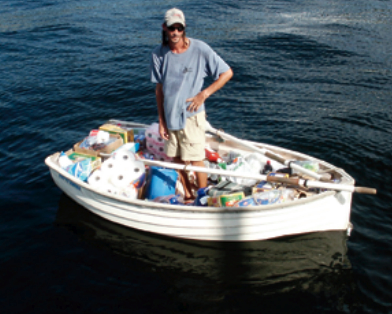
One concession to our warm-food lifestyle occurs when we go off- shore. The boys fish sunrise to sunset and often catch tuna, dolphin, mackerel, and wahoo. Even five of us cannot eat an entire fish before it spoils. Therefore, before we leave we ask friends to freeze gallon jugs of water for us to keep in the fridge. We can enjoy each fish for several days this way, perhaps until we catch another one, if we’re lucky. The ice lasts about 10 days, and since we only have a 42-gallon water tank, the five extra gallons of water after the ice melts is a nice bonus.
A friend cruising on a large boat with all of the latest gadgets states firmly, “Refrigeration is the root of all boat problems.” If his statement and our techniques seem extreme to some boaters, perhaps a compromise is more appropriate. Less food to cool means a smaller space and therefore a smaller and cheaper refrigeration unit (or less ice) necessary to cool it. Before purchasing your next fridge or bag of ice, consider all of your options, and you, too, may decide to cruise without a fridge.
Connie McBride left Kent Island, Maryland, in June 2002 with her husband, Dave, and three sons. Aboard their 34-foot Creekmore, Eurisko, they cruised the U.S. East Coast and are sailing onward to yet-to-be-determined destinations.
Thank you to Sailrite Enterprises, Inc., for providing free access to back issues of Good Old Boat through intellectual property rights. Sailrite.com