Stowing oars and more in a plastic tender’s slick interior
Issue 64 : Jan/Feb 2009
Back in the days of wooden dinghies, or at least wooden seats in plastic dinghies, a person always had a place to lash down useful “dinghy items.” These could be an extra fuel can, yesterday’s garbage bag, a set of oars, or even a bucket of laundry that would rock itself clean on the way to the next marina.
The advent of all-plastic dinghies has caused new dinghy owners to re-think the dinghy as a storage/transportation area for items that should not, or would not, fit in onboard lockers. Why is this so? Simply because there is no place to lash anything down in a one-piece, all-plastic dinghy.
Just look at any new plastic dinghy you can find today: the hull is one piece and the liner is one piece with no cleats or tie-downs to be found anywhere. The only exceptions are the oarlocks and bow and stern eyes, and these offer no tie-down possibilities at all.
How, then, can a plastic dinghy ever be used for anything other than the tail end of a very short nautical parade?
The answer is simple: add a few fairleads, several hooks, and a bit of bungee cord, and you have the problem solved.
Securing the oars
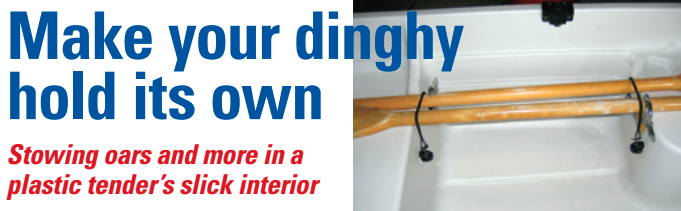
Fasten two fairleads to the front of the stern seat and the corresponding fairleads to the back of the midship seat to create attachment points for two bungee cords. Use #8 1 1/2‐inch stainless-steel sheet-metal screws to fasten the fairleads to the seats, and bed them in 3M 4000.
Cut two pieces of bungee cord and attach a stainless-steel bungee-cord hook to each end. Make the length such that the cord will be stretched tight when it is attached to one fairlead, passed over the oars, and secured to the second fairlead.
Be sure to place the oars in such a position that the oarlock inserts do not rub each other or any part of the dinghy.
And there you have it: oars that are easily accessible and will stay where you put them until you need them.
Now that the oars are secure, how about your dirty socks and underwear?
Making a washing machine
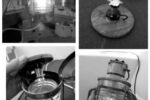
You can create a simple and convenient dinghy washer by using a 5-gallon bucket with a sealable lid. Secure it to the front of the midship seat with two more fairleads and a bit more bungee cord, using the same method you used to secure the oars.
To use, half-fill the bucket with water, add laundry detergent, and toss in your soiled items. Seal the lid on the bucket, secure it to the dinghy seat with the bungee cords, and let the motion of the ocean do the rest. After a day’s sail remove your laundry, rinse, and hang to dry. You now have clean wash with little effort on your part.
The expense for this little project is less than $20. You can easily save that much in Laundromat costs, let alone the money you’ll save by not having to replace the oars that you left on the dock because you forgot to put them back in the lazarette hatch.
How about that? Clean underwear . . . and you get to keep your oars!
Jim Shroeger is a retired teacher (special education and administration). He owned and ran a residential construction business simultaneously with his school career. His special love is woodworking, which has come in handy with a series of boats to maintain. He and his wife, Barb, currently own Sundew, a 1978 Watkins 27. They cruise between Traverse City, Michigan, and the Cheneaux Islands, 200 miles to the north.
Thank you to Sailrite Enterprises, Inc., for providing free access to back issues of Good Old Boat through intellectual property rights. Sailrite.com