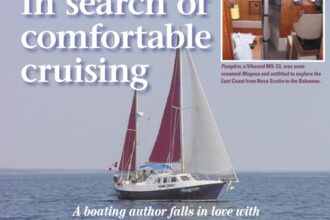
Review your expectations

Issue 64 : Jan/Feb 2009
What is the ideal boat size? Should I buy the biggest boat I can afford or the smallest boat I can possibly squeeze my family into? For most of us, the two ideas overlap. We all want the most boat for our money. The question remains: how “big” is big?
Expectations concerning comfort and boat speed have risen dramatically over the past three decades. It used to be that boats in the 27- to 32-foot range were acceptable dream machines. Today, if you believe the ads in sailing magazines, 40 feet is the benchmark that establishes minimal speed and comfort. Why the shift? Is it really necessary to spend upward of a half million dollars to “live the dream”?
There have always been mega-yachts and people to buy them. Nothing new there. But even mainstream cruising has become a high-budget affair as manufacturers have continued hunting for deeper pockets. Boatbuilders can make healthier sales by producing large, high-end boats that ultimately target a market having more disposable income. The hefty sticker prices generate enough cash to support sophisticated advertising and marketing strategies. Sub- sequently, most of the glossy ads and boat reviews tout the glossy boats.
One improvement
Technology has made it possible for a small crew to run a large boat safely and competently. Elaborate roller-furling systems and automated winches make it feasible to handle enormous sail plans — even for those who are less physically active. GPS and integrated chart plotters have made navigation safer and more easily understood. Prior to GPS, sailing out of sight of land, or even making long coastal passages, was not for the faint-hearted. Weather-receiving technology and forecasting have also improved dramatically. Onboard computers and email capabilities provide a reliable shoreside link for those who want to go cruising but are fearful of being out of contact with children or aging parents.
All these technological advances taken together create an electronic and mechanical fortress. The guess-work, tension, and perceived risk are greatly reduced. Assuming that nothing breaks down, a captain can now effortlessly handle a large expensive boat. Power to the people.
But for some cruisers, this kind of luxury dampens the magic of cruising, not to mention the possibility that owning a boat at all is out of reach. The “romance of cruising under sail” began as a way to simplify life, embrace hardship, and step out of predictable shoreside roles. Modern boats are becoming floating extensions of the living room where creature comforts are clung to like chintz life preservers.
I read the 2008 sailboat review in a leading sailing magazine that exemplified this shift in boat length, comfort, and price. In the review, a 40-foot sailboat was touted as “mid-sized” while a $300,000 35-footer was reported to be a “small” cruiser . . . Huh?
Although these delineations are marketing verbiage, the message is disturbing. Newcomers to the sport with salaries like mine are going to conclude that boating is out of reach. They should not lose heart! Low-budget cruising still exists. It takes a hearty soul to turn a deaf ear to the tantalizing ad ploys and decide to buy a cheap, used, 30-foot boat to go cruising. But remember, the purpose of an ad campaign is to shift a buyer’s perception from what’s needed to what’s wanted. It works.
Buying frenzy
For example, there seems to be a frenzy these days over expensive, HD flat-screen TV with HDVD capabilities and surround sound. “Bigger is better. A sharper image, better sound.” I don’t own a TV, but if I ever wanted to start watching TV again, I could probably pick up an inexpensive used digital set. When a consumer allots big dollars for a “perfect” picture, that’s a result of priorities.
Boats are nothing but priorities. When Jaja and I sailed our 25-footer, Direction, around the world, we saw the same sunsets and walked on the same beaches as the folks on the big boats. We had a galley, a head, a double bed, and the ability to cross oceans, raise children, and see the world. When we set off to go cruising in our 20s, we didn’t want to pay for anything bigger than 25 feet. We wanted to sail rather than work until we were able to afford a “proper sized boat” (which has been getting more expensive each year). We set off with what we had and witnessed firsthand what was possible on a small boat and slim budget.
In 1996 we bought our 33-foot, steel-hulled sloop, Driver. This purchase followed a lengthy search for a 40-footer. We couldn’t afford even a used 40-foot boat, but we were hoping to find a deal. How we planned to maintain, store, and repair a boat we couldn’t afford to buy was a hushed topic. We were convinced we needed a 40-foot boat. Had to have it.
At one point, we even considered borrowing money to purchase our 40-footer. We figured we’d stay ashore and work a few extra years to pay off the loan. It would be worth it. With visions of living in a “comfortable” space while sailing “comfortably” over lumpy seas, we blocked out the possibility of a smaller boat. We had boat buyers’ fever, a condition that did not match our financial wherewithal. We were on the threshold of going into debt and getting sucked into the very system we wanted to escape. We had lost sight of the entire project. Luckily, we didn’t run into any smooth-talking brokers.
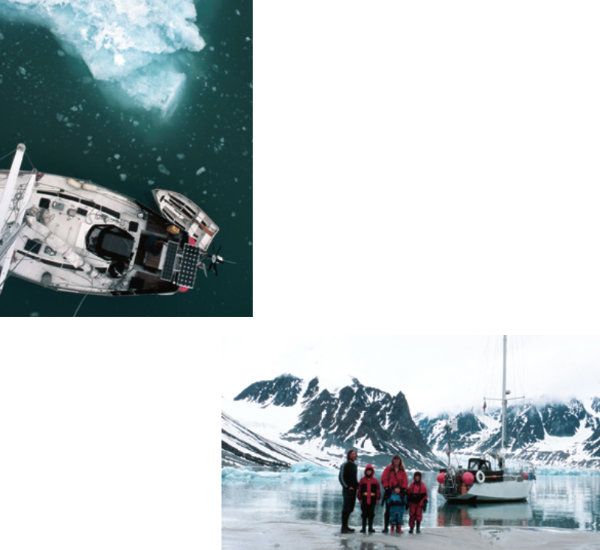
Our Icelandic sailing plans were beginning to spiral out of reach. Then one day we drove through a boatyard looking at “For Sale” signs and found the boat that would change our lives and the lives of our kids. She was 21 years old, a borderline derelict, and only 33 feet long. But Driver represented Going — the most crucial step in getting underway.
Back to reality
We boarded Driver skeptically. There was something about her rugged demeanor that appealed to us. Within five minutes we had one of those Moments. Everything came into sharp focus. The boat was overpriced but negotiable (we haggled and got a good price). Suddenly, the reality of a departure date was in our grasp. There would be plenty of room on the boat once we made some necessary modifications. Any boat, regardless of price or age, needs modifications.
Sitting in the cockpit, we realized that 33 feet of boat for our growing family of five was big enough for the voyage we were contemplating. Driver was cruise-ready two years later. By then we had sold, given away, or thrown out anything that didn’t fit on the boat. When we finally set off, we had no house, car, cell phone, or insurance policy of any kind. Priorities.
Looking back, it’s hard to believe how carried away we became when shopping for a boat. We had just finished a circumnavigation aboard Direction, so anything larger than 25 feet should have looked good. Where had our large-boat fixation come from? Was it overcompensation? Or did we feel we deserved it? Perhaps it was due to cruising in the company of so many bigger boats during our circumnavigation. A 40-foot boat feels like a house compared to a 25-footer. It is all comparative, of course. If you own a 40-footer you envy the 50-foot crowd. (We actually did have friends who envied our 25-footer but they were sailing a 19-foot converted lifeboat.)
Comfort zone
Is a 25-foot boat as comfortable as a 33-footer? No. Is a 33-foot boat as comfortable as a 50-footer? No way. Am I less likely to get seasick on a bigger boat? Not necessarily. I found the snappy motion of our 25-footer much more agreeable than the rolling gait of the bigger boats I’ve sailed over the years.
The real stumbling block when going aboard a boat that is 30 feet or smaller is the initial shock regarding lack of interior volume. The truth is that when I get used to a boat, and especially if I’m living on it full time, the walls disappear.
The boat becomes an extension of my psyche, which is otherwise limited to the space between my ears. Buying Driver and then sailing her to the Arctic and back on a five-year voyage proved to us, once again, that a strong boat is imperative, but length, gadgets, and interior volume are arbitrary.
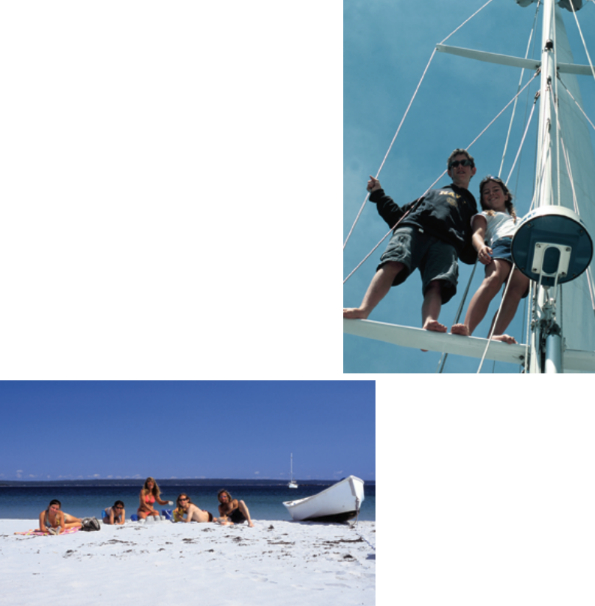
During the summer of 2007, we sailed Driver to southern Newfoundland with an 11-year-old and two teen- agers. Their kid-sized bunks (originally fitted when they were 2, 5, and 7) were a tight squeeze, but the five of us never felt that the boat was too small. What we enjoyed was being away from home for seven weeks . . . away from jobs and school and off on an adventure. We all had a place to sit, a place to sleep, and a place for our stuff.
For us, the real reason for any voyage — or a daysail — is to be outdoors, see new sights, feel the wind, and escape routine. Any boat, regardless of size and price, will satisfy these prerequisites. It does not matter to us how large or how small the cockpit is, how cramped the head, or how much counter space is available for preparing food. The world outside is limitless.
Dave Martin is a contributing editor with Good Old Boat. Between 1988 and 1995, Dave and his family circumnavigated aboard their Cal 25, Direction. Between 1998 and 2002, they voyaged to the Arctic aboard their 33-footer, Driver. They are now living in Maine.
Thank you to Sailrite Enterprises, Inc., for providing free access to back issues of Good Old Boat through intellectual property rights. Sailrite.com